
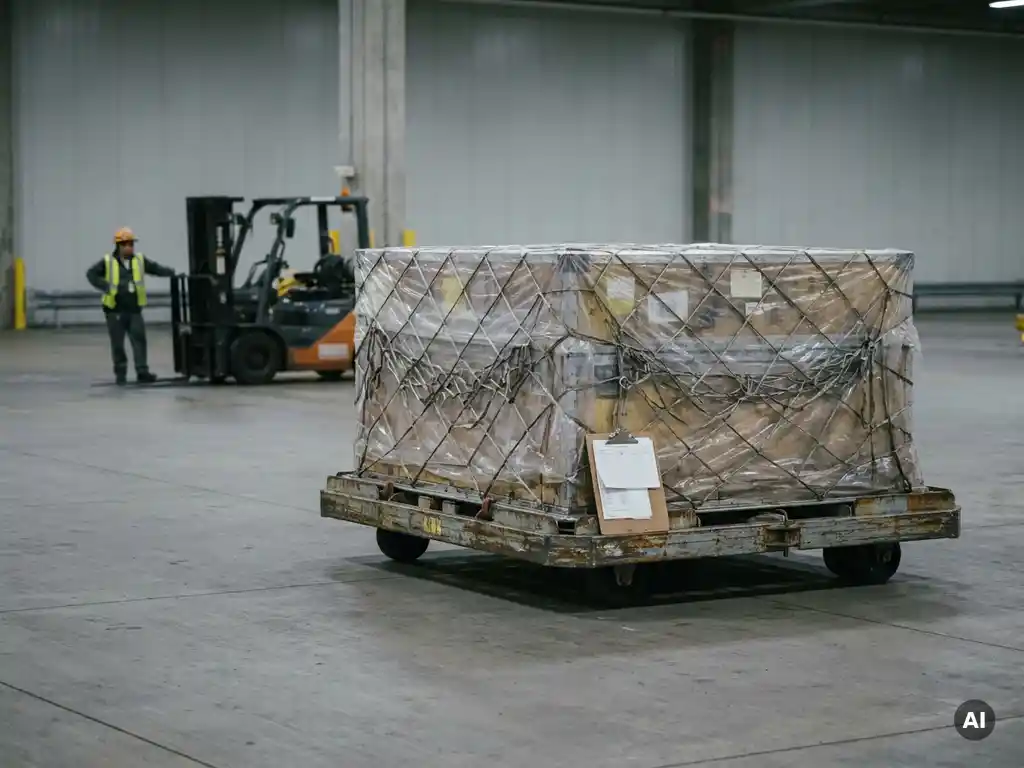
The most common air freight export mistakes fall into six categories: incomplete documentation, errors on the air waybill, customs compliance failures, incorrect packaging, weight miscalculations, and undeclared dangerous goods. Any one of these errors can delay a shipment, trigger penalties, or result in outright rejection by the carrier or customs authority. Businesses exporting goods from Europe to destinations such as Nigeria, Ghana, Kenya, or Tanzania are particularly exposed because regulatory requirements vary significantly across African markets.
What happens when air freight documentation is incomplete?
Incomplete documentation causes air freight shipments to be held, returned, or destroyed. Carriers and customs authorities in destination countries require a complete, consistent document set before releasing cargo. If any document is missing or contradicts another, the shipment stalls until the issue is resolved, often at significant cost to the exporter.
The core document set for an air freight export typically includes the commercial invoice, packing list, air waybill, certificate of origin, and any destination-specific permits or import licenses. For exports to regulated markets across West and East Africa, additional certificates such as conformity certificates or phytosanitary documents may be mandatory, depending on the commodity.
A common error is treating documentation as an afterthought once the cargo is ready. In practice, document preparation should begin as soon as a shipment is confirmed. Errors discovered after the cargo has been tendered to the airline are far more disruptive and expensive to correct than those caught during the booking phase. Businesses should maintain a destination-specific document checklist and review it for every shipment, not just new trade lanes.
What are the most common errors on an air waybill?
The most common air waybill errors include incorrect shipper or consignee details, inaccurate commodity descriptions, wrong airport codes, and mismatched weights or piece counts. These errors can cause the cargo to be misrouted, held at origin, or rejected at the destination airport.
The air waybill is the contract of carriage between the shipper and the airline. It must accurately reflect the shipment in every field. A mismatch between the air waybill and the commercial invoice, for example, a different declared value or a different description of goods, is a red flag for customs officers and can trigger a full inspection or seizure.
Particular attention should be paid to the commodity description. Vague terms such as “general merchandise” or “spare parts” are insufficient for customs clearance in most African markets. Descriptions must be specific enough to allow classification under the applicable tariff code. Exporters who work with a specialist freight forwarder can avoid many of these errors by having the air waybill prepared and reviewed by an experienced operator before the cargo is tendered.
Why do air freight shipments get held at customs?
Air freight shipments are held at customs when documentation is incomplete or inconsistent, when declared values appear understated, when import licenses are missing, or when the goods are subject to regulatory controls that have not been addressed. In many African markets, customs holds are also triggered by pre-shipment inspection requirements that were not fulfilled at origin.
Customs compliance is one of the most technically demanding aspects of Africa logistics. Regulations differ not only between countries but sometimes between ports of entry within the same country. Nigeria, for example, operates a pre-shipment inspection regime for many product categories. Kenya has specific import documentation requirements for food products, electronics, and chemicals. Exporters who apply a single standard procedure across all destinations will frequently encounter holds.
Undervaluation is a persistent trigger for customs delays. Customs authorities compare declared invoice values against reference price databases. Where the declared value falls significantly below the expected range for the commodity, the shipment is flagged for review. Exporters should declare accurate transaction values and be prepared to provide supporting documentation such as purchase orders or bank transfer records if requested.
One effective way to manage customs risk on export shipments to Africa is to work under a DDP (Delivered Duty Paid) arrangement, where the freight forwarder takes responsibility for customs clearance and duty payment at destination. This shifts the compliance burden to a party with direct knowledge of local requirements and established relationships with customs authorities.
How does incorrect packaging cause air freight rejections?
Incorrect packaging causes air freight rejections when cargo does not meet the structural requirements for air transport, when it poses a risk to the aircraft or other cargo, or when it fails to protect the goods sufficiently for the handling conditions of an air freight environment. Airlines and ground handlers apply strict acceptance standards, and non-compliant packaging is refused at the point of acceptance.
Air freight cargo is subject to significant pressure changes, vibration, and rapid temperature shifts during transit. Packaging that is adequate for road or sea transport may not be suitable for air. Fragile goods must be individually cushioned and packed in rigid outer cartons. Liquids must be sealed in leak-proof primary containers and placed in absorbent secondary packaging. Wooden crates used in air freight must comply with ISPM 15 phytosanitary treatment requirements for most African destinations.
Oversized or irregularly shaped cargo that exceeds the airline’s dimensional limits for standard unit load devices will also be rejected unless pre-arranged as special cargo. Exporters should confirm dimensional and weight limits with their freight forwarder before packing, not after. Repacking at the origin airport is costly and frequently causes missed flight departures.
What is the difference between volumetric weight and actual weight in air freight?
In air freight, the chargeable weight is the higher of the actual gross weight and the volumetric weight. Volumetric weight is calculated by dividing the total volume of the shipment in cubic centimetres by 6,000. If a shipment is physically light but occupies significant space, the volumetric weight will exceed the actual weight and become the basis for the freight charge.
This distinction is one of the most frequently misunderstood aspects of air freight services. Exporters who calculate costs based on actual weight alone and then receive an invoice based on volumetric weight are often surprised by the difference. For bulky, low-density goods such as foam products, plastic components, or assembled furniture, the volumetric weight can be several times the actual weight.
The practical implication is that packaging efficiency directly affects freight cost. Compact, dense packing reduces volumetric weight. Oversized boxes with excessive void fill inflate it. Before confirming a shipment, exporters should calculate both the actual and volumetric weight and use the higher figure for budgeting purposes. A freight forwarder will always charge on the basis of whichever is greater, as this is standard IATA practice.
When should dangerous goods be declared for air freight?
Dangerous goods must be declared for air freight whenever the shipment contains substances or articles classified under the IATA Dangerous Goods Regulations (DGR), regardless of quantity. This includes lithium batteries, aerosols, flammable liquids, oxidizers, toxic substances, and infectious substances. Failure to declare dangerous goods is a serious regulatory violation and a safety risk.
Many air freight export mistakes involving dangerous goods stem from a lack of awareness rather than deliberate concealment. Common commercial products, including some paints, adhesives, cleaning agents, perfumes, and electronic devices containing batteries, fall within the scope of the DGR. Exporters who are unsure whether their product is classified as dangerous should consult the Safety Data Sheet (SDS) and cross-reference it against the IATA hazardous materials list before booking.
When dangerous goods are confirmed, the shipment must be packed, labelled, and documented in strict accordance with IATA DGR requirements. This includes completing a Shipper’s Declaration for Dangerous Goods, applying the correct hazard labels and markings to the outer packaging, and ensuring that the airline has accepted the shipment under its specific dangerous goods acceptance procedures. Not all airlines accept all classes of dangerous goods on all routes, so early confirmation with the carrier is essential.
It is worth noting that Class 7 radioactive materials are outside the scope of standard air freight forwarding services. Exporters dealing with any other classified hazardous material should work with a forwarder that has certified dangerous goods staff and documented handling procedures.
How EAF helps you avoid air freight export mistakes
Avoiding these errors consistently requires more than a checklist. It requires a freight partner with deep knowledge of African customs environments, airline acceptance standards, and destination-specific compliance requirements. That is what we provide at EAF.
- Document preparation and review: We prepare and cross-check the full document set for every shipment, including destination-specific certificates and import permits where required.
- Air waybill accuracy: Our team completes air waybills in line with IATA standards and verifies consistency with the commercial invoice before cargo is tendered.
- DDP shipments to Africa: We manage customs clearance and duty payment at destination in markets including Nigeria, Ghana, Kenya, and Tanzania, removing the compliance burden from the exporter entirely.
- Weight and dimension checks: We calculate both actual and volumetric weight before booking so there are no surprises on the final invoice.
- Dangerous goods handling: Our certified staff assess DG classification, prepare Shipper’s Declarations, and coordinate acceptance with airlines on applicable routes.
- Packaging guidance: We advise on packaging requirements for air transport before cargo is prepared, not after it has been rejected at the ramp.
If your business exports goods from Europe to Africa and you want a freight partner that handles the compliance details so you can focus on your core operations, contact us directly. We will assess your shipment requirements and provide a clear, straightforward solution.
Ähnliche Artikel
- How Do You Label and Mark Cargo for Export by Air?
- How Does Insurance Work for Air Freight Shipments to Africa?
- Air Freight to Kenya: How Shipments Reach Nairobi
- Sending Goods by Air to Ghana: What Exporters Should Know
- What Documents Do You Need for Air Freight Export to Africa?
Dieser Inhalt wurde mithilfe von KI erstellt und kann Fehler enthalten.