
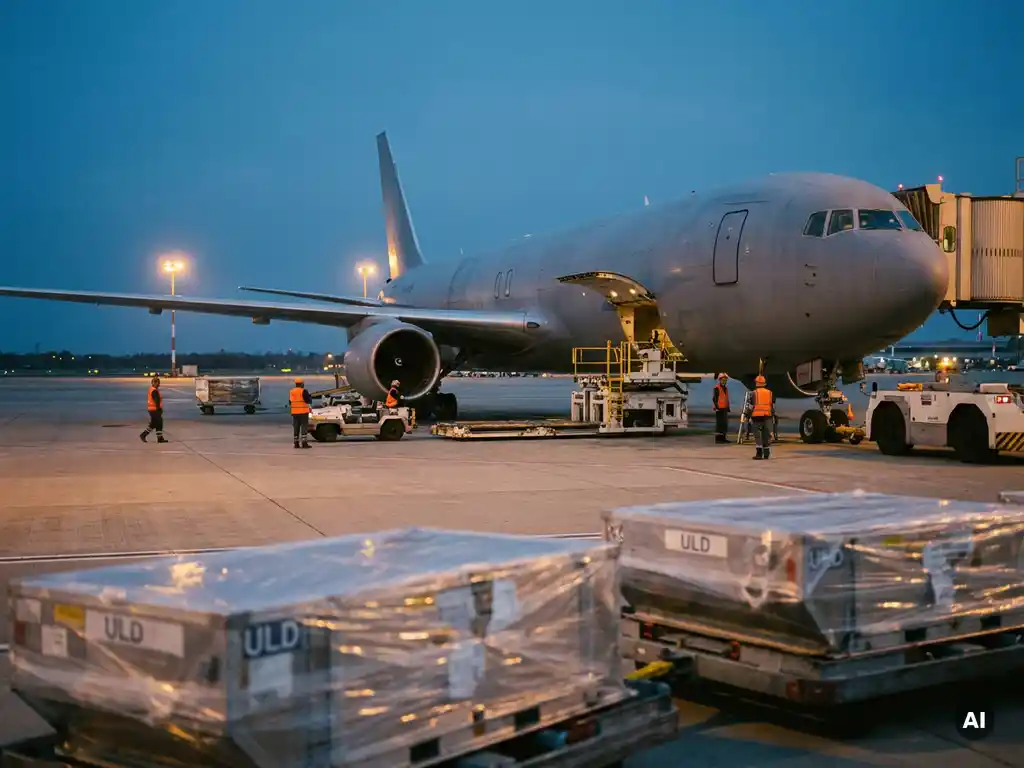
Air freight to Kenya connects European businesses with Nairobi in roughly two to five business days, depending on the routing, carrier, and service level selected. Jomo Kenyatta International Airport (JKIA) is the primary gateway, handling the vast majority of international cargo arrivals for the East African region. The sections below cover transit times, documentation, customs procedures, costs, cargo types, and when to work with a specialist freight forwarder.
How long does air freight to Kenya take?
Air freight from Europe to Kenya typically takes two to five business days from departure to delivery at destination. Direct flights from major European hubs to Nairobi operate several times per week, and transit times on these routes are at the shorter end of that range. Indirect routings via a Middle Eastern or African hub add one to two days to the overall schedule.
The figure above reflects flight time and standard handling at JKIA. Actual door-to-door delivery depends on several additional factors: how quickly customs clearance is completed, whether all documents are in order on arrival, and the distance between the airport and the final delivery address. Shipments destined for Nairobi itself clear quickly when documentation is complete. Onward distribution to cities such as Mombasa, Kisumu, or cross-border to Tanzania, Uganda, or Rwanda adds transit time beyond the airport.
What documents are required for air freight to Kenya?
Air cargo to Kenya requires a core set of documents: an airway bill (AWB), a commercial invoice, a packing list, and a certificate of origin. Depending on the nature of the goods, additional certificates may be required, including import permits, phytosanitary certificates for agricultural products, or conformity certificates for regulated items.
The commercial invoice must state the correct HS tariff codes, declared value in the transaction currency, and a precise description of the goods. Incomplete or inaccurate invoices are among the most common causes of customs delays at JKIA. Kenya Revenue Authority (KRA) uses a pre-arrival processing system, meaning documentation should be submitted before the shipment lands to avoid unnecessary storage charges. Businesses shipping regularly to Kenya should maintain a consistent document template that satisfies KRA requirements and reduces back-and-forth with customs officials.
How does customs clearance work at Nairobi airport?
Customs clearance at Jomo Kenyatta International Airport is managed by the Kenya Revenue Authority. Once a shipment lands, the licensed customs agent files an import entry through Kenya’s electronic single window system. KRA then assesses the shipment for applicable import duties and VAT, which are calculated on the CIF value (cost, insurance, and freight). Payment of duties triggers release of the cargo.
KRA applies a risk-based examination approach: most commercial shipments are cleared through documentary review alone, while a percentage are selected for physical inspection. Physical examination adds one to two days to clearance time. Goods subject to regulatory oversight, such as pharmaceuticals, food products, or electronics, may require pre-clearance approval from the relevant Kenyan authority before the shipment arrives. Businesses importing under a DDP arrangement, where the exporter covers all duties and delivers to the buyer’s door, benefit most from working with a forwarder who has an established local agent at JKIA with direct KRA relationships.
What affects the cost of air freight to Kenya?
The cost of air freight to Kenya is driven by chargeable weight, the applicable rate per kilogram on the Europe-Nairobi lane, fuel surcharges, and destination handling fees. Chargeable weight is the higher of actual gross weight and volumetric weight, calculated as length x width x height in centimetres divided by 6,000.
Beyond the base freight rate, the following cost components are standard on shipments to Kenya:
- Fuel and security surcharges: These vary by carrier and are adjusted periodically, so they should always be confirmed at the time of booking.
- Origin handling charges: Fees for accepting, weighing, and processing the shipment at the European departure airport.
- Destination handling charges (DHC): Levied by the handling agent at JKIA for offloading, breakdown, and delivery to the customs examination area.
- Import duties and VAT: Calculated by KRA on the CIF value. Rates vary by HS code; some goods benefit from reduced rates under trade agreements.
- Customs brokerage: The fee charged by the licensed agent filing the import entry on behalf of the consignee.
Consolidation services, where multiple smaller shipments from different exporters are grouped into a single air consignment, can reduce the per-kilogram rate significantly for businesses that do not fill a full charter or large general cargo booking. For time-sensitive shipments, direct flights command a premium over indirect routings.
What types of cargo can be shipped by air to Kenya?
The majority of commercial goods can be shipped by air to Kenya, including machinery parts, electronics, textiles, pharmaceuticals, medical equipment, perishables, and industrial components. Air freight is particularly suited to high-value, time-sensitive, or perishable cargo where speed justifies the cost premium over sea freight.
Certain cargo categories require special handling or documentation:
- Perishables: Temperature-sensitive goods such as fresh produce, vaccines, and biological samples require cold-chain handling and must comply with IATA Perishable Cargo Regulations.
- Dangerous goods: Hazardous materials classified under IATA DGR (excluding Class 7 radioactive materials) can be transported by air, provided they are correctly declared, packaged, and labelled. Acceptance depends on the carrier and the specific UN classification.
- Oversized or heavy cargo: Cargo exceeding standard ULD dimensions may require freighter capacity rather than belly hold space on passenger aircraft.
- Regulated goods: Pharmaceuticals, medical devices, and certain food products require import permits from Kenyan regulatory bodies such as the Pharmacy and Poisons Board or KEBS (Kenya Bureau of Standards).
Goods that are prohibited under Kenyan import regulations, or that require licences the consignee does not hold, cannot be cleared regardless of transport mode. Confirming import eligibility before booking is essential for businesses new to shipping to Africa.
Should you use a freight forwarder for air shipments to Kenya?
For business-to-business shipments to Kenya, working with a specialist freight forwarder is strongly advisable. Customs procedures at JKIA, KRA’s documentation requirements, and the coordination between European origin and Kenyan destination handling are complex enough that errors made without expert guidance typically cost more than the forwarder’s fee.
A freight forwarder with Kenya expertise handles carrier selection, airway bill issuance, pre-arrival document submission, customs brokerage at JKIA, and last-mile delivery to the consignee’s premises. For companies shipping on DDP terms, the forwarder effectively takes full responsibility for the shipment from the European exporter’s door to the buyer’s warehouse in Nairobi, including payment of all duties and taxes. This simplifies the transaction for both parties and removes the administrative burden from the buyer. Businesses without a customs registration number in Kenya, or those shipping to Kenya for the first time, will find the process significantly more manageable through a dedicated freight forwarding service that has established local agent relationships at JKIA.
How EAF supports your air freight shipments to Kenya
We have been organising air cargo from Europe to Kenya for over 30 years, and East Africa is one of our core lanes. From Nairobi, we regularly coordinate onward distribution to Tanzania, Uganda, Rwanda, and Mozambique. Our approach is built around removing the complexity of African customs from your side of the transaction.
Here is what we handle for your Kenya shipments:
- Carrier selection and booking: We select the most suitable routing and service level for your cargo type and timeline.
- Complete documentation: Airway bills, commercial invoices, certificates of origin, and any regulatory permits required for your goods.
- Customs clearance at JKIA: Our local agents in Nairobi file import entries directly with KRA and manage examination if required.
- DDP delivery: We offer Delivered Duty Paid shipments, covering all import duties, VAT, and last-mile delivery to your buyer’s address in Kenya.
- Dangerous goods handling: For applicable IATA DGR classes, we manage classification, packaging requirements, and carrier acceptance.
If you are shipping goods from Europe to Kenya and want a straightforward, reliable process from departure to delivery, contact us to discuss your shipment requirements.
Ähnliche Artikel
- What Is Air Charter and When Does It Make Sense for Shipping to Africa?
- How Does Air Freight from Europe to South Africa Work?
- What Goods Can and Can't Be Shipped to Africa by Air?
- How Is Air Freight Cost Calculated?
- What Documents Do You Need for Air Freight Export to Africa?
Dieser Inhalt wurde mithilfe von KI erstellt und kann Fehler enthalten.