
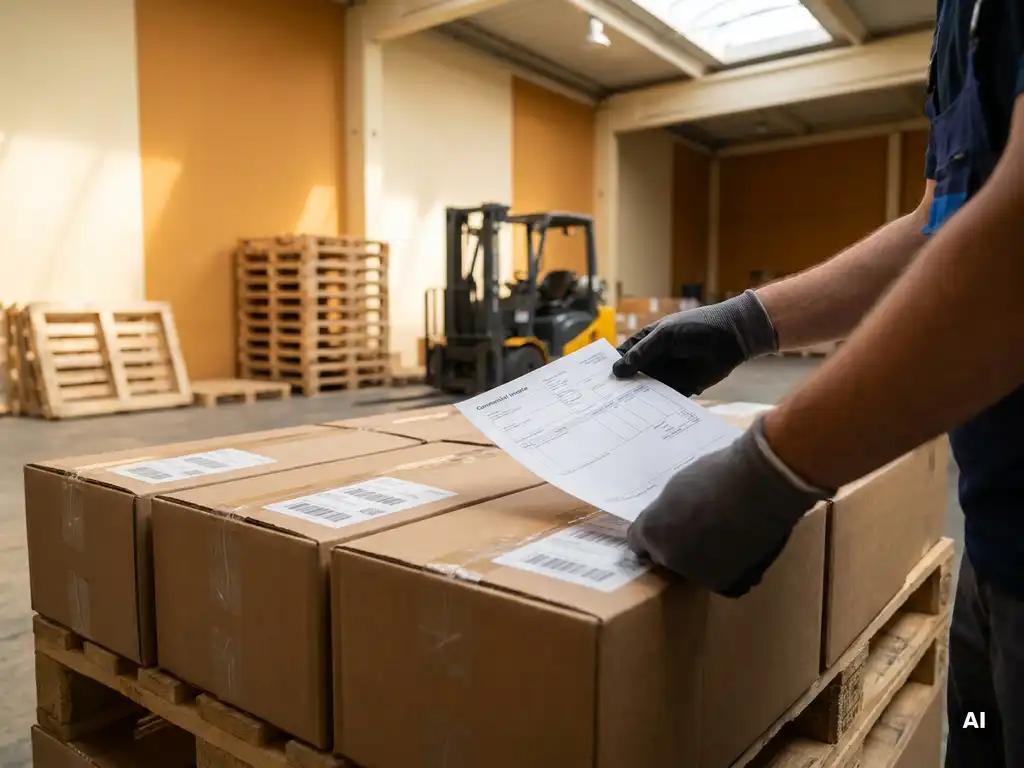
A commercial invoice is a legally binding document issued by the seller to the buyer that records the terms of a commercial transaction. For export, it serves as the primary document that customs authorities use to assess duties, verify the legality of the shipment, and confirm the declared value of the goods. Any business shipping goods from Europe to destinations in Africa, Asia, or elsewhere needs a correctly completed commercial invoice before freight can clear customs.
The sections below address the most common questions businesses ask about commercial invoices, from required fields to the errors that cause delays at clearance.
What information must a commercial invoice include?
A commercial invoice for export must include the seller’s and buyer’s full legal names and addresses, a detailed description of the goods, the quantity, unit price, total value, currency, country of origin, and the applicable Incoterms. It must also reference the shipment method and include the harmonised system (HS) tariff codes for each line item.
Customs authorities use these fields to classify goods and calculate applicable duties and taxes. Missing or vague entries, such as writing “spare parts” instead of specifying the exact item, are among the most frequent causes of clearance holds. For air freight shipments to destinations like Nigeria or Kenya, where customs procedures are detailed and duty calculations are precise, a complete and accurate invoice is not optional.
- Seller and buyer details: Full legal names, addresses, and VAT or tax registration numbers where applicable
- Invoice number and date: Required for document tracking and customs filing
- Goods description: Specific, technical descriptions, not generic terms
- HS codes: Correct tariff classification for each product line
- Quantity and unit of measure: Number of units, weight, or volume as appropriate
- Unit price and total value: In the agreed transaction currency
- Country of origin: Where the goods were manufactured, not where they are being shipped from
- Incoterms: The agreed delivery and risk transfer terms (e.g. DDP, FOB, CIF)
- Payment terms: How and when payment is to be made
How does a commercial invoice differ from a proforma invoice?
A proforma invoice is a preliminary document issued before a transaction is finalised, used to provide a quote or support import licence applications. A commercial invoice is issued after the sale is confirmed and the goods are ready to ship. The commercial invoice is the legally binding record of the actual transaction and is what customs requires for clearance.
In practice, a proforma invoice is often used early in the export process, particularly when a buyer in Ghana or Tanzania needs to apply for a letter of credit or obtain an import permit. Once the order is confirmed and the goods are dispatched, the commercial invoice replaces the proforma and becomes the official export document. The two documents may look similar, but only the commercial invoice carries legal weight for customs and payment purposes.
Why do customs authorities require a commercial invoice?
Customs authorities require a commercial invoice because it provides the verified basis for calculating import duties, confirming the declared value of goods, and checking that the shipment complies with trade regulations. Without it, customs cannot legally clear the goods for entry into the destination country.
For exports from Europe to African markets such as Nigeria, Kenya, or Ghana, customs agencies cross-reference the commercial invoice against other shipping documents to detect undervaluation, misdescription, or prohibited goods. Authorities may apply their own valuation methods if the declared value appears inconsistent with market rates. This is why the invoice must reflect the actual transaction value, not an artificially reduced figure intended to lower duty exposure, which constitutes customs fraud and can result in seizure, fines, or blacklisting.
What is the difference between a commercial invoice and a packing list?
A commercial invoice records the financial and legal terms of the transaction, while a packing list records the physical contents of the shipment. The invoice states what was sold and at what price; the packing list states what is physically in each package, including dimensions, weights, and how goods are packed.
Both documents are required for export and must be consistent with each other. Discrepancies between the two, such as a different quantity on the packing list than on the invoice, will trigger a customs query or physical inspection. For air freight shipments where handling charges are weight-based, the packing list also directly affects cost calculations. The two documents complement each other: customs uses the invoice to assess value and duties, and uses the packing list to verify the physical cargo.
When does a commercial invoice need to be certified or legalised?
A commercial invoice needs to be certified or legalised when the destination country’s customs or banking regulations require it, or when the transaction is governed by a letter of credit that specifies certified documents. Some African countries require invoices to be certified by a Chamber of Commerce or legalised by the destination country’s consulate in the country of export.
Requirements vary significantly by destination. Nigeria, for example, may require a Combined Certificate of Value and Origin for certain goods. Some transactions involving government buyers or regulated industries require consular legalisation. Businesses should confirm the specific requirements for their destination country before shipment, as obtaining certification after goods have been dispatched is difficult and can cause significant delays. A freight forwarder with established expertise in African trade routes can advise on country-specific documentation requirements.
What are the most common commercial invoice errors that delay shipments?
The most common commercial invoice errors that delay shipments are vague goods descriptions, incorrect or missing HS codes, mismatched values between the invoice and other documents, wrong or incomplete buyer and seller details, and missing Incoterms. Any of these can trigger a customs hold, additional inspections, or rejection of the shipment.
In practical terms, the errors that cause the most significant delays in African customs clearance include:
- Generic goods descriptions: Terms like “machine parts” or “electronics” are insufficient. Customs requires specific technical descriptions.
- Incorrect HS codes: A misclassified product may attract a higher duty rate or trigger a compliance check.
- Undervalued goods: Declaring a lower value to reduce duties is a customs offence and can result in seizure.
- Currency inconsistencies: The currency on the invoice must match the currency in the letter of credit or payment documentation.
- Wrong country of origin: The origin must reflect where goods were manufactured, not where they were consolidated or shipped from.
- Missing or incorrect Incoterms: These determine who bears responsibility for duties, insurance, and delivery costs. A DDP shipment, for example, has very different documentation implications than an FOB shipment.
- Buyer address errors: Incorrect consignee details can prevent goods from being released to the rightful recipient.
Catching these errors before the shipment departs is far less costly than resolving them at the port or airport of destination.
How EAF supports your export documentation
Getting export documentation right is one of the most practical ways to avoid delays, unexpected costs, and compliance problems. This is exactly where we add value for our clients. At EAF, we handle freight from Europe to destinations across Africa, including Nigeria, Ghana, Kenya, and Tanzania, and documentation accuracy is central to every shipment we manage.
When you ship with us, we provide:
- Pre-shipment document review to catch invoice errors before goods are tendered
- Guidance on HS code classification and country-specific certification requirements
- DDP (Delivered Duty Paid) services, where we manage customs clearance and duty payment on your behalf, so goods arrive at the consignee’s door without additional steps
- Coordination of all required export documents, including certificates of origin, packing lists, and any consular legalisation required by the destination country
- Direct communication with our partner network at destination to resolve any customs queries quickly
Businesses that ship regularly to Africa benefit from having a freight partner who understands the customs environment at destination, not just the export side. If you want to ensure your next shipment clears without delays, get in touch with us to discuss your requirements.
Ähnliche Artikel
- How Do You Book an Air Freight Shipment to Africa?
- What Causes Air Freight Delays and How Can You Avoid Them?
- How Do You Ship Oversized or Heavy Cargo to Africa by Air?
- How Does Air Freight from Europe to Nigeria Work?
- How Is Air Freight Cost Calculated?
Dieser Inhalt wurde mithilfe von KI erstellt und kann Fehler enthalten.