
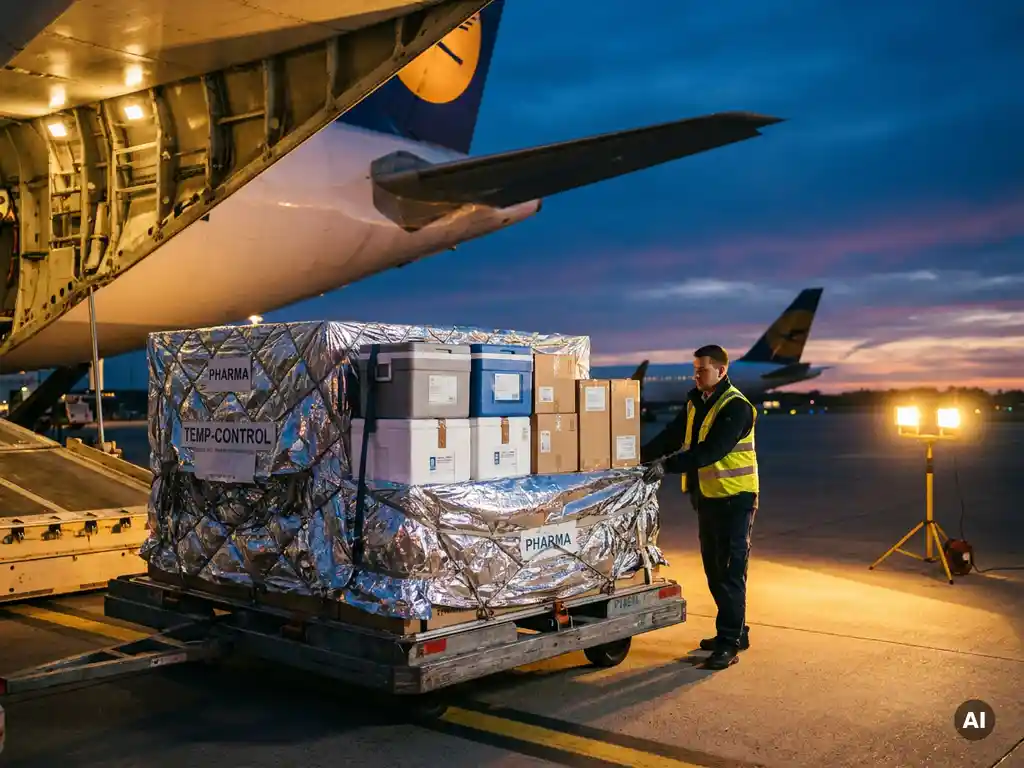
Shipping medical and pharmaceutical goods to Africa by air requires a combination of correct documentation, temperature-controlled handling, and knowledge of destination-specific import regulations. Air freight is the standard mode for pharmaceutical cargo to Africa precisely because it minimises transit time, reduces exposure risk for temperature-sensitive products, and keeps the cold chain intact far more reliably than sea freight. The sections below address the most common questions businesses face when planning a pharmaceutical air shipment from Europe to Africa.
What documentation is required to ship pharmaceuticals to Africa by air?
Shipping pharmaceuticals to Africa by air requires a core set of documents: a commercial invoice, packing list, airway bill (AWB), certificate of origin, and a product-specific import permit or drug registration certificate issued by the destination country’s regulatory authority. Without the import permit, customs clearance will stall regardless of how well the cargo is packed or routed.
Beyond the basics, most African regulatory bodies require a Good Manufacturing Practice (GMP) certificate for the manufacturer, a certificate of analysis (CoA) for the batch being shipped, and in many cases a free sale certificate from the exporting country. Some destinations also require an end-user certificate, particularly for controlled substances or narcotics.
Labelling requirements are frequently overlooked. Products must carry labels in the language accepted by the destination country, display shelf-life information, and comply with local packaging standards. Submitting incomplete documentation is the single most common reason pharmaceutical shipments are held at African airports, sometimes for weeks. Preparing a full document checklist before the cargo leaves Europe is not optional – it is the foundation of a successful delivery.
What are the cold chain requirements for medical air freight to Africa?
Cold chain air freight to Africa requires that temperature-sensitive pharmaceuticals are packed in validated thermal packaging, handled in temperature-controlled facilities at departure and arrival airports, and monitored continuously throughout transit. Products classified as requiring 2°C to 8°C storage (the standard refrigerated range) must maintain that range from the moment they leave the warehouse in Europe to final delivery at destination.
In practice, this means working with airlines that offer dedicated pharmaceutical handling services and GDP (Good Distribution Practice) compliant ground handlers at key African hub airports. Major hubs such as Nairobi, Lagos, and Accra have improved their cold chain infrastructure significantly, but capability varies. Choosing the right routing matters: a direct flight to Nairobi preserves the cold chain far better than a multi-stop itinerary with long ground transfer times.
Packaging selection is equally critical. Validated insulated shippers, phase-change materials, and dry ice (for deep-frozen products) are standard tools. For dry ice shipments, IATA Dangerous Goods Regulations (DGR) apply, and the quantity per package and per aircraft hold is regulated. Every link in the cold chain must be documented, as GDP compliance requires a full temperature record from origin to delivery.
Which African countries have the strictest pharmaceutical import regulations?
Nigeria and Kenya consistently apply the most rigorous pharmaceutical import controls among African destinations. Nigeria’s National Agency for Food and Drug Administration and Control (NAFDAC) requires product registration before any pharmaceutical can be imported commercially, and this process can take considerable time. Kenya’s Pharmacy and Poisons Board (PPB) operates a similarly structured registration and import permit system.
Ghana, through the Food and Drugs Authority (FDA Ghana), also maintains strict pre-shipment requirements, including product registration and mandatory inspection for certain categories. Tanzania’s Tanzania Medicines and Medical Devices Authority (TMDA) requires import permits for all regulated medicines and has increased enforcement in recent years.
What this means in practice is that businesses shipping pharmaceuticals to these markets must begin the regulatory process well in advance of the planned shipment date. Attempting to clear unregistered products through customs in Nigeria or Kenya is not a viable workaround – authorities will detain or destroy non-compliant cargo. Working with a freight partner that has established relationships and local knowledge in these markets is the most reliable way to navigate these requirements. Our Africa logistics network covers all of these key destinations.
How does air freight compare to sea freight for medical goods to Africa?
Air freight is the preferred mode for medical goods to Africa because transit times are measured in days rather than weeks, which is critical for temperature-sensitive products, short shelf-life medicines, and urgent medical supplies. Sea freight takes three to six weeks from Europe to most African ports, making it unsuitable for most pharmaceutical cargo without highly specialised reefer container solutions.
The cost difference is real: air freight rates per kilogram are significantly higher than sea freight. However, when you account for the cost of product loss due to temperature excursions, the regulatory complexity of reefer sea shipments, and the risk of delays at congested African ports, air freight often delivers a better total cost outcome for pharmaceutical cargo.
Sea freight remains viable for large-volume, non-temperature-sensitive medical equipment, consumables with long shelf lives, or situations where lead times allow for extended transit. For anything requiring a maintained cold chain or urgent delivery, air freight is the practical and commercially sound choice for shipments from Europe to Africa.
What are the most common problems when shipping pharmaceuticals to Africa by air?
The most common problems in pharmaceutical air freight to Africa are incomplete import documentation, cold chain breaks during ground handling, customs delays caused by product registration issues, and routing decisions that extend transit time unnecessarily. Each of these is avoidable with proper planning, but each is also frequently encountered by businesses shipping to Africa for the first time.
Documentation gaps are the leading cause of customs holds. Missing import permits, absent certificates of analysis, or labelling that does not match the registered product description will trigger detention. In Nigeria and Kenya especially, customs authorities cross-reference shipment documents against their product registration databases, and discrepancies are flagged immediately.
Cold chain failures most often occur during ground transfers, not in the air. Long tarmac exposure, inadequate storage at transit airports, or delays between the aircraft and the cold room at the destination airport can push temperatures outside the required range. Selecting airlines and ground handlers with verified pharmaceutical handling capability at the destination airport significantly reduces this risk.
A further issue is the use of general freight forwarders without Africa-specific expertise. Pharmaceutical shipping to Africa involves regulatory frameworks, local customs procedures, and last-mile logistics that differ substantially from standard freight. Partnering with a specialist reduces the likelihood of all of the above problems occurring.
How do you choose the right air freight partner for medical cargo to Africa?
The right air freight partner for pharmaceutical cargo to Africa must have verified experience with GDP-compliant cold chain handling, direct knowledge of destination country import regulations, and the ability to manage customs clearance and last-mile delivery at the African end. Choosing a general forwarder without Africa-specific expertise is the most common and costly mistake businesses make in this space.
Key criteria to evaluate include:
- Regulatory knowledge: Can the partner advise on import permit requirements for Nigeria, Ghana, Kenya, or Tanzania before the shipment is booked?
- Cold chain capability: Does the partner work with GDP-certified airlines and ground handlers at destination airports?
- Customs and last-mile coverage: Can the partner handle customs clearance and DDP (Delivered Duty Paid) delivery at the African destination, so the consignee receives cleared goods at their door?
- Track record: Has the partner handled pharmaceutical shipments to your specific destination markets, not just Africa in general?
- Accreditations: IATA accreditation and ISO 9001 certification are baseline indicators of operational standards.
DDP delivery is particularly important for pharmaceutical importers in Africa. It removes the burden of customs navigation from the local recipient, reduces the risk of clearance errors, and ensures the cold chain is not broken while the consignee attempts to arrange collection from a bonded warehouse.
How EAF supports pharmaceutical and medical air freight to Africa
We have been shipping specialised cargo from Europe to Africa for over 30 years, and pharmaceutical and medical goods are among the most demanding categories we handle. Our approach is built around removing the complexity from the shipper’s side and managing it on their behalf.
For pharmaceutical air freight to Africa, we provide:
- Documentation guidance for import permits, certificates of analysis, and labelling requirements specific to Nigeria, Ghana, Kenya, Tanzania, and other African markets
- GDP-aligned cold chain routing with airlines and ground handlers that meet pharmaceutical handling standards at destination airports
- DDP delivery (Delivered Duty Paid) to the consignee’s door, including customs clearance at the African end, so your customer receives cleared, temperature-verified goods without managing the import process themselves
- Regulatory support through our established local partner network across West and East Africa
- Handling of dangerous goods classifications where applicable (excluding Class 7 radioactive materials), in compliance with IATA DGR
We serve B2B clients with a customs registration number who need a reliable, accountable partner for air freight services to Africa. If you are planning a pharmaceutical or medical cargo shipment from Europe to Africa and want to discuss routing, documentation, or DDP delivery options, contact our team directly for a concrete assessment of your shipment.
Ähnliche Artikel
- How Do You Ship Electronics to Africa by Air?
- Which documents are required for air freight to Kenya?
- What Is Ex Works (EXW) and What Does It Mean for the Buyer?
- How Do You Ship Oversized or Heavy Cargo to Africa by Air?
- How Long Does Air Freight from Europe to Africa Take?
Dieser Inhalt wurde mithilfe von KI erstellt und kann Fehler enthalten.