
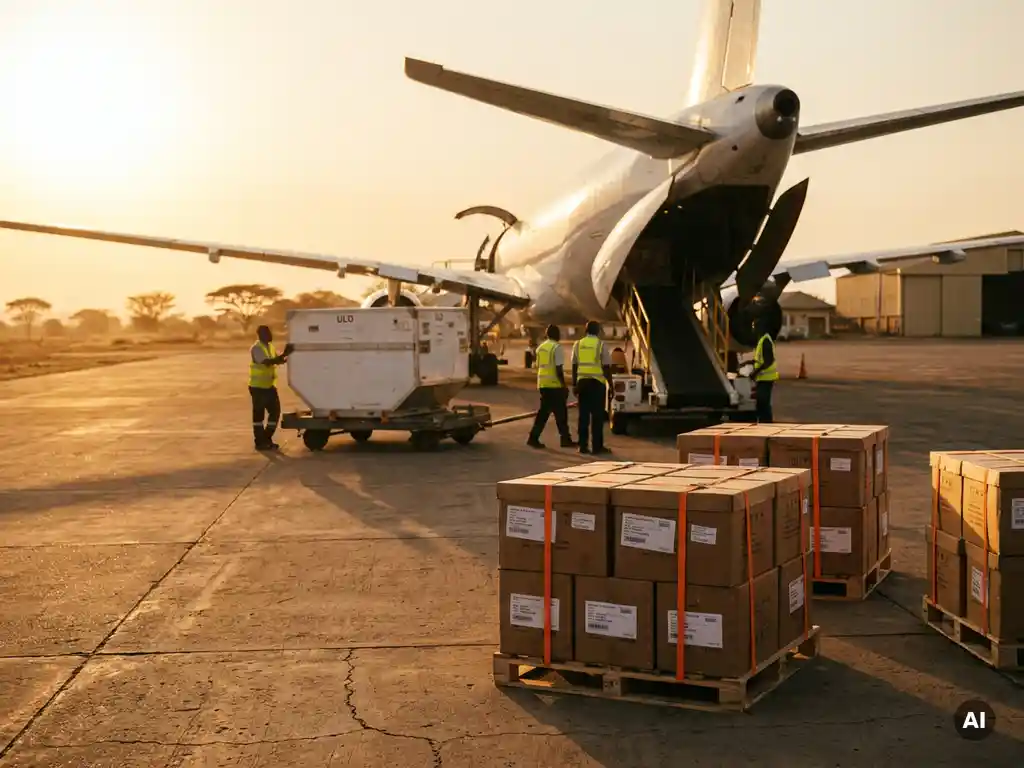
To book an air freight shipment to Africa, you contact a freight forwarder, provide shipment details and commercial documents, receive a quote, and confirm the booking. The forwarder then arranges collection, export customs clearance, airline booking, and delivery at destination. For B2B shipments from Europe to Africa, working with a specialist forwarder simplifies the entire process significantly, especially when destination customs and last-mile delivery are involved. The sections below walk through each stage in detail.
What information do you need before booking air freight to Africa?
Before you can book an air freight shipment to Africa, you need to provide your forwarder with the commodity description, HS tariff code, total weight and dimensions, declared value, country of origin, and the full addresses of both shipper and consignee. Having this information ready speeds up quoting and avoids errors in the booking.
Beyond the basics, your forwarder will also need to know:
- Whether the goods require special handling (temperature control, hazardous goods classification, or oversized packaging)
- The preferred delivery terms, such as DDP (Delivered Duty Paid), which means that all customs duties and delivery costs to the final address are covered
- Your company’s customs registration number and, where applicable, the consignee’s import licence or customs ID in the destination country
- Any deadlines or time constraints driving the shipment
For destinations like Nigeria, Ghana, Kenya, or Tanzania, import regulations can vary considerably by commodity. Knowing the exact product and its end use early in the process allows your forwarder to flag any licensing requirements before the shipment moves.
How does the air freight booking process work step by step?
The air freight booking process for shipments to Africa follows a clear sequence: quote request, booking confirmation, cargo collection, export customs clearance, airline handover, transit, import clearance at destination, and final delivery. Each stage involves coordination between the shipper, forwarder, airline, and destination agent.
Here is how the process typically unfolds:
- Quote request: You submit shipment details to your forwarder, who calculates the rate based on chargeable weight, routing, and any special handling requirements.
- Booking confirmation: Once you accept the quote, the forwarder secures space with the airline and issues a booking reference.
- Cargo collection: The forwarder arranges pickup from your warehouse or factory and transports the goods to the departure airport.
- Export customs clearance: Documents are submitted to customs authorities in the country of departure. The forwarder handles this on your behalf.
- Airline handover and departure: Cargo is checked in, loaded, and dispatched on the agreed flight.
- Transit: Depending on the destination, there may be one or more transit stops before arrival in Africa.
- Import clearance at destination: Your forwarder’s local partner handles customs entry, duty payment, and release of the goods.
- Last-mile delivery: Cargo is delivered to the consignee’s address, completing the door-to-door service.
For a smooth process, confirm all document requirements with your forwarder before the cargo moves. Errors at the export stage can cause delays that affect the entire chain.
What documents are required for air freight shipments to Africa?
The core documents required for shipping to Africa by air are the commercial invoice, packing list, and airway bill (AWB). Depending on the commodity and destination country, additional documents such as a certificate of origin, import permit, or pre-shipment inspection certificate may also be mandatory.
Here is a breakdown of the standard document set:
- Commercial invoice: Must state the full description of goods, HS code, unit price, total value, currency, and Incoterms. Accuracy here directly affects import duty calculation at destination.
- Packing list: Details the number of packages, dimensions, gross and net weights per item.
- Airway bill (AWB): The transport contract between shipper and airline. Your forwarder issues this once the booking is confirmed.
- Certificate of origin: Required for many African countries, particularly where preferential duty rates or import licences are linked to origin.
- Import permits or licences: Certain product categories, including pharmaceuticals, food products, and electronics, require prior approval from the destination country’s regulatory authority.
Nigeria, for example, requires a Form M and, for many goods, a pre-shipment inspection under the NAFDAC or SON schemes. Kenya and Tanzania have their own specific requirements for regulated products. Your forwarder should confirm the exact document checklist per destination before you ship.
How long does air freight to Africa typically take?
Air freight to Africa typically takes between two and five business days from Europe to major hubs such as Lagos, Accra, Nairobi, or Dar es Salaam, depending on the routing and frequency of direct or connecting flights. Customs clearance at destination adds one to three additional business days in most cases.
Transit times vary by destination:
- West Africa (Nigeria, Ghana): Two to four days flight time from Europe, with customs clearance adding one to three days.
- East Africa (Kenya, Tanzania): Two to four days flight time, with customs clearance adding one to three days. Onward distribution to inland destinations such as Uganda or Rwanda adds further transit time.
The total door-to-door time for a DDP shipment, including collection in Europe, export clearance, flight, import clearance, and final delivery, typically ranges from five to ten business days. Unusual commodities, incomplete documents, or port congestion can extend this timeline.
What’s the difference between air freight and express courier for Africa shipments?
Air freight and express courier both move goods by air, but they differ in how cargo is handled, priced, and cleared through customs. Express courier services are optimised for small, document-like shipments with standardised processes, while air cargo to Africa via a freight forwarder is suited to larger commercial consignments that require tailored customs handling.
Air freight via a freight forwarder
Air freight is handled as cargo, typically consolidated with other shipments or booked as a dedicated consignment on a commercial airline. The freight forwarder manages export and import customs clearance separately, which allows for more complex documentation, DDP delivery terms, and handling of regulated or high-value goods. This route is standard for B2B shipments where the consignee holds a commercial customs registration.
Express courier services
Express courier networks use their own aircraft and ground infrastructure to move small parcels quickly, with automated customs clearance for low-value shipments. They work well for samples, spare parts, or documents. For larger commercial shipments, express couriers often charge significantly higher rates per kilogram and offer less flexibility on customs terms, particularly for DDP delivery into African markets where import duties are substantial.
What causes delays in air freight shipments to Africa?
The most common causes of delays in air freight shipments to Africa are incomplete or incorrect documentation, customs holds at the destination, and capacity constraints on specific routes. Understanding these factors helps businesses plan realistic timelines and avoid preventable disruptions.
The main delay drivers include:
- Document errors: A mismatch between the commercial invoice value and the declared customs value, or a missing import permit, can halt clearance for days.
- Customs holds and inspections: Destination customs authorities in Nigeria, Ghana, Kenya, and Tanzania conduct physical inspections on selected shipments. Certain commodity categories are inspected more frequently.
- Missing import licences: Regulated goods that arrive without the required pre-approval are held in a bonded warehouse until documentation is resolved, which can take weeks.
- Airline capacity constraints: On some African routes, belly cargo capacity is limited. During peak periods, cargo can be rolled to the next available flight.
- Public holidays and port closures: African markets observe a range of national holidays that affect customs office hours and delivery schedules.
Working with a forwarder that has direct local contacts at destination is one of the most effective ways to reduce clearance delays. Proactive document checking before departure eliminates the most common hold causes.
How EAF supports your air freight shipments to Africa
We have been organising air freight from Europe to Africa for over 30 years, with a focus on the destinations where documentation complexity and customs requirements are highest. Our Africa logistics expertise covers the full door-to-door process, including DDP delivery to the consignee’s premises with all duties and last-mile logistics included.
When you work with us, we handle:
- Document review and preparation before cargo moves, to prevent customs holds at destination
- Export customs clearance from Europe and import customs clearance at destination through our established local partner network
- DDP shipments to Nigeria, Ghana, Kenya, Tanzania, and other African markets, with duties settled on arrival
- Routing and airline selection based on frequency, reliability, and capacity to your specific destination
- Ongoing shipment updates and a direct point of contact throughout the process
We work exclusively with businesses and require a valid customs registration number. If you are planning a commercial air freight shipment from Europe to Africa and want a straightforward quote with no hidden steps, contact us directly and we will come back to you with a clear proposal.
Ähnliche Artikel
- What Causes Air Freight Delays and How Can You Avoid Them?
- How Do You Label and Mark Cargo for Export by Air?
- What Is Air Charter and When Does It Make Sense for Shipping to Africa?
- How Does Air Freight from Europe to Nigeria Work?
- How Is Air Freight Cost Calculated?
Dieser Inhalt wurde mithilfe von KI erstellt und kann Fehler enthalten.