
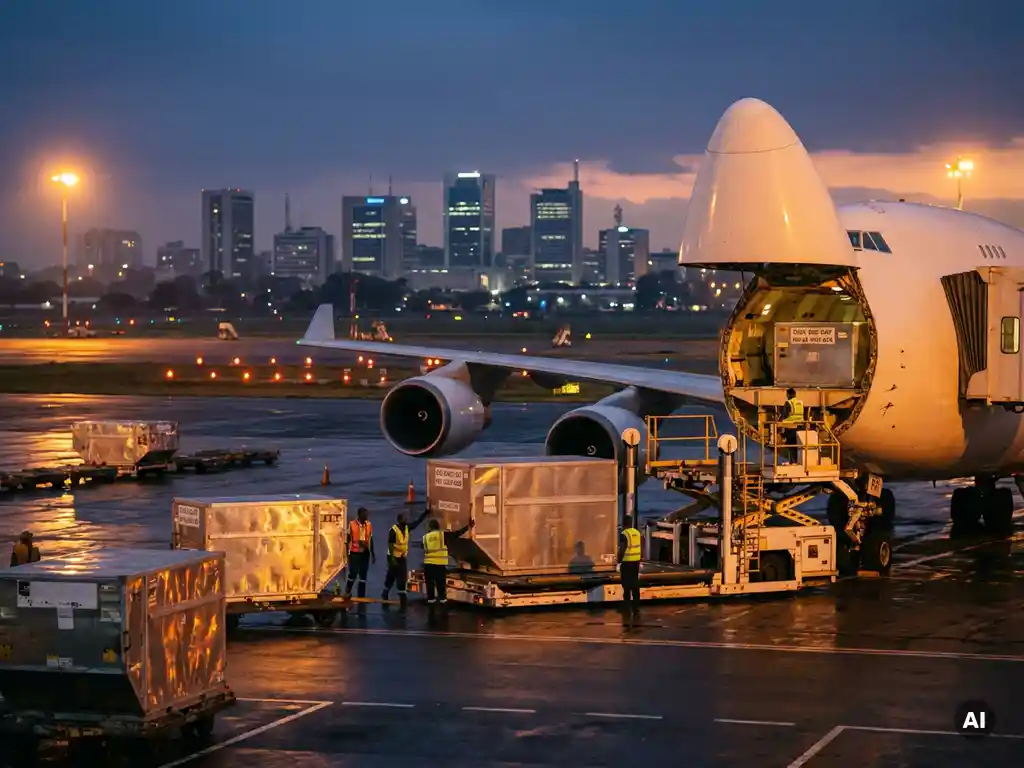
Air charter means booking an entire aircraft exclusively for your cargo, rather than purchasing space on a scheduled airline flight. For businesses shipping goods from Europe to Africa, it is a specialist tool used when speed, cargo size, or route limitations make scheduled air freight impractical. The sections below cover how charter works, what it costs, and when it genuinely makes sense for Africa-bound shipments.
How does air charter differ from scheduled air freight?
Scheduled air freight moves cargo on fixed airline routes with published timetables, alongside other shippers’ goods. Air charter means contracting an entire aircraft for a single shipment, with the route, timing, and loading configuration determined by the shipper’s requirements rather than an airline’s network.
The practical differences are significant. With scheduled freight, you book space in kilograms and cubic metres, and your cargo travels according to the airline’s schedule, often with one or more transit stops. With an air freight charter, the aircraft flies when and where you need it to. There are no slot constraints, no consolidation delays, and no dependency on an airline’s Africa network coverage.
Charter also removes the weight and dimension restrictions that apply to belly cargo on passenger aircraft. Outsized machinery, vehicles, or palletised goods that exceed standard ULD dimensions can be loaded on freighter aircraft configured specifically for the shipment. This makes air freight services via charter particularly relevant for project cargo and industrial equipment heading to destinations across Africa.
What types of cargo are typically moved by air charter?
Air charter to Africa is most commonly used for cargo that is time-critical, outsized, high-value, or destined for a location with limited scheduled freighter coverage. The shipment type, not the shipper’s preference, is usually what drives the decision to charter.
Typical cargo categories include:
- Project and industrial equipment: Heavy machinery, generators, drilling components, and construction equipment that cannot be broken down to fit standard freight dimensions
- Perishables and pharmaceuticals: Temperature-sensitive goods requiring fast transit and controlled loading conditions
- Emergency relief and humanitarian cargo: Medical supplies, disaster response equipment, or urgent spare parts where delivery timelines are fixed
- High-value goods: Electronics, automotive parts, or precision instruments where security and handling control justify the cost
- Dangerous goods (select classes): Certain hazardous materials that require dedicated aircraft and certified handling, excluding Class 7 radioactive materials
What these categories share is that the cost of delay or damage outweighs the premium of chartering. Businesses shipping routine commercial goods in standard volumes will almost always find scheduled air cargo to Africa more cost-effective.
When does air charter make sense for shipping to Africa?
Air charter makes sense for Africa-bound shipments when scheduled services cannot meet the delivery requirement, either because of route gaps, cargo characteristics, or urgency. It is a B2B tool used in specific operational circumstances, not a general-purpose upgrade from scheduled freight.
Consider air charter when one or more of the following conditions apply:
- The destination has no direct scheduled freighter service: Many secondary cities and inland hubs across West and East Africa are not served by scheduled all-cargo aircraft. Charter can bridge the gap, landing closer to the final delivery point.
- The cargo is too large or heavy for scheduled options: Outsized project cargo that cannot be containerised to airline specifications requires a freighter aircraft with appropriate load configurations.
- The delivery window is fixed and narrow: Production line shutdowns, contract penalties, or event-driven deadlines can make the cost of a charter economically rational compared to the cost of delay.
- Volume justifies full aircraft use: For very large shipments, the per-kilogram cost of a charter can approach or match consolidated scheduled rates, while offering superior control over timing and handling.
For standard commercial shipments to major destinations such as Lagos, Accra, Nairobi, or Dar es Salaam, scheduled air freight remains the default. Charter is the right answer when scheduled freight is genuinely not the right tool.
How is the cost of an air charter calculated?
Air charter costs are calculated primarily on the basis of aircraft type, flight distance, and operational factors rather than a per-kilogram rate. The shipper pays for the aircraft’s time and capacity, regardless of whether every kilogram of payload is used.
The main cost components are:
- Aircraft type and payload capacity: Larger freighters cost more per flight but lower the cost per tonne for high-volume shipments. The aircraft must match the cargo’s weight, volume, and any special handling requirements.
- Route and distance: Fuel, landing fees, overflight permits, and positioning costs all scale with distance. Flights to secondary African destinations often involve additional permit costs and ground handling arrangements.
- Handling and ground services: Loading equipment, ground crews, and storage at origin and destination airports are typically quoted separately or included in a full-service charter package.
- Customs and delivery: For door-to-door shipments on a DDP (Delivered Duty Paid) basis, import duties, customs clearance fees, and last-mile delivery to the consignee are factored into the total landed cost.
Because charter pricing is built from multiple variables, quotes are always shipment-specific. A freight forwarder with Africa expertise will assess the cargo details, destination, and timeline before recommending an aircraft type and routing.
What are the main challenges of air charter to African destinations?
Air charter to Africa presents operational challenges that do not apply to the same degree on European or transatlantic routes. Permit complexity, ground infrastructure, and customs procedures at destination airports are the most common friction points.
Key challenges include:
- Landing and overflight permits: Many African countries require advance permits for charter aircraft, and processing times vary significantly by country. Last-minute charters to destinations with slow permit authorities carry real schedule risk.
- Ground handling capability: Not all African airports have the equipment or certified staff to handle heavy or outsized freight. This must be confirmed before aircraft and route selection is finalised.
- Customs clearance at destination: Import procedures, documentation requirements, and clearance timelines differ by country. Nigeria, for example, has specific import licensing requirements that affect what can be cleared and how quickly. Without proper preparation, cargo can be held at the airport after the aircraft has departed.
- Positioning costs: If no suitable aircraft is based near the origin airport, positioning the aircraft to the departure point adds cost and time to the operation.
These challenges are manageable with experienced coordination, but they underline why air charter to Africa requires a forwarder with on-the-ground knowledge of destination procedures, not just aircraft access.
How do you arrange an air charter shipment to Africa?
Arranging an air charter to Africa involves working with a freight forwarder or charter broker who can source suitable aircraft, manage permits, and coordinate ground handling and customs at the destination. The process is more involved than booking scheduled freight and requires early engagement.
The typical steps are:
- Define the cargo and delivery requirement: Provide full details on weight, dimensions, commodity type, dangerous goods classification if applicable, origin airport, destination, and required delivery date.
- Receive a charter proposal: The forwarder assesses aircraft options, routing, permit requirements, and ground handling, then presents a cost and timeline estimate.
- Confirm documentation: Commercial invoice, packing list, airway bill, and any required import licences or permits for the destination country must be prepared in advance. For DDP shipments, customs value and duty calculations are completed at this stage.
- Secure permits and ground services: Landing and overflight permits are applied for, and ground handling at the destination airport is confirmed.
- Execute the flight and manage delivery: The forwarder coordinates loading, monitors the flight, and manages customs clearance and final delivery at the destination.
Lead time matters. For destinations with complex permit requirements or limited ground handling, a minimum of five to seven working days before the required departure date is a practical baseline. Emergency charters with shorter windows are possible but carry higher costs and greater operational risk.
How EAF handles air charter shipments to Africa
We arrange air charter solutions for businesses shipping goods from Europe to Africa, including to destinations where scheduled freighter coverage is limited or where cargo characteristics make scheduled services impractical. Our work covers the full scope of the shipment, not just the aircraft booking.
What we manage on your behalf:
- Aircraft sourcing and route planning matched to your cargo type and destination
- Landing and overflight permit coordination for African destinations
- Customs documentation preparation and import clearance at the destination
- DDP delivery to the consignee’s door, including duty and tax settlement
- Ground handling confirmation at destination airports across West and East Africa, including Nigeria, Ghana, Kenya, and Tanzania
As an IATA-accredited freight forwarder with over 30 years of Africa logistics experience, we understand the customs environments, permit processes, and ground realities at the destinations we serve. If you have a shipment that scheduled air freight cannot handle, contact us to discuss your requirements.
Ähnliche Artikel
- What's Included in an Air Freight Quote to Africa?
- How Do You Ship Oversized or Heavy Cargo to Africa by Air?
- What Are the Most Common Air Freight Export Mistakes?
- How Does Air Freight from Europe to South Africa Work?
- Sending Goods by Air to Ghana: What Exporters Should Know
Dieser Inhalt wurde mithilfe von KI erstellt und kann Fehler enthalten.