
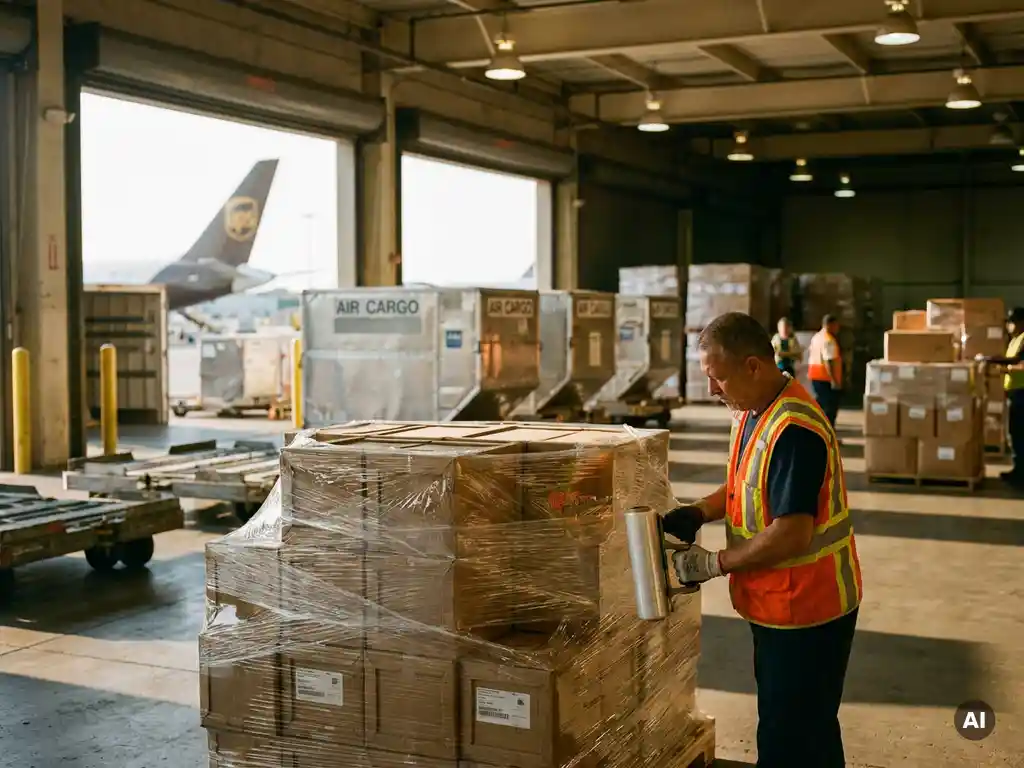
To package goods for air freight to Africa, use rigid outer cartons or crates, secure contents with appropriate cushioning materials, seal all seams with strong packing tape, and label each package clearly with consignee details, destination, and any handling instructions. Air cargo moves through multiple handling points, and packages destined for markets like Nigeria, Kenya, Ghana, or Tanzania must withstand mechanical stress, temperature variations, and customs inspection. The sections below cover approved materials, size limits, fragile goods, labeling, special cargo, and how packaging affects customs clearance.
What packaging materials are approved for air freight?
Approved packaging materials for air freight include new or structurally sound corrugated cardboard boxes, wooden crates, plywood cases, and rigid plastic containers. Internal cushioning materials such as bubble wrap, foam padding, air pillows, and packing peanuts are all acceptable. The key requirement is that the outer packaging must be strong enough to protect the contents under stacking pressure and repeated handling.
Cardboard boxes are the most common choice for commercial shipments. When selecting a box, choose one rated for the gross weight of the shipment. Double-walled corrugated cardboard is recommended for anything over 10 kg or for goods with hard edges that could puncture single-wall material.
Wooden crates and pallets used in international air freight must comply with ISPM 15 phytosanitary standards, which require heat treatment or methyl bromide fumigation to prevent the spread of pests. Untreated wood packaging is routinely rejected at African customs points, so always verify that your supplier or packing service uses ISPM 15-compliant timber.
Avoid reusing damaged boxes, packaging with previous labels still attached, or any material that shows signs of moisture damage. Customs authorities and cargo handlers in destinations like Lagos or Nairobi will flag poorly conditioned packaging, which can delay clearance.
What are the weight and size limits for air freight to Africa?
Air freight to Africa does not have a single universal weight or size limit, but individual pieces typically must not exceed 150 kg per package and must fit within the aircraft’s cargo hold dimensions. In practice, most airlines set piece limits between 70 kg and 150 kg depending on the aircraft type and route. Oversized or overweight pieces require prior approval and may need specialist handling equipment.
Dimensional weight (also called volumetric weight) is equally important. Airlines calculate chargeable weight as the greater of actual weight or dimensional weight, using the formula: length x width x height (in cm) divided by 6,000. A large but lightweight package can therefore cost more than a compact but heavy one.
For palletized shipments, standard air freight pallets (ULDs) have fixed footprint dimensions. Your freight forwarder will advise on the most cost-efficient build-up based on the total volume and weight of your consignment. When shipping commercial goods from Europe to destinations such as Dar es Salaam or Accra, consolidating cargo efficiently on a pallet reduces handling costs and minimizes the risk of individual packages being separated.
How should fragile or high-value goods be packed for air cargo?
Fragile or high-value goods for air cargo should be individually wrapped in bubble wrap or foam, placed in a rigid inner container, and then packed inside a sturdy outer box or crate with at least 5 cm of cushioning on all sides. The package should be marked “FRAGILE” and “THIS SIDE UP” on at least two faces.
For high-value items such as electronics, medical devices, or precision instruments, consider double-boxing: pack the item in a snug inner box, then place that box inside a larger outer box with cushioning filling the gap. This absorbs shock from drops and compression during loading and unloading.
Valuables that require temperature stability should be packed in insulated containers with appropriate gel packs or phase-change materials. If your goods are sensitive to humidity, include desiccant sachets inside the packaging. Humidity levels can vary significantly during transit through multiple airports and during last-mile delivery in West or East Africa.
For air freight to Africa, it is also worth considering that customs inspections may involve opening packages. Pack in a way that allows re-sealing without compromising the integrity of the contents. Include a packing list inside the box so customs officers can identify contents without handling individual items.
What labeling is required on packages sent by air freight to Africa?
Every package sent by air freight to Africa must carry a label showing the full name and address of the consignee, the full name and address of the shipper, the gross weight, the country of origin, and any applicable handling symbols. The airway bill number should also appear on the outer packaging. Labels must be securely attached and legible throughout the journey.
In addition to standard address labels, the following markings are commonly required or strongly recommended:
- Handling labels: “FRAGILE,” “THIS SIDE UP,” “KEEP DRY,” or “DO NOT STACK” as appropriate to the cargo
- Dangerous goods labels: IATA-compliant hazard labels for any regulated goods (see the section on special packaging below)
- Country of origin: Required for customs purposes in all African destination countries
- HS code reference: Including the Harmonized System code on or inside the package helps customs officers in Nigeria, Kenya, Ghana, and Tanzania process declarations accurately
- Number of packages: Mark each box as “1 of 3,” “2 of 3,” and so on when sending multiple pieces as a single consignment
Labels must be printed clearly, not handwritten where legible printing is possible, and placed on a flat surface of the package away from seams or tape. Remove or fully cover any old labels from previous shipments to avoid misdirection.
What goods require special packaging for air freight?
Goods that require special packaging for air freight include dangerous goods classified under IATA regulations, lithium batteries, perishables, pharmaceuticals, and oversized industrial equipment. Each category has specific packaging, labeling, and documentation requirements that must be met before the shipment is accepted by the airline.
Dangerous goods (excluding Class 7)
IATA classifies dangerous goods into nine hazard classes, ranging from flammables and corrosives to compressed gases and infectious substances. Each class requires UN-approved packaging that has been tested to withstand air transport conditions. Packaging must display the correct IATA hazard label, UN number, and proper shipping name. Shippers must also provide a Shipper’s Declaration for Dangerous Goods. Note that Class 7 radioactive materials are outside the scope of standard air freight services.
Lithium batteries
Lithium batteries, whether shipped alone or contained in equipment, are among the most regulated items in air cargo. They must be packed at a state of charge no greater than 30% (for standalone batteries), protected against short circuit, and packed in strong outer packaging. Batteries contained in devices must be individually protected against damage. Mispackaged lithium batteries are a leading cause of air freight rejections.
Perishables and pharmaceuticals
Temperature-sensitive goods require insulated packaging validated for the expected transit time and ambient temperatures along the route. For pharmaceutical shipments to Africa, GDP (Good Distribution Practice) guidelines apply, and packaging must maintain the required temperature range from origin to final delivery. Perishable food products must be packed to prevent leakage and comply with destination country import regulations.
How does poor packaging affect air freight customs clearance in Africa?
Poor packaging directly delays air freight customs clearance in Africa by triggering physical inspections, generating discrepancies between declared and observed contents, and raising suspicion of misdeclaration. Customs authorities in Nigeria, Kenya, Ghana, and Tanzania are entitled to open and examine any shipment, and damaged or inadequate packaging increases the likelihood of a full inspection and potential re-examination fees.
When packaging does not match the declared goods, or when contents shift and are damaged during transit, customs officers may detain the shipment pending clarification from the importer. This adds days or weeks to the delivery timeline and generates additional storage costs at the airport.
Poorly labeled packages create a separate set of problems. Missing or illegible consignee details, absent country-of-origin markings, or incorrect HS codes on the documentation cause declaration errors that must be corrected before release. For businesses shipping on DDP terms to Africa, these delays affect the entire delivery promise, not just the customs stage.
From a practical standpoint, packaging that arrives damaged also creates liability questions. If goods are damaged due to inadequate packaging rather than carrier mishandling, insurance claims may be rejected. Investing in correct packaging at the point of origin is significantly cheaper than the cost of delays, re-inspection, or damaged goods at destination.
How EAF supports correct packaging and smooth delivery to Africa
Getting packaging right for air freight to Africa requires knowledge of airline acceptance standards, destination customs requirements, and the specific conditions goods will face in transit. We work with B2B shippers across Europe to ensure consignments arrive at their African destinations on time and in the condition they left.
Here is what we handle on your behalf:
- Pre-shipment packaging advice: We review your cargo type and advise on the correct packaging, labeling, and documentation before your goods reach the airline
- Dangerous goods compliance: We guide shippers on IATA classification, UN-approved packaging requirements, and the correct completion of dangerous goods declarations
- DDP delivery to Africa: We offer Delivered Duty Paid services to destinations including Nigeria, Ghana, Kenya, and Tanzania, covering customs clearance and last-mile delivery so your customer receives the goods without additional charges or complications
- Documentation management: We prepare and verify all export and import documents, reducing the risk of customs holds caused by paperwork errors
- Direct partner network: Our established contacts at key African airports mean we can intervene quickly if a shipment is held for inspection
If you are preparing a shipment from Europe to Africa and want to confirm packaging requirements before booking, contact our team directly. We provide straightforward answers based on the specific goods, destination, and delivery terms you need.
Ähnliche Artikel
- What Causes Air Freight Delays and How Can You Avoid Them?
- How Do You Label and Mark Cargo for Export by Air?
- What Are the Most Common Air Freight Export Mistakes?
- What Happens to Your Cargo Between Pickup and the Airport?
- How Does Air Freight from Europe to South Africa Work?
Dieser Inhalt wurde mithilfe von KI erstellt und kann Fehler enthalten.