
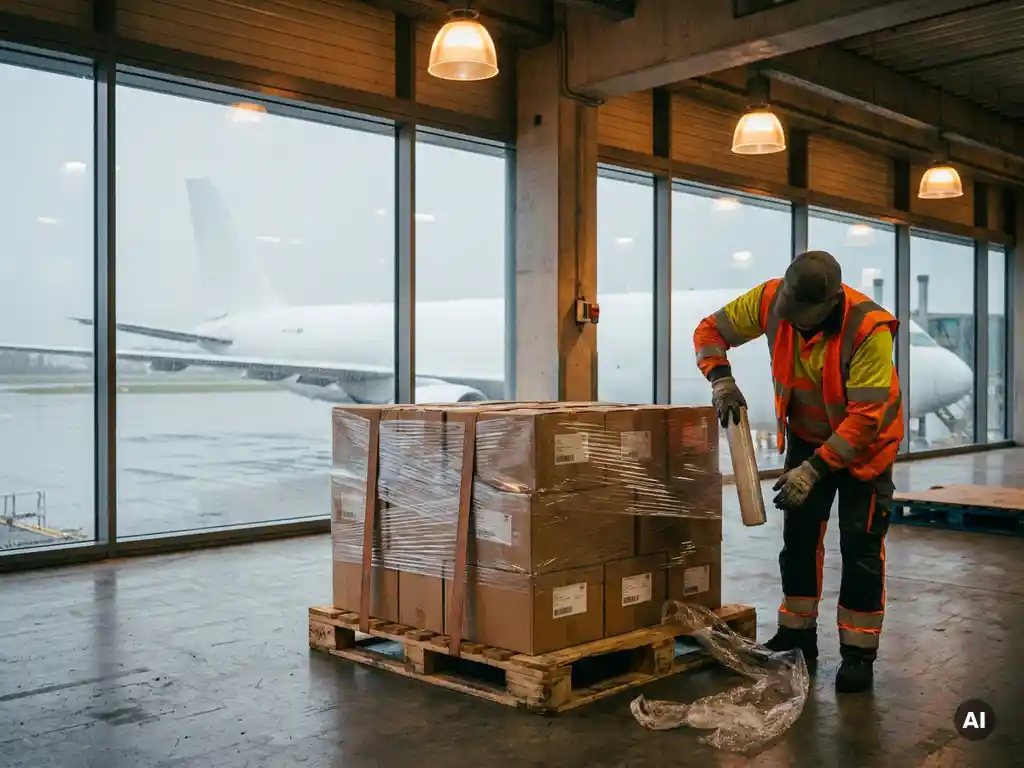
To prepare a shipment for air freight export, you need to complete the correct export documentation, package goods to IATA standards, verify weight and size limits, check whether your cargo is restricted or prohibited, label everything correctly, and hand the shipment over to your freight forwarder within the carrier’s cut-off times. Getting each of these steps right before the cargo reaches the airport is what separates a smooth transit from a costly delay. The sections below walk through each requirement in practical terms.
What documents are required for an air freight export shipment?
An air freight export shipment requires, at minimum, a commercial invoice, a packing list, and an Air Waybill (AWB). Depending on the destination and the nature of the goods, you will also need an export customs declaration, a certificate of origin, and in some cases a phytosanitary certificate, a dangerous goods declaration, or an import permit issued by the destination country.
For shipments moving from Europe to destinations such as Nigeria, Ghana, Kenya, or Tanzania, the documentation set is typically more extensive than for intra-European trade. Customs authorities in West and East Africa require precise and consistent information across all documents. Any discrepancy between the invoice value, the packing list quantity, and the AWB description can trigger a hold at the destination airport.
Key documents to prepare before handover:
- Commercial invoice with a full description of goods, unit values, HS codes, and Incoterms
- Packing list showing gross and net weights, dimensions, and number of pieces
- Air Waybill issued or co-signed by your freight forwarder
- Export customs declaration filed with the relevant customs authority in the country of export
- Certificate of origin where required by the importing country
- Dangerous goods declaration if the shipment contains any IATA-regulated substances
- Import permits or licenses required by the destination country for specific product categories
If the shipment is moving on DDP terms to Africa, the freight forwarder will also handle destination customs clearance and duty payment on your behalf, which requires a power of attorney or equivalent authorization in advance.
How should goods be packaged for air freight transport?
Goods shipped by air freight must be packaged to withstand stacking, vibration, and pressure changes in the aircraft hold. Use rigid outer cartons or crates, secure contents with adequate internal cushioning, and ensure that no single package can be damaged by the weight of another placed on top of it. Pallets should be stretch-wrapped and strapped.
Air freight packaging differs from sea freight in one important respect: transit times are shorter, but cargo is handled more frequently and loaded into Unit Load Devices (ULDs) that are shaped to fit the aircraft fuselage. This means irregular or oversized packages may need to be repacked or placed on a specific aircraft type.
Practical packaging guidelines for air freight:
- Use new, undamaged cartons rated for the gross weight of their contents
- Fill void spaces with appropriate dunnage to prevent internal movement
- Seal all seams with strong adhesive tape, not standard office tape
- For fragile items, double-box with a minimum of 5 cm of cushioning on all sides
- Palletize where possible and wrap with stretch film; avoid wooden pallets that require ISPM 15 fumigation unless pre-treated
- Ensure the packaging can withstand a compression load of at least four times the gross weight of the package
What are the weight and size restrictions for air freight?
Air freight weight and size restrictions depend on the aircraft type and the airline. Most commercial passenger aircraft accept individual pieces up to around 150 kg and 300 x 150 x 160 cm, while dedicated freighter aircraft can handle significantly larger and heavier shipments. Chargeable weight is calculated as the higher of actual gross weight and volumetric weight (length x width x height in cm divided by 6,000).
For regular general cargo moving from Europe to Africa, the volumetric weight calculation is often the determining factor for pricing, particularly with lightweight but bulky goods such as machinery components or consumer electronics packaging. Understanding this early helps you plan packaging dimensions efficiently and avoid unnecessary freight costs.
For heavy or oversized cargo that exceeds standard limits, charter solutions or specialized freighter bookings are required. Your freight forwarder should be consulted before the shipment is packed if there is any possibility the cargo falls into a heavy-lift category.
Which goods are prohibited or restricted on passenger and cargo aircraft?
IATA’s Dangerous Goods Regulations (DGR) define which goods are prohibited outright and which are permitted under specific conditions. Prohibited items on passenger aircraft include certain classes of explosives, flammable liquids above threshold quantities, and compressed gases. Many of these same goods are permitted on all-cargo aircraft with proper declaration, certified packaging, and approved labeling.
The nine IATA dangerous goods classes cover a wide range of everyday commercial products. Businesses exporting industrial equipment, chemicals, batteries, or aerosols to destinations in West or East Africa frequently encounter these restrictions without realizing it.
Goods prohibited on passenger aircraft but permitted on cargo aircraft
These include certain flammable liquids (Class 3), oxidizing substances (Class 5.1), toxic substances (Class 6.1), and corrosives (Class 8) when packed in quantities that exceed passenger aircraft limits. With the correct documentation and packaging, these can move on dedicated freighter services.
Goods prohibited on all aircraft
Some materials cannot be transported by air under any circumstances. This includes Class 1 explosives in most commercial categories, certain infectious substances above defined thresholds, and radioactive material of Class 7. EAF does not handle Class 7 radioactive cargo.
If you are unsure whether your product falls under the dangerous goods regulations, the safest approach is to provide your freight forwarder with the full product name, CAS number if applicable, and the Safety Data Sheet (SDS) before booking.
How should labels and markings be applied to air freight shipments?
Every air freight package must be clearly labeled with the shipper’s name and address, the consignee’s name and address, and the shipment reference number or AWB number. Dangerous goods require additional IATA-prescribed hazard labels, handling labels, and orientation arrows where applicable. Labels must be affixed to a flat surface, free from seams, and remain legible throughout transit.
For shipments to Africa, it is also advisable to include the destination country’s name prominently on each piece, as cargo may transit through multiple hubs before reaching the final airport. At busy transit hubs, clear destination labeling reduces the risk of misrouting.
Labeling requirements to follow:
- Shipper and consignee details on every individual piece, not only the master carton
- AWB number on each piece in the shipment
- Piece count in the format “1 of 5,” “2 of 5,” etc.
- Gross weight and net weight per piece
- Country of origin where required
- IATA dangerous goods labels if applicable, in the correct size and color
- “This Way Up” arrows on packages containing liquids or fragile items
Remove or cover all old labels from reused packaging to avoid confusion during handling.
When should a shipment be handed over to the freight forwarder?
A shipment should be handed over to the freight forwarder at least 24 to 48 hours before the planned flight departure, though this window varies by airline, route, and cargo type. Dangerous goods shipments and those requiring special handling typically require 48 to 72 hours of lead time. Late acceptance can result in the cargo being rolled to the next available flight.
For routes from Europe to Africa, airlines often operate on specific schedules with limited weekly frequencies on certain lanes. Missing a cut-off on a Tuesday departure to Nairobi or Lagos, for example, may mean a delay of several days rather than just one. Early coordination with your freight forwarder allows them to book capacity in advance and confirm acceptance deadlines with the airline.
As a practical rule for B2B exporters:
- Confirm booking and space with your forwarder at least three to five working days before the required departure
- Have all documents ready before the physical handover of goods
- For dangerous goods, allow extra time for DGR acceptance checks at the airline
- For DDP shipments, ensure destination import permits and customs authorizations are in place before departure
How EAF supports your air freight export to Africa
Preparing an air freight export correctly requires precise coordination across documentation, packaging, compliance, and airline cut-off schedules. For businesses shipping from Europe to Africa, the complexity increases with destination-specific customs requirements, import licensing, and last-mile delivery conditions in markets such as Nigeria, Ghana, Kenya, and Tanzania.
We specialize in exactly this. As a freight forwarder with over 30 years of experience in European exports to Africa, we handle the full scope of what exporters find most difficult:
- Preparing and reviewing export documentation for African destination requirements
- Advising on IATA dangerous goods classification and compliance before booking
- Securing airline capacity on key Europe-Africa routes with reliable cut-off management
- Managing DDP (Delivered Duty Paid) shipments including destination customs clearance and duty payment
- Coordinating last-mile delivery to the consignee’s premises in major African cities
We work exclusively with business clients who have a customs registration. If you want to discuss your next air freight export to Africa, get in touch with our team and we will assess your shipment requirements directly.
Ähnliche Artikel
- What Is a Certificate of Origin and When Do You Need One?
- How Do You Ship to Landlocked African Countries by Air?
- What Is Air Charter and When Does It Make Sense for Shipping to Africa?
- How Does Insurance Work for Air Freight Shipments to Africa?
- How Long Does Air Freight from Europe to Africa Take?
Dieser Inhalt wurde mithilfe von KI erstellt und kann Fehler enthalten.