
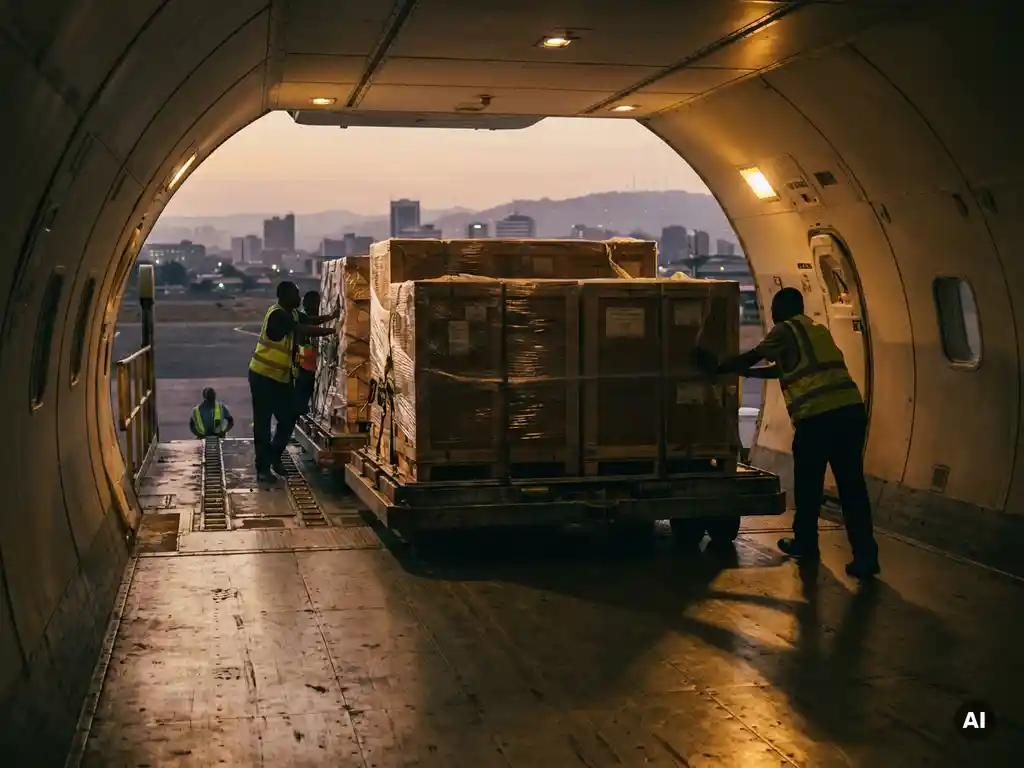
You can ship to landlocked African countries by air by routing cargo through the nearest international hub airport, then arranging onward ground transport to the final destination. For businesses shipping from Europe, this means selecting a freight forwarder with established inland networks and customs expertise at both the entry port and the destination country. The sections below cover routing, documentation, transit times, and the key decisions involved.
Which African countries are landlocked and how are they reached by air?
Africa has more landlocked countries than any other continent. Key destinations for European exporters include Uganda, Rwanda, Ethiopia, Zambia, Zimbabwe, Malawi, Burkina Faso, Mali, Niger, Chad, South Sudan, and the Central African Republic. Each is reached by air through a coastal or regionally dominant hub airport, with onward road transport completing the delivery.
The most commonly used hub airports for air freight to landlocked Africa include Nairobi (NBO) for East Africa, Addis Ababa (ADD) as a major continental hub, Dar es Salaam (DAR) for southern East Africa, and Accra (ACC) or Lagos (LOS) for West Africa. From these hubs, cargo moves inland by road to the final consignee. Destinations across Africa are typically served through one of these regional entry points, depending on geography and available transit infrastructure.
Ethiopia is a special case: Addis Ababa Bole International Airport is one of Africa’s busiest cargo hubs and serves as both a direct destination and a transit point for surrounding countries. For shipping to Uganda or shipping to Rwanda, Nairobi is the standard entry point, with road connections to Kampala and Kigali, respectively.
How does air freight actually reach a landlocked African country?
Air freight to a landlocked African country arrives at the nearest international gateway airport and is then cleared through customs before moving inland by road. The air leg handles the international distance; the final delivery depends on ground transport across one or more borders. This combined routing is standard practice for air cargo inland Africa.
The process typically follows this sequence:
- Cargo departs Europe on a direct or connecting flight to the regional hub airport.
- The shipment is unloaded and transferred to a bonded warehouse at the hub.
- Import or transit customs procedures are completed in the hub country.
- Cargo is loaded onto road transport and moves to the landlocked destination country.
- Import clearance is completed at the destination country’s border or inland customs post.
- Goods are delivered to the consignee’s premises.
For shipments on a DDP (Delivered Duty Paid) basis, the freight forwarder manages all steps, including customs duties and last-mile delivery. This is the most straightforward option for business importers who want cost certainty and no involvement in clearance procedures.
What customs and transit documentation is required for landlocked shipments?
Shipping air freight to a landlocked African country requires documentation for both the transit country and the destination country. At minimum, you will need a commercial invoice, packing list, airway bill (AWB), and a certificate of origin. Depending on the goods and the transit corridor, additional permits or transit declarations may apply.
For shipments transiting through East Africa via Kenya, a Regional Transit Bond is typically required. This guarantees customs duties in the transit country will not be evaded before the goods exit. The East African Community (EAC) has harmonised some procedures across Kenya, Uganda, Rwanda, and Tanzania, but each country still applies its own import requirements at the final destination.
Common documentation requirements include:
- Commercial invoice with accurate HS codes and declared value
- Packing list with gross and net weights per package
- Master and house airway bill
- Certificate of origin (often required for duty preference under trade agreements)
- Import permit or licence for controlled goods (pharmaceuticals, chemicals, food products)
- Transit bond or transit declaration for the hub country
- Pre-shipment inspection certificate where required by the destination country
Errors in documentation are among the most common causes of delays at African border crossings. Working with a freight forwarder who understands the specific requirements of each transit corridor significantly reduces this risk.
How long does air freight take to landlocked African destinations?
Air freight from Europe to a landlocked African country typically takes between 5 and 14 business days door to door, depending on the destination, customs clearance speed, and inland transit distance. The air leg itself is usually 1 to 3 days; the remainder is customs processing and road transport.
Transit times vary considerably by corridor:
- Shipping to Uganda via Nairobi: typically 7 to 10 business days from Europe
- Shipping to Rwanda via Nairobi: typically 8 to 12 business days from Europe
- Shipping to Ethiopia direct to Addis Ababa: often 4 to 7 business days, as no inland transit is required
- Landlocked West African destinations (e.g. Burkina Faso, Mali): 8 to 14 business days via Lagos or Accra
Customs clearance at the hub airport is frequently the variable that most affects total transit time. Congestion, incomplete documentation, or goods subject to inspection can add several days. Pre-clearance preparation and accurate documentation submission before the flight arrives are the most effective ways to keep transit times predictable.
What are the biggest challenges when shipping air freight inland in Africa?
The main challenges for air freight to landlocked Africa are customs clearance complexity, road infrastructure variability, border crossing delays, and local handling capacity at smaller inland destinations. These factors are manageable with the right logistics partner but can cause significant delays when handled without regional knowledge.
Specific challenges include:
- Multiple customs jurisdictions: A shipment to Uganda crosses Kenyan customs in Nairobi and Ugandan customs at the border. Each has its own procedures, fees, and inspection risks.
- Road conditions and distance: The Nairobi to Kampala corridor is well-established, but more remote landlocked destinations involve longer routes with less predictable road conditions.
- Local handling capacity: Smaller inland cities may have limited warehousing or handling infrastructure, which affects scheduling and last-mile delivery.
- Documentation errors: Incorrect HS codes, undervalued invoices, or missing permits are flagged at customs and can result in holds, fines, or seizure of goods.
- Currency and payment logistics: Duties and local fees in some countries must be paid in local currency, which adds a layer of coordination for the clearing agent on the ground.
Freight forwarders with established Africa logistics services and on-the-ground partner networks are better positioned to anticipate and resolve these issues before they affect delivery timelines.
Should you use air freight or sea freight for landlocked African countries?
For landlocked African countries, air freight is generally the better choice when shipment value is high, cargo is time-sensitive, or volumes are small. Sea freight becomes more cost-effective for large, heavy, or non-urgent cargo, but the total transit time is significantly longer once inland transport from the coast is included.
Sea freight to a landlocked destination requires the cargo to arrive at a coastal port, clear customs, and then travel overland, often several hundred kilometres. For a destination like Kampala, that means the port of Mombasa or Dar es Salaam plus a multi-day road journey. Total door-to-door transit by sea can easily reach 6 to 10 weeks from Europe.
Air freight compresses the international leg to days and, with a well-managed inland connection, can deliver to many landlocked capitals within two weeks. The higher freight cost is often justified by:
- Reduced inventory holding costs for the importer
- Lower risk of damage or theft over a shorter transit window
- Faster response to urgent commercial or operational needs
- Simpler insurance and liability management on high-value goods
For regular, high-volume shipments of lower-value goods, sea freight remains the standard. Many businesses use a combination: sea freight for bulk stock and air freight for urgent replenishment or high-value items.
How EAF supports air freight to landlocked African countries
We specialise in air freight from Europe to Africa, including regular shipments to landlocked destinations such as Uganda, Rwanda, and Ethiopia. Our approach combines direct airline relationships, established clearing agents at key hub airports, and on-the-ground partner networks for inland delivery.
For businesses shipping to landlocked destinations, we provide:
- DDP (Delivered Duty Paid) shipments to landlocked African countries, covering all customs duties, transit bonds, and last-mile delivery in a single service
- Full documentation preparation, including HS code review, certificate of origin, and permit coordination
- Routing advice for the most reliable hub and inland corridor based on your specific destination
- Regular freight consolidations on key Europe-to-East Africa routes, keeping costs competitive for smaller shipments
- Transparent communication throughout the shipment, from booking to final delivery confirmation
If you are a business looking to ship goods from Europe to a landlocked African country and want a freight partner who manages the full chain, contact us to discuss your requirements.
Ähnliche Artikel
- What's Included in an Air Freight Quote to Africa?
- What Is Air Charter and When Does It Make Sense for Shipping to Africa?
- What Are the Most Common Air Freight Export Mistakes?
- What Happens to Your Cargo Between Pickup and the Airport?
- What Is Air Freight Export and How Does It Work?
Dieser Inhalt wurde mithilfe von KI erstellt und kann Fehler enthalten.