
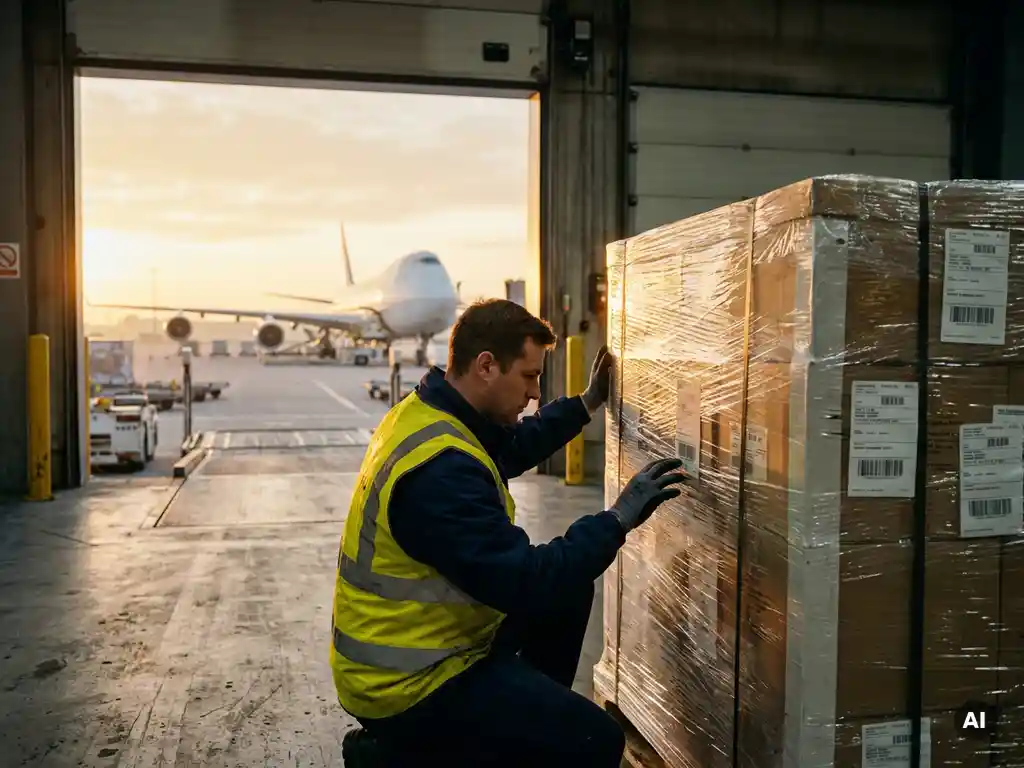
Ex Works (EXW) is an Incoterm under which the seller fulfills their entire obligation by making the goods available at their own premises. The buyer takes on all costs and risks from that point forward, including export clearance, loading, transport, customs, and final delivery. EXW places the maximum burden on the buyer and the minimum on the seller. The sections below break down exactly what that means in practice for businesses shipping goods from Europe to Africa.
Who is responsible for what under EXW?
Under EXW Incoterms 2020, the seller is responsible only for making the goods available at a named location, typically their factory or warehouse. The buyer is responsible for everything else: arranging collection, loading the goods onto the vehicle, handling export documentation, paying freight costs, clearing customs at both origin and destination, and managing all risks during transit.
This division of responsibility is more extreme than any other Incoterm. In practical terms, it means the buyer must either have a freight forwarder in the seller’s country or appoint one to act on their behalf. For a business based in Nigeria or Kenya buying goods from a European supplier, that means coordinating export procedures in a country where they may have no local presence and no customs registration.
- Seller’s obligations: Pack the goods, make them available at the agreed location, provide relevant documentation (commercial invoice, packing list).
- Buyer’s obligations: Load the goods, arrange inland transport to the port or airport, handle export customs clearance, pay all freight charges, manage import clearance at destination, arrange last-mile delivery.
One critical point: under EXW, the buyer is technically responsible for obtaining the export license and completing export formalities. In the EU, this creates a practical problem, because export declarations must typically be submitted by a party with an EU establishment. Buyers outside the EU often cannot do this themselves.
What are the risks of buying on EXW terms?
The main risk of buying on EXW terms is that the buyer assumes full liability for the goods from the moment they are available at the seller’s premises. If anything goes wrong during loading, inland transport, export clearance, or ocean or air transit, the financial and logistical consequences fall entirely on the buyer.
For B2B buyers importing into Africa, this creates several specific risks:
- Export clearance complications: The buyer must arrange EU export formalities without necessarily having a local EU entity. Errors here can lead to delays, fines, or shipments being held at the port or airport of departure.
- Loading damage: Risk transfers at the seller’s premises. Any damage that occurs during loading or initial transport is the buyer’s problem, not the seller’s.
- Cost unpredictability: Buyers who are unfamiliar with European freight markets may underestimate the total landed cost when accepting EXW terms. Fuel surcharges, handling fees, and compliance costs can add up quickly.
- Coordination complexity: Managing a freight chain across multiple countries and carriers requires experience and established relationships. Without a reliable freight forwarder in Europe, delays are common.
In short, EXW is a high-responsibility Incoterm. Buyers who accept it without the right logistics support take on significant operational and financial exposure.
How does EXW compare to FCA and other Incoterms?
EXW and FCA (Free Carrier) are often compared because both require the buyer to arrange most of the freight. The key difference is where responsibility transfers. Under FCA, the seller is responsible for delivering the goods to a named carrier or location and for completing export clearance. Under EXW, the seller does neither.
For international buyers, FCA is almost always preferable to EXW. It gives the buyer control over the main freight leg while keeping the seller responsible for the export formalities they are best placed to handle. This matters particularly for EU-origin shipments, where export declarations require an EU-established party.
Here is how EXW compares to other common Incoterms on the responsibility spectrum:
- EXW: Maximum buyer responsibility. The seller only makes the goods available at their premises.
- FCA: Seller handles export clearance and delivers to the first carrier. Buyer manages the rest.
- CPT / CIP: Seller pays for main carriage to destination. Risk transfers at the point of handover to the carrier.
- DAP: Seller delivers to destination, unloaded. Buyer handles import duties.
- DDP: Seller handles everything, including import duties and delivery to the final destination. Maximum responsibility on the seller.
For businesses receiving goods in Nigeria, Ghana, Kenya, or Tanzania, DDP shipments offer the clearest, most predictable outcome: the seller or their freight forwarder manages the entire chain, including customs at destination.
When should a buyer agree to EXW terms?
A buyer should agree to EXW terms only when they have a reliable, experienced freight forwarder already operating in the seller’s country who can handle export formalities and collection on their behalf. Without that, EXW creates more problems than it solves.
There are scenarios where EXW can make commercial sense:
- The buyer has significant purchasing volume and wants full control over freight costs and carrier selection.
- The buyer already has a trusted European logistics partner who can act as their local representative.
- The seller is unwilling or unable to manage export procedures and offers a lower price to reflect that limitation.
For most B2B buyers sourcing goods from Europe for delivery to Africa, EXW is not the most practical choice. The administrative burden and risk exposure are high, and the cost savings rarely outweigh the complexity. Negotiating FCA, CPT, or DDP terms is usually more efficient and reduces the risk of costly delays at origin.
What does EXW mean for air freight and sea freight shipments?
EXW applies to all modes of transport, but its practical implications differ depending on whether goods move by air or sea. For air freight to Africa, EXW means the buyer must arrange collection from the seller’s premises, inland transport to the departure airport, export customs clearance, and booking with an airline or air freight consolidator. All of this must happen before the goods even reach the aircraft.
For sea freight, the process is similar but involves additional port handling steps: booking a container or LCL space, coordinating with the terminal, and managing cut-off deadlines. Delays at any point before the vessel departs fall entirely on the buyer under EXW terms.
In both cases, the practical challenge is the same: the buyer needs a competent freight forwarder in the country of origin. For shipments originating in Europe and destined for markets like Nigeria, Ghana, Kenya, or Tanzania, that means having a partner who understands European export regulations, can handle customs documentation correctly, and has established relationships with carriers on the relevant trade lanes.
Without that, EXW shipments by air or sea carry a high risk of missing departures, incurring demurrage charges, or failing export compliance checks.
How EAF supports buyers navigating complex Incoterm arrangements
We work with B2B buyers and sellers across the Europe-to-Africa trade lane and regularly handle shipments under a range of Incoterms, including EXW, FCA, and DDP. If your supplier insists on EXW terms, we can step in as your European-based freight forwarder and manage the entire export side on your behalf.
Here is what we handle:
- Collection from the seller’s premises anywhere in Europe
- Export customs clearance in the EU
- Air freight consolidation and booking to Nigeria, Ghana, Kenya, Tanzania, and other African destinations
- Import clearance and DDP delivery at destination, where required
- Direct communication throughout the shipment, with a single point of contact
If you are evaluating Incoterm options for an upcoming shipment or want to understand what a DDP arrangement from Europe to Africa would look like for your business, get in touch with us for a direct conversation with our team.
Ähnliche Artikel
- How Do You Choose an Air Freight Forwarder for Shipping to Africa?
- What's Included in an Air Freight Quote to Africa?
- How Does Insurance Work for Air Freight Shipments to Africa?
- How Is Air Freight Cost Calculated?
- How Long Does Air Freight from Europe to Africa Take?
Dieser Inhalt wurde mithilfe von KI erstellt und kann Fehler enthalten.