
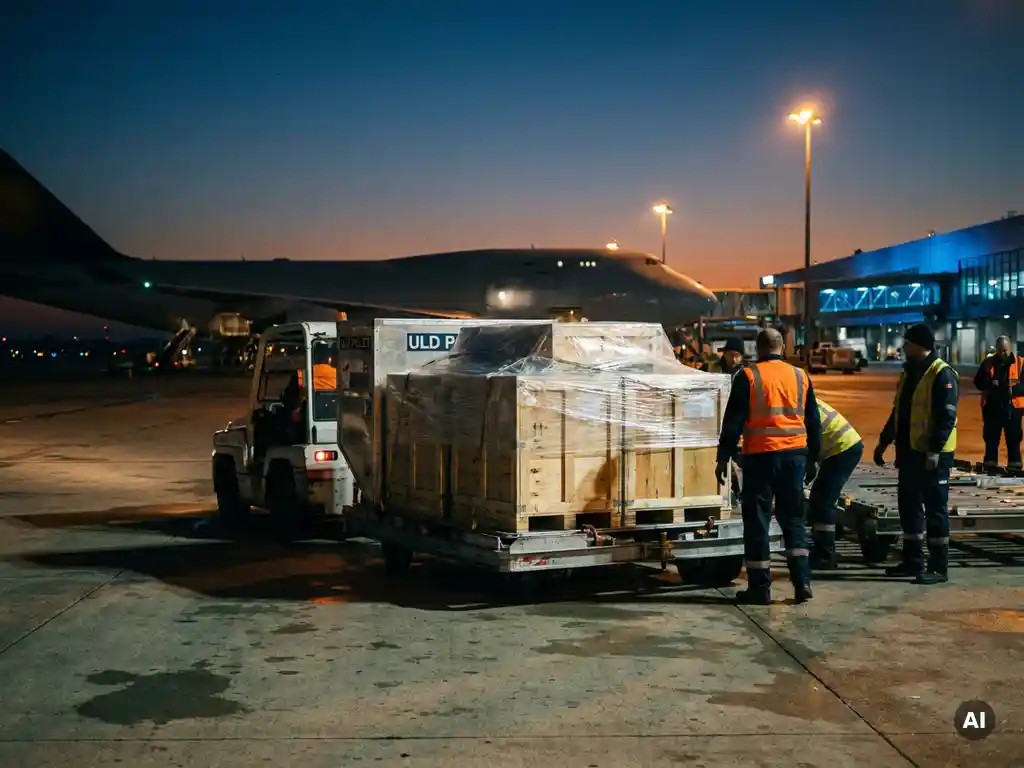
An air freight quote to Africa typically includes the base freight rate, fuel and security surcharges, and handling fees at origin. Whether destination charges, customs clearance, and last-mile delivery are included depends entirely on the service scope agreed with your freight forwarder. Understanding what each line item covers helps businesses budget accurately and avoid unexpected costs on arrival.
The breakdown below answers the most common questions businesses ask when evaluating air freight pricing for shipments from Europe to Africa.
What cost components make up an air freight quote?
An air freight quote to Africa is made up of several distinct cost components. At minimum, a quote will include the base freight rate (charged per kilogram or per chargeable weight unit), a fuel surcharge, a security surcharge, and origin handling fees. Depending on the service scope, it may also include destination handling, customs clearance, and final delivery.
Breaking it down by category makes it easier to compare quotes side by side:
- Base freight rate: The core charge for transporting the shipment from the origin airport to the destination airport, calculated on chargeable weight
- Fuel surcharge (FSC): A variable surcharge tied to aviation fuel prices, adjusted regularly by airlines
- Security surcharge (SSC): A fixed or semi-fixed charge covering screening and security compliance
- Origin handling (OHC): Fees for accepting, weighing, and processing the shipment at the departure station
- Destination handling (DHC): Charges levied at the arrival airport for offloading and documentation
- Customs clearance: Fees for filing import declarations on behalf of the consignee
- Delivery to door: Last-mile transport from the destination airport to the final address
Not every quote includes all of these items. Some forwarders quote airport-to-airport only, while others offer comprehensive door-to-door services that bundle most or all of these costs into a single price.
How is chargeable weight calculated for air freight to Africa?
Chargeable weight in air freight is the higher of the actual gross weight and the volumetric weight of the shipment. Volumetric weight is calculated by multiplying the length, width, and height of the shipment in centimetres and dividing by 6,000. Whichever figure is higher becomes the basis for the freight rate.
For example, a lightweight but bulky shipment of industrial equipment packaging may have an actual weight of 80 kg but a volumetric weight of 140 kg. In that case, the freight rate would be charged on 140 kg. This is particularly relevant for shipments to destinations like Lagos, Nairobi, or Accra, where oversized or awkwardly packed goods are common.
Shippers can reduce costs by optimising packaging to minimise unnecessary volume without compromising protection. Working with a freight forwarder who reviews packing dimensions before booking can make a meaningful difference to the final invoice.
What surcharges are typically added to an air freight quote?
Beyond the base freight rate, several surcharges are standard on air freight quotes to Africa. The most common are the fuel surcharge (FSC) and security surcharge (SSC), which apply on virtually every shipment. Additional surcharges depend on the nature of the cargo, the route, and the time of year.
Common surcharges to expect include:
- Fuel surcharge (FSC): Fluctuates with jet fuel prices and is typically expressed as a rate per kilogram
- Security surcharge (SSC): Covers screening requirements and is usually a fixed rate per kilogram
- Dangerous goods surcharge: Applied when cargo requires special handling under IATA regulations (excluding Class 7 radioactive materials)
- Oversized cargo surcharge: Triggered when individual pieces exceed standard dimension limits
- Congestion surcharge: Occasionally applied on busy routes or during peak shipping periods
- Remote area surcharge: Relevant for final delivery to locations beyond major hubs like Nairobi, Lagos, or Dar es Salaam
Surcharges are not always listed as separate line items. Some forwarders bundle them into an all-in rate. When comparing quotes, always ask whether the rate is all-in or excludes variable surcharges.
What does door-to-door versus airport-to-airport mean in a quote?
Airport-to-airport means the freight forwarder is responsible for the shipment only between the departure airport and the arrival airport. The shipper arranges collection at origin, and the consignee arranges customs clearance and delivery at destination. Door-to-door means the forwarder manages the entire journey, from collection at the shipper’s premises in Europe to delivery at the consignee’s address in Africa.
For shipments to West or East Africa, door-to-door is often the more practical option for B2B shippers. Customs clearance at airports like Lagos Murtala Muhammed, Kotoka International in Accra, or Jomo Kenyatta in Nairobi requires local knowledge, established relationships with customs authorities, and the ability to manage documentation in real time. Without a local partner, delays at the airport can accumulate quickly.
A delivered duty paid (DDP) arrangement goes one step further: the exporter takes full responsibility for all costs and risks up to the point of delivery, including import duties and taxes. This gives the buyer in Africa complete cost certainty and removes the administrative burden of dealing with customs entirely. For businesses shipping regularly to Nigeria, Ghana, Kenya, or Tanzania, DDP is increasingly the preferred commercial arrangement.
Are customs duties and import taxes included in an air freight quote?
Customs duties and import taxes are not included in a standard air freight quote unless the shipment is booked on DDP (Delivered Duty Paid) terms. Under standard terms such as CPT or CIP, the consignee in the destination country is responsible for paying import duties, VAT, and any applicable levies. The freight quote covers transport and handling only.
Import duty rates in African countries vary significantly by commodity type, country of destination, and declared value. Nigeria, for example, applies tariff rates that differ by product category under the ECOWAS Common External Tariff. Kenya applies duties under the East African Community (EAC) framework. These charges can be substantial and should always be factored into the total landed cost calculation before shipping.
When a forwarder quotes DDP, the freight quote includes an estimated or pre-calculated amount for duties and taxes. This requires the forwarder to have strong local customs expertise and established relationships in the destination country. It is the most transparent pricing structure for the buyer and eliminates the risk of unexpected charges on arrival.
How can shippers compare air freight quotes accurately?
To compare air freight quotes to Africa accurately, shippers need to ensure every quote is based on the same scope of service, the same chargeable weight, and the same incoterm. A low headline rate that excludes destination handling, customs clearance, and delivery will almost always cost more in total than a higher all-in or DDP quote.
A structured comparison should include:
- Confirm the service scope: Is the quote airport-to-airport, door-to-airport, or door-to-door? Does it include customs clearance at destination?
- Verify the weight basis: Is the rate based on gross weight or chargeable weight? Have dimensions been accounted for?
- Check which surcharges are included: Ask specifically whether FSC and SSC are included or added separately
- Clarify the incoterm: EXW, DAP, and DDP quotes are not comparable without adjustment
- Ask about destination charges: DHC, customs brokerage fees, and local delivery are often quoted separately or not quoted at all
- Check transit time and routing: A cheaper rate via an indirect routing may result in longer transit and higher risk of delay
For regular shipments to the same destination, requesting a rate sheet that separates fixed and variable components makes ongoing cost tracking far more reliable than comparing individual spot quotes.
How EAF handles air freight quotes to Africa
We provide transparent, itemised air freight quotes for shipments from Europe to Africa, covering destinations including Nigeria, Ghana, Kenya, Tanzania, Uganda, and Rwanda. Rather than quoting a headline rate that leaves gaps in the cost picture, we build quotes that reflect the full scope of what your shipment requires.
What we offer as part of our quoting and service process:
- All-in and DDP pricing options, so you know the total landed cost before committing
- Chargeable weight calculation based on your actual cargo dimensions and weight
- Clear surcharge breakdown, including fuel and security charges
- Customs clearance at destination, handled by our local partners with established relationships at African airports
- Door-to-door delivery to business addresses across West and East Africa
- Guidance on commodity-specific import duty requirements for your destination country
We work exclusively with businesses and require a valid customs number for all shipments. If you are planning a shipment from Europe to Africa and want a quote that covers the full picture, contact our team directly. You can also review our Africa destinations and services to understand what is available for your specific route.
Ähnliche Artikel
- What Are the Most Common Air Freight Export Mistakes?
- What Happens to Your Cargo Between Pickup and the Airport?
- How Does Insurance Work for Air Freight Shipments to Africa?
- How Does Air Freight from Europe to South Africa Work?
- Air Freight to Kenya: How Shipments Reach Nairobi
Dieser Inhalt wurde mithilfe von KI erstellt und kann Fehler enthalten.