
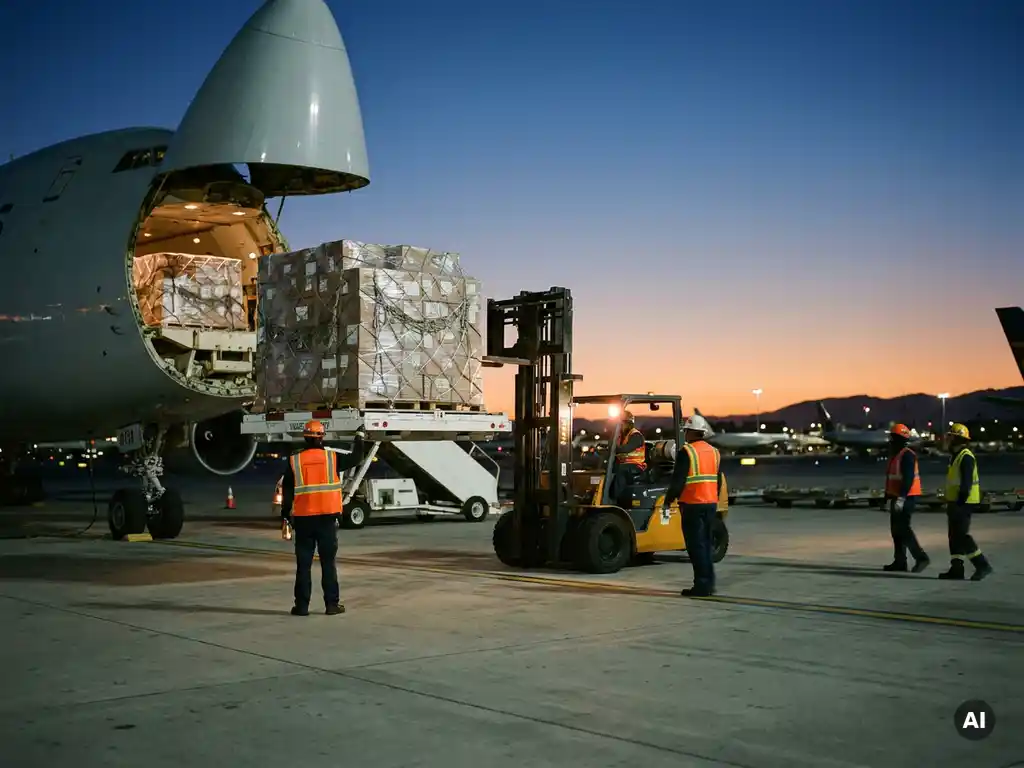
Air freight from Europe to South Africa follows a standard international air cargo process: goods are collected from the shipper in Europe, consolidated or shipped as direct cargo, flown to a major South African airport (typically Johannesburg O.R. Tambo or Cape Town), cleared through customs, and delivered to the consignee. For B2B shipments, the process involves export documentation in Europe, an air waybill issued by the freight forwarder, and import clearance in South Africa handled either by the consignee or the forwarder. The sections below cover transit times, costs, documentation, customs, restrictions, and when air freight makes commercial sense over sea freight.
How long does air freight from Europe to South Africa take?
Air freight from Europe to South Africa typically takes 3 to 7 business days from collection to delivery. Direct or express air cargo services can reach Johannesburg in as little as 2 to 3 days. Consolidated (groupage) shipments, where cargo is grouped with other freight to fill a unit load device, generally take 5 to 7 business days depending on frequency and routing.
Transit time is influenced by several factors. Flight frequency on the Europe-to-South Africa corridor is strong, with multiple carriers operating daily services via hubs such as Amsterdam, Frankfurt, Doha, and Dubai. However, the total door-to-door time also includes customs clearance at the destination, which can add 1 to 3 days depending on the completeness of documentation and the nature of the goods. Shipments requiring import permits or physical inspection will take longer.
For time-critical cargo, a direct air freight service with pre-lodged customs documents is the fastest option. Working with an experienced freight forwarder who understands South African customs procedures can significantly reduce delays at the clearance stage.
What does air freight from Europe to South Africa cost?
Air freight rates from Europe to South Africa are calculated on a chargeable weight basis, using whichever is greater between actual weight and volumetric weight (length x width x height in cm divided by 6,000). Rates vary based on shipment size, urgency, routing, and current market conditions, but businesses should budget for both the freight charge and destination-side costs including customs duties, VAT, and handling fees.
The total landed cost of an air shipment to South Africa includes several components:
- Freight rate (per kg, based on chargeable weight)
- Fuel and security surcharges (applied by airlines and reviewed regularly)
- Origin charges (handling, documentation, export customs)
- Destination charges (airport handling, customs clearance, delivery)
- Import duties and VAT in South Africa, calculated on the CIF value of goods
For businesses shipping on DDP (Delivered Duty Paid) terms, the forwarder covers all costs including duties and last-mile delivery, giving the consignee a single, predictable total. This is particularly useful for businesses that want to simplify their supply chain and avoid unexpected charges at destination.
What documents are required for air freight to South Africa?
Air freight to South Africa requires a standard set of export and import documents. The core documents are the Air Waybill (AWB), a commercial invoice, a packing list, and an export customs declaration from the origin country. South African customs also requires a Bill of Entry (SAD500) lodged by a licensed clearing agent at destination.
Depending on the nature of the goods, additional documentation may be required:
- Certificate of Origin (for goods claiming preferential tariff treatment under trade agreements)
- Import permit (for controlled goods such as pharmaceuticals, food products, or certain chemicals)
- Dangerous goods declaration (for any cargo classified under IATA DGR categories)
- Phytosanitary or health certificate (for agricultural products or items subject to biosecurity controls)
All documents must be accurate and consistent with each other. Discrepancies between the invoice value, the AWB, and the packing list are a common cause of customs delays. The commercial invoice must state the correct HS (Harmonised System) tariff code, country of origin, and full description of goods. South African customs cross-references these details when assessing duties.
How does customs clearance work at South African airports?
Customs clearance for air freight into South Africa is managed by the South African Revenue Service (SARS) through its Customs and Excise division. All commercial shipments must be declared using a Bill of Entry (SAD500), lodged by a SARS-registered clearing agent. The consignee must hold a valid customs client number to receive commercial goods.
The clearance process follows these main steps:
- The freight arrives at the airport and is received by the ground handling agent.
- The clearing agent lodges the Bill of Entry electronically via the SARS eFiling or EDI system.
- SARS assesses the entry and either releases it (green channel), requests supporting documents (orange channel), or flags it for physical inspection (red channel).
- Once duties and VAT are paid or guaranteed, the shipment is released for delivery.
Johannesburg O.R. Tambo International Airport handles the majority of air cargo into South Africa and has established procedures for most cargo types. Cape Town International Airport is the secondary hub. Pre-lodgement of documents before the aircraft lands can accelerate release significantly, particularly for routine commercial shipments.
What goods can and cannot be shipped by air to South Africa?
Most commercial goods can be shipped by air to South Africa, provided they comply with IATA regulations, South African import controls, and any applicable licensing requirements. Prohibited or restricted items include narcotics, counterfeit goods, certain weapons, and specific agricultural products. Dangerous goods classified under IATA DGR can be shipped but require full compliance with packaging, labelling, and documentation rules.
Goods that commonly require special handling or permits include:
- Pharmaceuticals and medical devices (subject to SAHPRA registration)
- Food and agricultural products (subject to DAFF inspection and phytosanitary controls)
- Chemicals and hazardous materials (must comply with IATA DGR; Class 7 radioactive materials are excluded from standard air freight)
- Electronics and communications equipment (may require ICASA type approval)
- Used goods and second-hand equipment (may attract higher scrutiny and specific import conditions)
Before shipping, it is advisable to confirm the HS code for your goods and check whether an import permit is required under South Africa’s Import Control Regulations. A freight forwarder with experience in freight to Africa can identify permit requirements early and prevent shipments from being held at the border.
When should you choose air freight over sea freight for South Africa?
Air freight is the right choice when speed, security, or the nature of the cargo outweighs the cost difference versus sea freight. For South Africa, sea freight from Europe takes roughly 20 to 30 days, while air freight delivers in under a week. The decision depends on the value of the goods, the urgency of delivery, and the cost of delays in the supply chain.
Air freight is typically the better option in these situations:
- High-value goods where the carrying cost of capital in transit justifies the higher freight rate
- Time-sensitive shipments such as production parts, spare components, or goods tied to contractual deadlines
- Perishable or temperature-sensitive cargo where sea transit is too long
- Small to medium shipments where the volume does not justify a sea freight booking
- Emergency replenishment to cover a stockout or production stoppage
Sea freight remains cost-effective for large, non-urgent consignments of bulk goods. However, for businesses shipping machinery parts, technical equipment, or goods with a short order-to-delivery window, air freight to South Africa offers predictability and speed that sea freight cannot match.
How EAF supports your air freight shipments to South Africa
We have been handling air freight from Europe to Africa for over 30 years, and South Africa is a well-established destination in our network. Our air freight services are built around the specific requirements of B2B exporters who need reliable, compliant delivery to South African businesses.
When you work with us, we handle the complexity so your team does not have to:
- Export customs clearance and documentation preparation in Europe
- Booking and consolidation on established Europe-to-South Africa air routes
- Coordination with licensed clearing agents at Johannesburg or Cape Town
- DDP (Delivered Duty Paid) delivery, covering duties, VAT, and last-mile logistics
- Permit and compliance checks before shipment to avoid clearance delays
Whether you are shipping a single urgent consignment or managing regular cargo flows to South Africa, we provide straightforward, experienced support at every stage. Contact us to discuss your shipment requirements and receive a freight quote.
Ähnliche Artikel
- How Do You Label and Mark Cargo for Export by Air?
- How Do You Ship Oversized or Heavy Cargo to Africa by Air?
- What Are the Most Common Air Freight Export Mistakes?
- Air Freight to Kenya: How Shipments Reach Nairobi
- How Is Air Freight Cost Calculated?
Dieser Inhalt wurde mithilfe von KI erstellt und kann Fehler enthalten.