
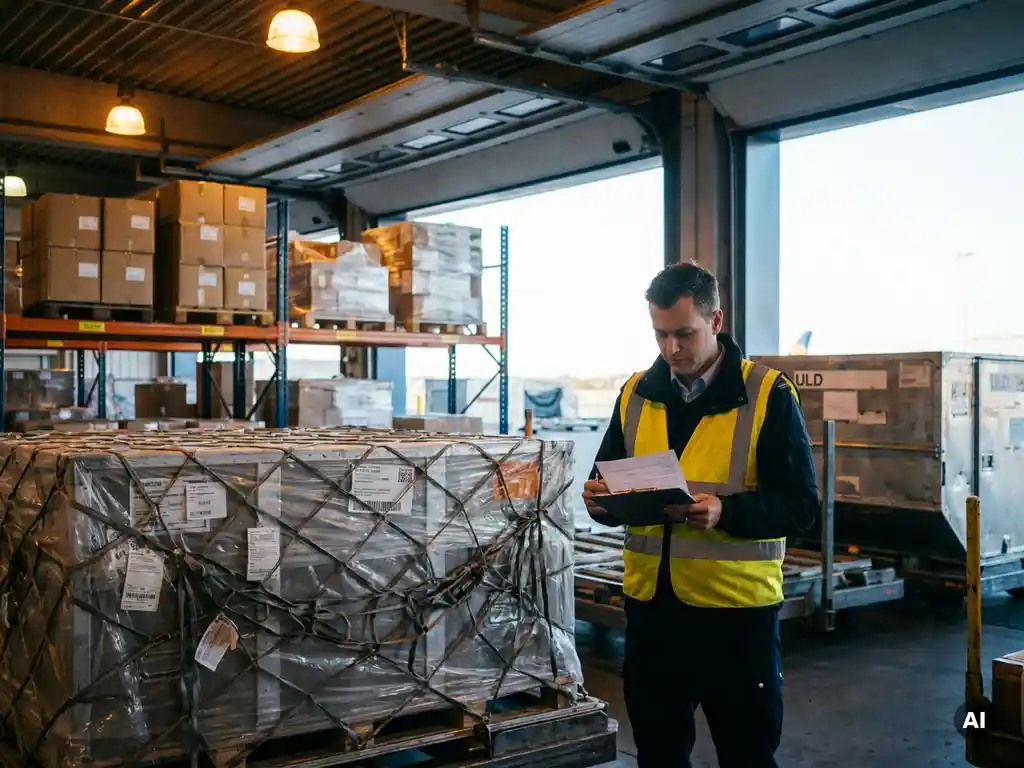
Customs clearance for air freight exports to Africa requires the exporter to submit a set of standard trade documents, pay applicable import duties and taxes at the destination, and have those documents verified by the destination country’s customs authority before the goods are released. The process applies to all commercial shipments and is handled either by the exporter’s freight forwarder or a licensed customs broker at the destination. The sections below break down each stage of the process, from document requirements to common delays and regional differences.
What documents are required for air freight exports to Africa?
Every air freight export to Africa requires a core set of trade documents: a commercial invoice, a packing list, an airway bill (AWB), and a certificate of origin. Depending on the destination country and the nature of the goods, additional permits, conformity certificates, or import licenses may also be required before customs will release the shipment.
The commercial invoice is the most critical document. It must state the full description of the goods, the HS tariff code, the declared value in the transaction currency, the buyer and seller details, and the Incoterms. Customs authorities use this document to calculate duties and verify the legitimacy of the shipment.
Beyond the core set, specific destinations impose their own requirements:
- Nigeria: Importers must obtain a Form M and, for regulated product categories, a SON or NAFDAC certification before shipment.
- Ghana: A Ghana Standards Authority (GSA) permit is required for many product categories. Importers must also have a valid Tax Identification Number.
- Kenya: Certain goods require a Kenya Bureau of Standards (KEBS) pre-export verification of conformity (PVoC) certificate issued before the goods leave Europe.
- Tanzania: The Tanzania Bureau of Standards (TBS) runs a similar pre-export verification scheme for regulated products.
Missing or incorrectly completed documents are the single most common cause of customs delays. Every field on the commercial invoice must match the packing list and the AWB exactly.
How does the customs clearance process work step by step?
The air freight customs clearance process in Africa follows a standard sequence: the shipment arrives at the destination airport, the importer or their broker lodges a customs declaration, customs authorities review and verify the documents, duties and taxes are assessed and paid, and the goods are physically released. The entire process can take anywhere from one day to several weeks depending on the country and the completeness of the documentation.
The typical sequence looks like this:
- Pre-arrival preparation: The importer or customs broker prepares the import declaration and gathers all required documents before or immediately after the flight departs.
- Arrival and lodgement: Once the aircraft lands, the airline or ground handling agent notifies the consignee. The customs declaration is lodged electronically through the destination country’s customs management system.
- Document verification: Customs officers review the declaration against the submitted documents. Some shipments are cleared on the basis of documents alone; others are selected for physical examination.
- Duty assessment: Customs calculates the applicable import duties, VAT, and any other levies based on the declared HS code and customs value.
- Payment: The importer or their broker pays the assessed duties. In most African countries, payment must be made before the goods are released.
- Release: Once payment is confirmed, customs issues a release order and the goods can be collected from the airport cargo terminal.
For businesses shipping under DDP (Delivered Duty Paid) terms, the exporter or their freight forwarder takes responsibility for the entire process, including duty payment, on behalf of the importer. This simplifies the process considerably for the receiving business and reduces the risk of delays caused by an unprepared importer at the destination.
What duties and taxes apply to air freight imports in Africa?
Import duties and taxes on air freight arriving in Africa vary by country and product type, but most shipments are subject to at least three charges: an import duty (calculated as a percentage of the customs value), VAT, and one or more additional levies such as an excise duty, import levy, or port surcharge. The total tax burden on a shipment can range from under 10% to over 50% of the goods’ value, depending on the HS code and destination.
African countries that are members of regional trade blocs apply a common external tariff to goods arriving from outside the bloc. For example, the Economic Community of West African States (ECOWAS) applies a common external tariff with rates of 0%, 5%, 10%, 20%, or 35% depending on the product category. The East African Community (EAC), which includes Kenya, Tanzania, and Uganda, operates a similar structure.
In addition to the standard tariff, importers in Nigeria pay a VAT of 7.5%, while Kenya charges 16% VAT. Ghana applies a combination of import duty, VAT, and a special levy that together can represent a substantial share of the shipment value. Exporters quoting prices to African buyers should factor these costs into their commercial terms or clearly agree on who bears the duty liability.
Why do air freight shipments get held at African customs?
Air freight shipments are most commonly held at African customs because of incomplete or inconsistent documentation, missing import permits or pre-shipment certifications, undervalued or misdescribed goods, or unpaid duties. In some cases, shipments are held because the importer does not have a valid customs registration or tax identification number on file with the relevant authority.
The most avoidable causes of delays include:
- Discrepancies between the commercial invoice, packing list, and AWB (different weights, quantities, or descriptions)
- Incorrect or missing HS tariff codes on the commercial invoice
- Missing pre-export certificates required by the destination country (such as PVoC for Kenya or Form M for Nigeria)
- Goods declared at a value that customs considers suspiciously low, triggering a valuation dispute
- No licensed customs broker appointed at the destination
Storage charges at African airport cargo terminals accumulate quickly. A shipment held for five to ten days while documentation issues are resolved can generate storage and demurrage costs that rival the value of the goods themselves. Preparing documents thoroughly before the shipment departs Europe is the most effective way to avoid this.
What’s the difference between customs clearance in East Africa versus West Africa?
The key difference between customs clearance in East Africa and West Africa is the regulatory framework and the pre-shipment requirements. East African countries such as Kenya and Tanzania operate under the EAC common external tariff and use pre-export verification of conformity schemes that require certain certifications to be obtained in Europe before the goods ship. West African countries, particularly Nigeria and Ghana, rely more heavily on import licensing and destination inspection processes.
East Africa: Kenya and Tanzania
Kenya and Tanzania both require pre-export verification for regulated product categories. For Kenya, this means obtaining a KEBS PVoC certificate from an accredited inspection body in Europe before the goods leave. Tanzania operates a similar scheme through TBS. These certifications confirm that the goods meet the destination country’s standards before they arrive, which can actually speed up clearance once the shipment lands. The EAC customs management system is relatively well-integrated, and Nairobi’s Jomo Kenyatta International Airport has an established air cargo handling infrastructure.
West Africa: Nigeria and Ghana
Nigeria requires importers to obtain a Form M from a Nigerian bank before the goods are shipped. This is a foreign exchange control mechanism as much as a customs tool, and shipments arriving without a valid Form M face serious complications at the port or airport. Ghana’s customs process is managed through the Ghana Integrated Customs Management System (ICUMS), and importers must ensure their tax registration is current. Both countries carry out destination inspection for many product categories, which adds time to the clearance process compared to a pre-shipment verification model.
For exporters shipping regularly to both regions, the practical implication is that air freight to Africa requires destination-specific preparation rather than a single standard approach.
When should you use a customs broker for African air freight exports?
A customs broker should be used for any commercial air freight export to Africa where the importer does not have in-house customs expertise at the destination. In practice, this means most B2B shipments benefit from professional customs representation, particularly for first-time shipments to a new destination, high-value or regulated goods, and any shipment subject to pre-shipment certification requirements.
Customs brokers at the destination provide licensed representation before the customs authority, manage the declaration process, calculate and arrange duty payment, and handle any queries or examinations that arise. For exporters shipping under DDP terms, the freight forwarder typically coordinates the customs broker as part of the end-to-end service.
Using a broker is especially important when:
- The goods fall under a regulated product category requiring a permit or certification
- The shipment involves multiple product lines with different HS codes
- The importer is a new entity without an established customs account at the destination
- The shipment is time-sensitive and delays caused by documentation errors are not acceptable
For ongoing air freight services to Africa, working with a forwarder that has established broker relationships at the destination is more efficient than appointing a broker separately for each shipment.
How EAF handles customs clearance for air freight exports to Africa
We manage the full customs clearance process for air freight exports from Europe to Africa, including destinations in Nigeria, Ghana, Kenya, and Tanzania. Our approach is built around DDP delivery: we take responsibility for duties, taxes, and last-mile delivery on behalf of our clients, so the receiving business does not need to navigate the destination country’s customs authority independently.
What we provide in practice:
- Pre-shipment document review to identify missing permits, incorrect HS codes, or valuation issues before the goods leave Europe
- Coordination of pre-export certifications such as KEBS PVoC for Kenya-bound shipments
- Licensed customs broker representation at the destination airport
- Duty calculation and payment under DDP terms
- Direct communication with our established partner network in Lagos, Accra, Nairobi, and Dar es Salaam
If your business ships goods from Europe to Africa and you need a freight partner that handles the customs complexity end to end, get in touch with us to discuss your requirements.
Ähnliche Artikel
- What Are Pallets and ULDs in Air Freight?
- How do you get a Form M number for air freight to Nigeria?
- How Does Insurance Work for Air Freight Shipments to Africa?
- How Does Air Freight from Europe to Nigeria Work?
- What Goods Can and Can't Be Shipped to Africa by Air?
Dieser Inhalt wurde mithilfe von KI erstellt und kann Fehler enthalten.