
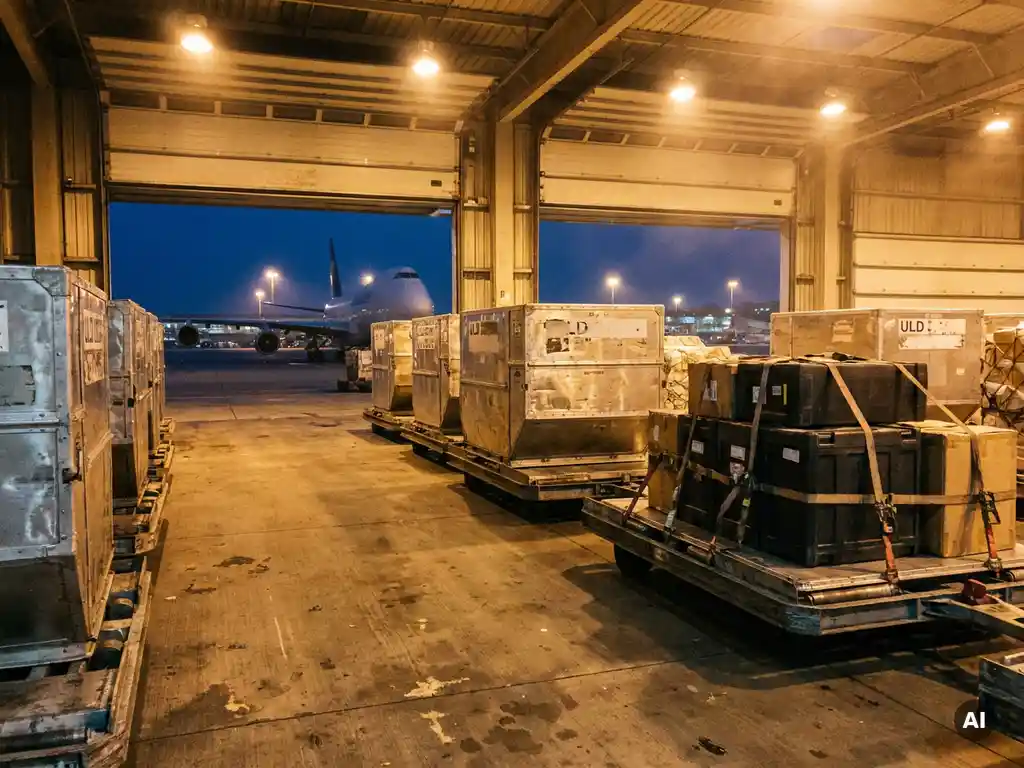
In air freight, a pallet is a flat, rigid loading platform used to stack and secure cargo, while a ULD (Unit Load Device) is the broader category that includes both pallets and enclosed containers designed to fit the specific contours of an aircraft fuselage. The distinction matters because ULD type directly affects how cargo is loaded, how it is priced, and what can actually be shipped. The sections below answer the most common questions shippers have about pallets and ULDs when moving goods by air.
What is the difference between a pallet and a ULD in air freight?
A ULD is any standardized unit used to consolidate air cargo for loading onto an aircraft. Pallets are one type of ULD. The other main type is the air freight container, which encloses cargo on all sides. Both are engineered to interlock with aircraft floor systems and meet strict weight and dimension specifications set by IATA.
Air cargo pallets are flat aluminum sheets with a net system that holds freight in place. They offer maximum flexibility for oversized or irregularly shaped goods because cargo can be built up freely before the net is secured. Containers, by contrast, have rigid walls and a door, making them better suited for loose cartons, temperature-sensitive goods, or shipments that need physical protection during transit.
The term “ULD” is therefore not a synonym for a pallet. It is the umbrella term. When a freight forwarder or airline quotes a rate on a ULD basis, they are specifying the loading unit type, which could be a pallet, a container, or a combination of both depending on the aircraft type and cargo characteristics.
What are the main types of ULDs used in air cargo?
The main ULD types in air freight are classified by their IATA designator codes, which define their dimensions, maximum gross weight, and compatible aircraft. The most common types encountered in commercial air cargo are:
- LD3 container: A half-width container that fits the lower deck of wide-body aircraft such as the Boeing 777 or Airbus A330. It is the most widely used ULD type in international air freight.
- LD7 pallet: A full-width main-deck pallet used on wide-body freighters. It accommodates large, heavy shipments and is common on dedicated cargo aircraft.
- PMC pallet (96 x 125 inches): A large main-deck pallet used on freighters and some wide-body passenger aircraft. It offers significant volume and is frequently used for industrial or project cargo.
- AKE container (LD3 equivalent): One of the most common lower-deck containers, used extensively on passenger aircraft operating long-haul routes.
- PIP / PAG pallets: Smaller or standard pallets used on narrow-body aircraft where lower-deck container loading is not possible.
For shipments moving from Europe to destinations such as Nigeria, Ghana, Kenya, or Tanzania, the aircraft type on the route determines which ULD types are available. Long-haul routes to West and East Africa are typically served by wide-body aircraft, meaning LD3 containers and PMC pallets are the standard loading units.
How does ULD type affect air freight costs?
ULD type affects air freight costs primarily through the rate structure applied by the airline. Airlines offer ULD rates as a flat charge per unit, which can be more economical than paying per kilogram once a shipment reaches sufficient volume or weight. Choosing the right ULD type is therefore a direct cost lever for businesses shipping goods by air.
The key pricing factors linked to ULD type include:
- Minimum weight commitment: Each ULD type has a pivot weight, the minimum chargeable weight at which the flat ULD rate applies. Shipments below that weight are charged per kilogram instead.
- Volumetric versus actual weight: Air freight is charged on whichever is higher, actual weight or volumetric weight. ULD type influences how efficiently cargo fills the unit, which affects the volumetric calculation.
- Build-up and handling fees: Pallets require manual build-up and netting at the origin warehouse. Some carriers pass these handling costs on to the shipper, and the cost varies by ULD size.
- Aircraft compatibility: If the required ULD type is not available on a specific routing, cargo may need to be broken down and re-consolidated, adding cost and transit time.
For air freight services to Africa, a freight forwarder with route-specific knowledge can advise whether a ULD rate or a per-kilogram rate is more cost-effective for a given shipment size and destination.
Who owns and manages ULDs — the airline or the shipper?
ULDs are almost always owned and managed by the airline, not the shipper. Airlines maintain their own ULD fleets and lease additional units through specialist ULD management companies. Shippers and freight forwarders use ULDs temporarily as part of the cargo booking, but they do not purchase or own them.
When cargo is handed over to the airline or its ground handling agent, it is loaded into airline-owned ULDs. The shipper’s responsibility is to present cargo in a condition that can be safely loaded, not to provide the loading unit itself. If cargo arrives at the freight terminal already palletized on a shipper-owned pallet, it will typically be transferred onto an IATA-compliant airline ULD before loading.
One important operational point: ULDs are tracked assets. Airlines monitor their ULD inventory closely, and delays in returning units can result in detention charges. This is handled between the airline and the freight forwarder, not directly by the shipper, but it is a factor that affects turnaround time at destination.
What cargo cannot be loaded into standard ULDs?
Certain cargo types cannot be loaded into standard ULDs due to size, safety regulations, or physical incompatibility. Oversized freight that exceeds ULD dimensions, live animals, and specific dangerous goods categories all require alternative handling arrangements outside of standard unit load devices.
The main categories of cargo that cannot use standard ULDs include:
- Oversized or out-of-gauge cargo: Items that exceed the maximum dimensions of available ULD types must be shipped as bulk cargo in the aircraft hold or on a freighter main deck with special restraints.
- Live animals: Live animal shipments require specific ventilated containers and dedicated handling procedures that differ from standard ULD protocols.
- Certain dangerous goods: Some hazardous materials (DGR cargo) are restricted from loading in passenger aircraft holds regardless of ULD type, and others require specific segregation that standard ULDs cannot provide. Note that Class 7 radioactive materials are excluded from air freight entirely under most carrier policies.
- Heavy machinery and project cargo: Single pieces that exceed ULD weight limits must be distributed across multiple units or shipped as heavy freight with structural reinforcement.
- Human remains: These require dedicated handling under specific regulatory frameworks and are not loaded in standard ULDs.
For businesses shipping goods to destinations across Africa, it is worth confirming with your freight forwarder early whether your cargo type has any ULD restrictions, particularly for project cargo, industrial equipment, or goods with hazardous properties.
How EAF handles ULD planning for shipments to Africa
Choosing the right loading unit is not a detail. It directly affects cost, transit time, and whether cargo arrives at destination in the condition it left Europe. We handle ULD selection and load planning as part of the overall shipment coordination, so our clients do not need to navigate airline specifications themselves.
- We assess each shipment’s dimensions, weight, and cargo type to determine the optimal ULD configuration for the routing.
- We consolidate smaller shipments into shared ULDs where appropriate, reducing per-unit costs for businesses that ship regularly to Nigeria, Ghana, Kenya, Tanzania, and other African markets.
- We manage documentation, dangerous goods declarations, and airline coordination so that cargo meets all loading requirements at origin.
- For DDP shipments, we coordinate the full chain from loading in Europe through customs clearance and last-mile delivery at destination, so the ULD question is one part of a fully managed process.
If you are planning an air freight shipment from Europe to Africa and want to understand the right approach for your cargo, contact us directly for a concrete assessment.
Ähnliche Artikel
- What Is a Known Consignor and Why Does It Matter?
- How Do You Choose an Air Freight Forwarder for Shipping to Africa?
- How Should You Package Goods for Air Freight to Africa?
- What Are the Most Common Air Freight Export Mistakes?
- Sending Goods by Air to Ghana: What Exporters Should Know
Dieser Inhalt wurde mithilfe von KI erstellt und kann Fehler enthalten.