
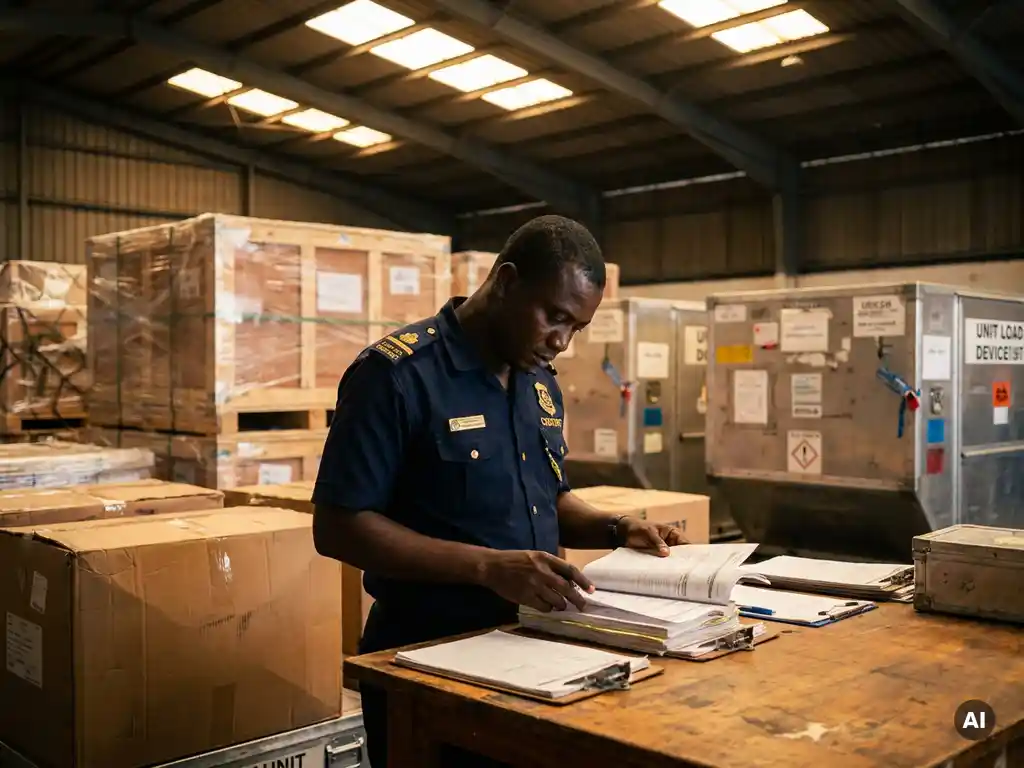
Customs clearance for air freight to Ghana requires businesses to submit a specific set of import documents, pay applicable duties and taxes assessed by the Ghana Revenue Authority, and comply with the country’s destination inspection scheme. The process applies to all commercial shipments and involves coordination between the shipper in Europe, the consignee in Ghana, and a licensed customs broker on the ground. The sections below address the most important practical questions that arise when clearing air freight through Accra’s Kotoka International Airport.
What documents are required for air freight customs clearance in Ghana?
The core documents required for air freight customs clearance in Ghana are the air waybill (AWB), a commercial invoice, a packing list, and an import permit where applicable. Additional certificates such as a certificate of origin, conformity certificate, or phytosanitary certificate may be required depending on the nature of the goods.
Here is a practical breakdown of the standard documentation set:
- Air waybill (AWB): The primary transport document identifying the shipment, consignee, and declared value
- Commercial invoice: Must state the full description of goods, unit prices, total value in a declared currency, and the Incoterms used
- Packing list: Details the weight, dimensions, and contents of each package
- Certificate of origin: Required for goods claiming preferential tariff treatment or for specific product categories
- Import permit or license: Mandatory for regulated goods such as pharmaceuticals, food products, chemicals, and telecommunications equipment
- Conformity certificate: Required for goods subject to Ghana’s quality and standards regulations
All documents must be accurate and consistent with each other. Discrepancies between the invoice value and the AWB declared value are one of the most common triggers for customs holds. Businesses shipping from Europe should ensure that documents are prepared before the shipment departs, not after it lands.
How does Ghana’s customs authority assess import duties and taxes?
Ghana’s customs authority, the Ghana Revenue Authority (GRA), assesses import duties based on the CIF value of the shipment, that is, the cost of goods plus insurance and freight to the point of entry. The applicable duty rate depends on the HS code (Harmonized System code) of the goods, which determines the tariff band under Ghana’s customs tariff schedule.
In addition to import duty, businesses should account for the following charges:
- Value Added Tax (VAT): Applied at the standard rate on the duty-inclusive value of goods
- National Health Insurance Levy (NHIL): A levy applied alongside VAT
- Ghana Education Trust Fund Levy (GETFund): An additional levy charged at import
- ECOWAS Levy: A regional trade levy applicable to imports into Ghana
- Examination and processing fees: Administrative charges applied by customs
The combined tax burden on imported goods in Ghana can be substantial, particularly for goods in higher tariff bands. Businesses that ship on Delivered Duty Paid (DDP) terms need to factor all of these charges into their landed cost calculations before the shipment departs Europe. Undervaluing goods on the commercial invoice does not reduce the assessed duty; the GRA uses reference values and destination inspection reports to verify declared values.
What goods are restricted or prohibited from air import into Ghana?
Ghana prohibits the import of certain categories of goods entirely and restricts others to licensed importers only. Prohibited goods include counterfeit products, certain used goods (depending on category), and items that contravene public health or safety regulations. Restricted goods require prior authorization from the relevant Ghanaian regulatory authority before shipment.
Common categories that require special handling or permits for air freight to Africa include:
- Pharmaceuticals and medical devices (regulated by the Food and Drugs Authority of Ghana)
- Telecommunications equipment (requires type approval from the National Communications Authority)
- Food and agricultural products (subject to phytosanitary and food safety controls)
- Chemicals and hazardous materials (require Environmental Protection Agency permits)
- Arms, ammunition, and related equipment (strictly controlled and require government authorization)
- Used electrical and electronic equipment (subject to import restrictions to prevent e-waste dumping)
Businesses shipping regulated goods from Europe must obtain the relevant Ghanaian import permits before the cargo departs. Arriving without the correct authorization will result in the goods being held at the airport, with costs accumulating while the permit is obtained or the goods are re-exported.
How does Ghana’s destination inspection scheme affect air freight clearance?
Ghana operates a destination inspection scheme under which imported goods are physically examined at the port or airport of entry rather than at the country of export. For air freight arriving at Kotoka International Airport, this means that cargo is subject to inspection by Ghana Customs officers and, where applicable, by approved inspection companies contracted by the GRA.
The inspection process verifies that the declared goods match the shipping documents, that the declared value is accurate, and that the goods meet applicable standards and regulations. Goods above a certain value threshold are typically subject to mandatory inspection before customs clearance can be completed.
The practical implications for businesses are significant. Shipments must be packed and labeled in a way that allows inspectors to verify contents without destroying packaging. Detailed and accurate documentation is essential: vague descriptions on the commercial invoice such as “spare parts” or “general merchandise” are likely to trigger extended examination. The inspection adds time to the clearance process, and businesses should build this into their logistics planning when calculating transit times from Europe to Ghana.
What are the most common causes of customs delays for air freight to Ghana?
The most common causes of customs delays for air freight to Ghana are incomplete or inaccurate documentation, missing import permits, undervalued or misdescribed goods, and failure to pay duties promptly. Many delays are avoidable with proper pre-shipment preparation.
Specific issues that regularly cause clearance delays include:
- Invoice discrepancies: Mismatches between the commercial invoice and the air waybill, or between the declared value and the GRA’s reference values
- Missing permits: Regulated goods arriving without the required import license or sector-specific authorization
- Incorrect HS codes: Goods classified under the wrong tariff code, leading to disputes over the applicable duty rate
- Incomplete packing lists: Failure to itemize contents in sufficient detail for customs verification
- Payment delays: Consignees who are not prepared to pay assessed duties promptly, causing storage charges to accumulate
- Regulatory holds: Goods flagged for additional inspection by sector regulators such as the Food and Drugs Authority
Businesses that ship regularly to Ghana benefit from establishing a consistent document preparation process on the European side and working with a reliable customs broker in Accra who can act quickly when issues arise. Understanding air freight logistics services end-to-end reduces the risk of surprises at the clearance stage.
When should you use a licensed customs broker for Ghana air freight?
Businesses should use a licensed customs broker for air freight to Ghana whenever they are shipping regulated goods, shipping above low-value thresholds, or shipping to Ghana for the first time. In practice, virtually all commercial air freight consignments benefit from professional customs representation, as the Ghanaian customs process involves multiple regulatory touchpoints that require local expertise to navigate efficiently.
A licensed customs broker in Ghana can:
- File the customs entry declaration on behalf of the consignee
- Verify that HS codes and declared values align with GRA expectations before submission
- Liaise directly with customs officers during the inspection process
- Coordinate with sector regulators to obtain release for controlled goods
- Arrange duty payment and collect the goods once clearance is granted
For businesses shipping on DDP (Delivered Duty Paid) terms, the logistics provider in Europe typically coordinates with the customs broker in Ghana as part of the end-to-end service. This removes the administrative burden from the consignee entirely and ensures that duties and taxes are settled before delivery. For businesses new to importing into Ghana, this arrangement significantly reduces the risk of costly clearance errors.
How EAF supports air freight customs clearance to Ghana
We manage the full customs clearance process for commercial air freight shipments from Europe to Ghana, including DDP delivery to the consignee’s premises. Our approach is built on local knowledge and established relationships with customs authorities and inspection bodies in Accra. Specifically, we provide:
- Pre-shipment document review: We check commercial invoices, packing lists, and permits before cargo departs Europe to prevent clearance problems at destination
- HS code verification: We confirm correct tariff classification to avoid duty disputes and delays
- DDP handling: We cover all import duties, taxes, and customs fees on your behalf and deliver cleared goods to the final address in Ghana
- Coordination with Ghanaian customs brokers: We work with trusted local partners in Accra to ensure efficient clearance and fast release of cargo
- Permit guidance: We advise on which goods require import authorization and help coordinate the permit process where possible
If your business ships goods from Europe to Ghana and you need a reliable partner who handles the customs process from start to finish, get in touch with us to discuss your shipment requirements.
Ähnliche Artikel
- How Should You Package Goods for Air Freight to Africa?
- How Do You Ship Oversized or Heavy Cargo to Africa by Air?
- What Are the Most Common Air Freight Export Mistakes?
- Sending Goods by Air to Ghana: What Exporters Should Know
- How Is Air Freight Cost Calculated?
Dieser Inhalt wurde mithilfe von KI erstellt und kann Fehler enthalten.