
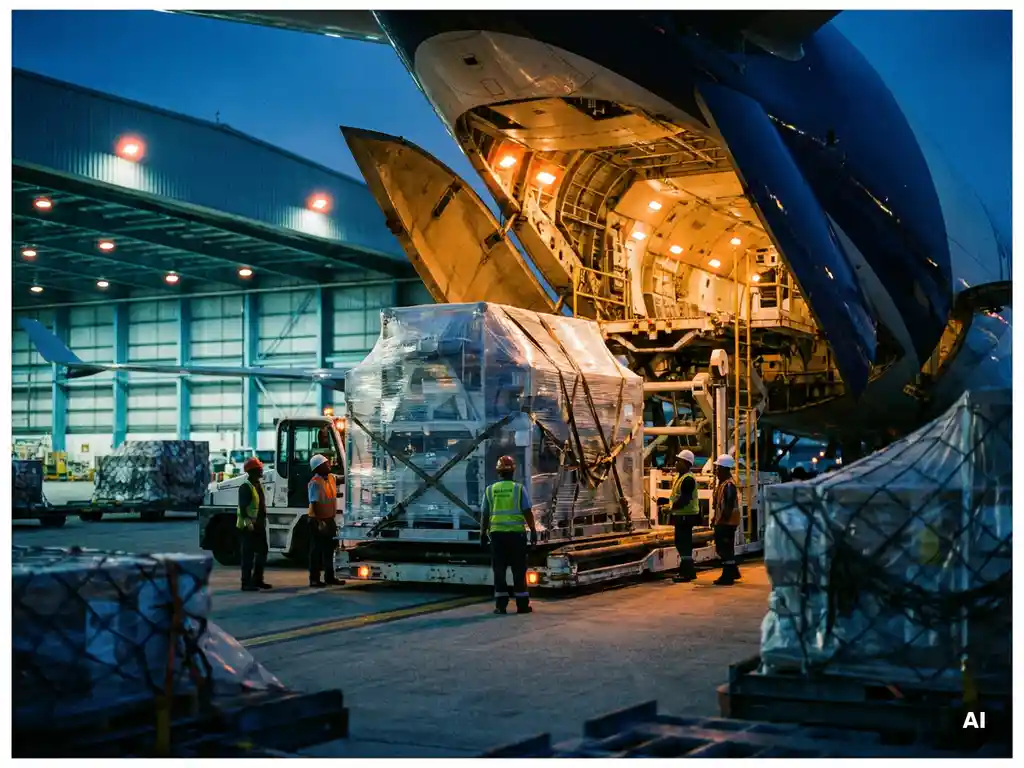
You can ship oversized or heavy cargo to Africa by air, but it requires specialist handling, specific aircraft types, and careful pre-planning. Standard airline capacity will not accommodate most out-of-gauge shipments, so the process runs through charter operators or freighter airlines with appropriate equipment. This article breaks down what qualifies as oversized air cargo, how the booking and documentation process works, and how to decide whether air or sea freight is the right choice for your shipment.
What counts as oversized or heavy cargo in air freight?
In air freight, cargo is classified as oversized or out-of-gauge (OOG) when it exceeds the standard dimensions or weight limits of a regular Unit Load Device (ULD). As a general rule, any single piece exceeding 300 cm in length, 150 cm in width, or 160 cm in height, or weighing more than 500 kg, falls outside standard handling parameters. Heavy lift air cargo typically refers to individual pieces above 1,000 kg.
The distinction matters because standard belly cargo and most freighter configurations have fixed floor dimensions, door openings, and structural load limits. Cargo that cannot fit through the main deck door of a freighter aircraft, or that exceeds the floor load-bearing capacity, requires a different aircraft type or a different transport mode entirely.
Common examples of oversized air freight to Africa include industrial machinery components, generators, transformers, medical equipment, and project cargo for construction or energy sector deployments in countries like Nigeria, Kenya, or Ghana. For businesses moving this type of equipment, specialist freight services are essential from the outset.
Which aircraft types can carry oversized cargo to Africa?
The aircraft type determines what oversized cargo can physically be transported by air. For large or heavy lift shipments to Africa, the main options are widebody freighters such as the Boeing 747-400F or 747-8F, the Antonov AN-124, and in some cases the Boeing 777F. The AN-124 is the workhorse for true heavy lift air cargo, with a payload capacity exceeding 120 tonnes and a nose-loading door that allows extremely long or bulky items to be loaded directly onto the main deck.
The Boeing 747 freighter remains the most commonly used aircraft on Europe-to-Africa freight routes and can handle oversized pieces that fit within its main deck envelope, typically up to around 12 metres in length depending on the configuration. For cargo that exceeds even these parameters, an AN-124 charter is usually the only viable air freight solution.
Not all African airports can receive these aircraft types. Major hubs such as Lagos (LOS), Nairobi (NBO), Accra (ACC), and Dar es Salaam (DAR) can handle large freighters, but secondary destinations may require transhipment or onward road transport from the nearest capable airport. This is a critical factor in route planning for out-of-gauge air freight to Africa.
How does the booking process differ for out-of-gauge air freight?
Booking out-of-gauge air freight to Africa is significantly more complex than standard air freight. It cannot be done through a general rate inquiry. The process begins with a detailed technical submission to the carrier or charter broker, including precise dimensions, weight, centre of gravity, and any special handling requirements. Only once this information is assessed can a carrier confirm whether the shipment is feasible on a given aircraft type and route.
For OOG shipments, the typical booking process involves the following steps:
- Prepare a full technical data sheet with piece dimensions, gross weight, and stacking or orientation restrictions
- Submit the data to specialist freight forwarders with access to freighter capacity or charter operators
- Receive a feasibility assessment and space confirmation from the carrier
- Agree on the loading method, ground handling requirements, and any special equipment needed at origin and destination
- Confirm booking and issue airway bill with all OOG notations
Lead times for out-of-gauge air freight bookings are considerably longer than for standard shipments. Depending on the aircraft type required and the destination in Africa, you should allow at least one to two weeks for planning, and longer for AN-124 charters. Last-minute OOG bookings to Africa are rarely feasible.
What documentation is required for heavy air cargo to Africa?
Heavy air cargo to Africa requires the same core documentation as standard air freight, plus additional paperwork specific to the shipment type and destination country. The standard set includes the airway bill (AWB), commercial invoice, packing list, and certificate of origin. For OOG or heavy lift cargo, you will also typically need a technical data sheet and, depending on the goods, an import permit or pre-shipment inspection certificate from the destination country.
Many African countries, including Nigeria and Ghana, operate mandatory pre-shipment inspection regimes for commercial goods above a certain value threshold. For industrial equipment and machinery, destination customs authorities often require additional documentation such as an equipment specification sheet or a conformity assessment certificate. Failing to prepare these documents before shipment can cause costly delays at the destination port or airport.
For shipments moving on a DDP (Delivered Duty Paid) basis, the freight forwarder handles customs clearance and duty payment on behalf of the consignee. This requires a valid customs number and a power of attorney or customs mandate from the receiving business. DDP is particularly relevant for oversized cargo to Africa because destination clearance for heavy equipment is often complex and benefits from local expertise at the destination end.
Businesses shipping to East Africa should also be aware that Kenya, Tanzania, and Uganda operate within the East African Community (EAC) customs framework, which has its own documentation standards and tariff classifications. Understanding these requirements in advance is part of effective Africa logistics planning.
What factors affect the cost of shipping oversized cargo by air to Africa?
The cost of heavy cargo shipping to Africa by air is driven by several factors beyond simple weight and distance. The primary cost drivers are chargeable weight (the higher of actual weight and volumetric weight), the aircraft type required, routing, and any special handling or ground equipment needed at origin and destination.
Key factors that affect the total cost include:
- Chargeable weight: For large, bulky items, the volumetric weight often exceeds actual weight, significantly increasing the base freight rate
- Aircraft type: AN-124 charters are substantially more expensive than standard freighter capacity, but may be the only option for certain dimensions
- Destination airport: Remote or secondary airports in Africa may require transhipment, adding cost and transit time
- Special handling: Crane loading, custom cradles, or reinforced pallets add to ground handling costs at both origin and destination
- Fuel surcharges and security fees: These vary by carrier and route and can represent a significant proportion of the total invoice
- Customs duties and taxes: On DDP shipments, import duties at the destination are included in the total cost and vary by commodity and country
For accurate cost planning, a detailed quote based on actual cargo dimensions and weight is always necessary. Indicative rates without confirmed dimensions are rarely reliable for OOG shipments.
Should you ship oversized cargo to Africa by air or sea?
For most oversized or heavy cargo destined for Africa, sea freight is the more cost-effective option. Air freight for out-of-gauge cargo is significantly more expensive per kilogram than sea freight, and for very large pieces such as complete machinery or heavy industrial equipment, sea freight via flat rack or open top container is often the only practical choice. However, air freight makes sense when speed is critical, the cargo value justifies the premium, or the destination has no reliable port access.
The decision typically comes down to three factors: urgency, cargo dimensions, and total landed cost. If a production line is stopped and a replacement part is needed within days in Nairobi or Lagos, air freight is justified regardless of cost. If the shipment is a large generator destined for Tanzania with a four-week installation window, sea freight on a flat rack is almost always the better commercial decision.
There is also a middle ground. Some project cargo movements to Africa use a split approach: critical components or spare parts travel by air, while the main equipment moves by sea. This requires careful coordination between the air and sea legs to ensure both arrive in sequence at the destination.
One practical consideration for air freight to secondary African destinations: even if the main leg travels by air to a hub like Nairobi or Accra, the final delivery may still involve road transport to the end destination. A DDP arrangement that covers the full door-to-door movement simplifies this considerably for the shipper.
How EAF handles oversized and heavy cargo to Africa
We specialise in air freight from Europe to Africa, including out-of-gauge and heavy lift shipments to destinations across West and East Africa. Our approach is hands-on from the first inquiry: we assess feasibility, identify the right aircraft type, and manage the full booking and documentation process so that your shipment moves without unnecessary delays.
For oversized cargo, we provide:
- Feasibility assessment based on your cargo dimensions and destination
- Access to freighter capacity and charter solutions for heavy lift air cargo
- Full documentation management, including pre-shipment inspection coordination where required
- DDP delivery to the consignee’s door in Nigeria, Ghana, Kenya, Tanzania, and beyond
- Customs clearance handled by local partners at the destination, included in the DDP scope
We work exclusively with businesses. If you have a customs number and need to move oversized or heavy cargo from Europe to Africa, contact us directly for a tailored assessment and quote.
Ähnliche Artikel
- What Is Air Charter and When Does It Make Sense for Shipping to Africa?
- What Are the Most Common Air Freight Export Mistakes?
- What Happens to Your Cargo Between Pickup and the Airport?
- How Does Air Freight from Europe to South Africa Work?
- Sending Goods by Air to Ghana: What Exporters Should Know
Dieser Inhalt wurde mithilfe von KI erstellt und kann Fehler enthalten.