
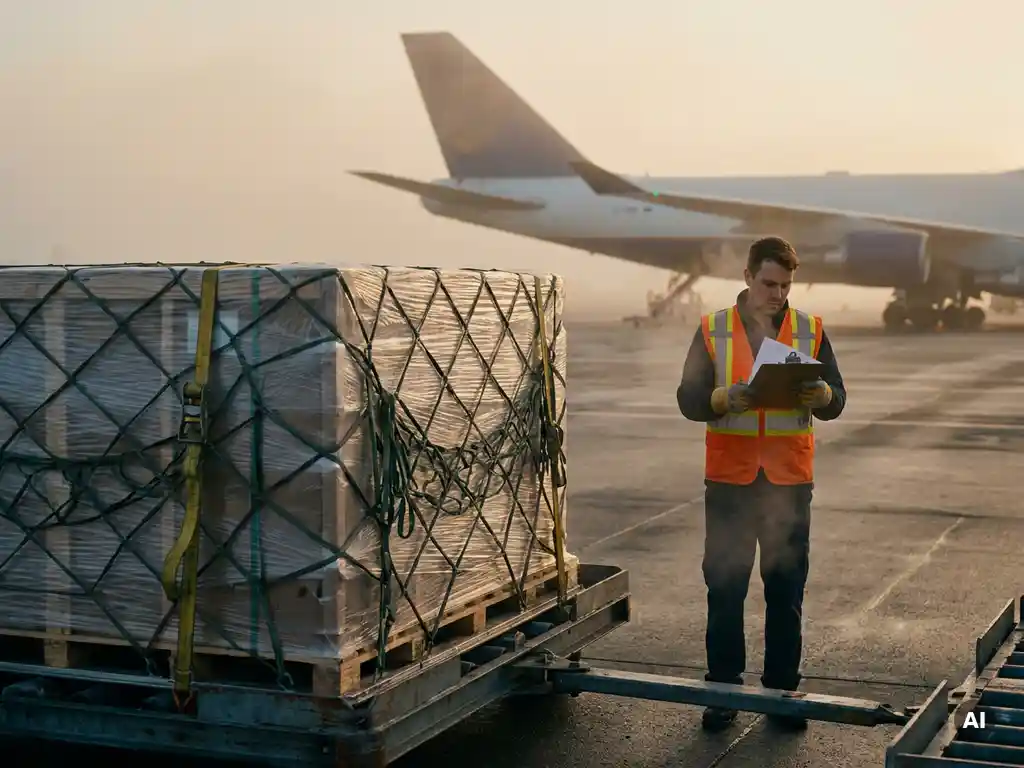
Sending goods by air to Ghana is straightforward for businesses that understand the documentation, customs process, and regulatory requirements in advance. Air freight from Europe to Ghana typically arrives within two to five business days, making it the preferred option for time-sensitive commercial shipments. The sections below cover the key questions exporters ask before shipping cargo to Accra or other Ghanaian destinations.
What documents are required to ship goods by air to Ghana?
Every commercial air freight shipment to Ghana requires a core set of documents: an airway bill (AWB), a commercial invoice, a packing list, and a certificate of origin. Depending on the goods and their value, additional permits or certificates may apply. Incomplete or inaccurate documentation is the most common cause of customs delays at Kotoka International Airport.
The commercial invoice must clearly state the buyer and seller details, a precise description of the goods, the HS tariff code, unit prices, total value, and Incoterms. Ghana Customs uses this document as the primary basis for duty assessment, so any discrepancy between the invoice and the physical shipment creates problems.
Additional documents that are frequently required include:
- Certificate of origin issued by a recognized chamber of commerce in the country of export
- Phytosanitary or health certificates for food products, agricultural goods, or items of animal origin
- Conformity assessment certificates for regulated product categories such as electronics, chemicals, or building materials
- Import permits for controlled goods such as pharmaceuticals, medical devices, or certain chemicals
- Fumigation certificates for wooden packaging materials in line with ISPM 15 standards
All values must be declared accurately. Ghana Customs applies strict scrutiny to undervalued invoices, and penalties for misdeclaration are significant. Businesses shipping regularly to Ghana benefit from working with a freight forwarder who can review documentation before the shipment departs Europe.
How does Ghana Customs clear air freight shipments?
Ghana Customs clears air freight shipments through the Ghana Revenue Authority (GRA) using the GCNet electronic customs management system. Once the cargo arrives at Kotoka International Airport in Accra, the consignee or their licensed customs broker submits an import declaration, and the shipment is assessed, inspected if selected, and released upon payment of applicable duties and taxes.
The process generally follows these steps:
- The freight agent or customs broker lodges the import entry electronically via GCNet
- The system assigns a risk channel: green (documentary check only), yellow (physical inspection), or red (detailed examination)
- Duties and taxes are calculated, and a payment assessment is issued
- The importer or their broker pays the assessed amount
- Customs releases the cargo for collection or onward delivery
Ghana also operates the Destination Inspection Scheme, under which certain shipments are subject to pre-shipment inspection or post-arrival verification. Importers must hold a valid Tax Identification Number (TIN) and, for commercial shipments, a customs import declaration number. Delays most often occur when documents are incomplete, values are queried, or goods fall into a category requiring additional permits.
For businesses that want their goods delivered without managing the customs process themselves, a DDP (Delivered Duty Paid) arrangement transfers full responsibility for customs clearance and duty payment to the freight forwarder.
What are the import duties and taxes on goods arriving in Ghana?
Goods arriving in Ghana by air are subject to import duty, Value Added Tax (VAT), the Ghana Education Trust Fund levy (GETFL), and the ECOWAS levy. The total tax burden varies by product category, but combined charges frequently range between 20% and 35% of the customs value for standard commercial goods. Duty rates are determined by the HS tariff code assigned to the goods.
The main charges applied at import are:
- Import duty: typically 0%, 5%, 10%, or 20% depending on the product category under the ECOWAS Common External Tariff
- VAT: 15% applied to the customs value plus duty
- NHIL (National Health Insurance Levy): 2.5%
- GETFL (Ghana Education Trust Fund Levy): 2.5%
- ECOWAS levy and African Union levy: small percentage charges applied to the customs value
The customs value is calculated on a CIF basis, meaning it includes the cost of the goods, international insurance, and freight charges to the point of entry. This means the air freight cost itself forms part of the taxable base. Accurate freight and insurance figures must therefore appear in the shipping documents.
Some goods benefit from preferential duty rates or exemptions, particularly under trade agreements or for specific sectors such as humanitarian aid or capital equipment. Confirming the correct HS code before shipment helps avoid unexpected duty assessments on arrival.
Which goods are prohibited or restricted for import into Ghana?
Ghana prohibits the import of certain goods outright and restricts others through licensing or permit requirements. Prohibited items include narcotics, counterfeit goods, obscene material, and goods that violate intellectual property rights. Restricted goods require advance authorization from the relevant Ghanaian authority before they can be imported.
Categories that are commonly restricted and require prior permits or licenses include:
- Pharmaceuticals and medical devices (regulated by the Food and Drugs Authority)
- Pesticides and agrochemicals
- Firearms, ammunition, and military equipment
- Telecommunications equipment (subject to NCA approval)
- Certain food products and beverages requiring health certification
- Hazardous chemicals and industrial gases
- Used clothing and second-hand goods (subject to specific conditions)
For air freight specifically, dangerous goods must be classified, packaged, and documented in accordance with IATA Dangerous Goods Regulations (DGR). Not all dangerous goods classes are accepted on all airlines or routes, and some categories require advance approval from the carrier. Exporters should confirm acceptance with their freight forwarder before booking.
Checking the current Ghana Standards Authority and Ghana Revenue Authority guidelines before shipping is advisable, as restricted categories and licensing requirements are updated periodically.
How long does air freight from Europe to Ghana take?
Air freight from Europe to Ghana takes two to five business days from the point of departure to arrival at Kotoka International Airport in Accra. Direct services from major European cargo hubs typically achieve the shorter end of this range, while shipments requiring a transit stop may take an additional day. Customs clearance time at the destination adds one to three working days under normal conditions.
The total door-to-door transit time therefore depends on three factors: the flight routing and frequency, the speed of customs clearance, and the efficiency of last-mile delivery to the final consignee address. Shipments that arrive with complete and accurate documentation clear customs significantly faster than those with errors or missing permits.
Consolidation shipments, where cargo from multiple exporters is grouped into a single consignment, may have slightly longer lead times than dedicated charter or direct groupage services, as the consolidation process adds time at origin before departure.
What affects the cost of air freight to Ghana?
The cost of air freight to Ghana is primarily determined by the chargeable weight of the shipment, the current market rate per kilogram on the Europe-Accra route, and any applicable surcharges. Chargeable weight is the higher of actual gross weight and volumetric weight, calculated by dividing the total volume in cubic centimeters by 6,000.
Key factors that influence the final freight cost include:
- Chargeable weight: lightweight but bulky cargo is rated on volume, which can significantly increase costs
- Fuel surcharges: applied by airlines and adjusted periodically based on fuel price indices
- Security surcharges: standard charges for screening and handling at origin
- Dangerous goods handling fees: additional charges apply when shipments require DGR documentation and special handling
- Peak season demand: rates on the Europe-West Africa corridor rise during periods of high demand
- Incoterms: whether the exporter quotes EXW, CPT, CIP, or DDP determines how much of the cost chain falls on the shipper versus the consignee
- Customs clearance and delivery fees at destination: these are separate from the air freight rate and vary by agent and location within Ghana
For businesses shipping regularly to Ghana, consolidating smaller shipments into weekly groupage departures is a cost-effective alternative to booking individual airway bills. Comparing total landed cost, including duties and local delivery, gives a more accurate picture than comparing freight rates alone.
You can find an overview of freight services to Africa to understand the full range of options available for your trade lane.
How EAF supports your air freight shipments to Ghana
We have been shipping commercial cargo from Europe to West Africa for over 30 years, and Ghana is one of our established destinations. Our approach is built around taking the complex parts off your plate, specifically documentation, customs clearance, and last-mile delivery, so that your goods arrive without unnecessary delays or surprises.
When you ship with us, we handle:
- Complete documentation review before departure to prevent customs holds in Accra
- DDP (Delivered Duty Paid) shipments where we manage import duties, customs clearance, and final delivery to your consignee’s address
- Dangerous goods handling in accordance with IATA DGR for shipments that require it
- Regular groupage departures from Europe to Ghana for cost-efficient smaller consignments
- Transparent cost breakdowns covering freight, surcharges, duties, and local delivery
As an IATA-accredited freight agent and ISO 9001-certified company, we combine technical compliance with direct, personal service. If you are preparing a shipment to Ghana or want to discuss the best routing for your cargo, get in touch with our team for a straightforward quote and advice.
Ähnliche Artikel
- What's Included in an Air Freight Quote to Africa?
- What Is Air Charter and When Does It Make Sense for Shipping to Africa?
- How Does Insurance Work for Air Freight Shipments to Africa?
- How Is Air Freight Cost Calculated?
- How Long Does Air Freight from Europe to Africa Take?
Dieser Inhalt wurde mithilfe von KI erstellt und kann Fehler enthalten.