
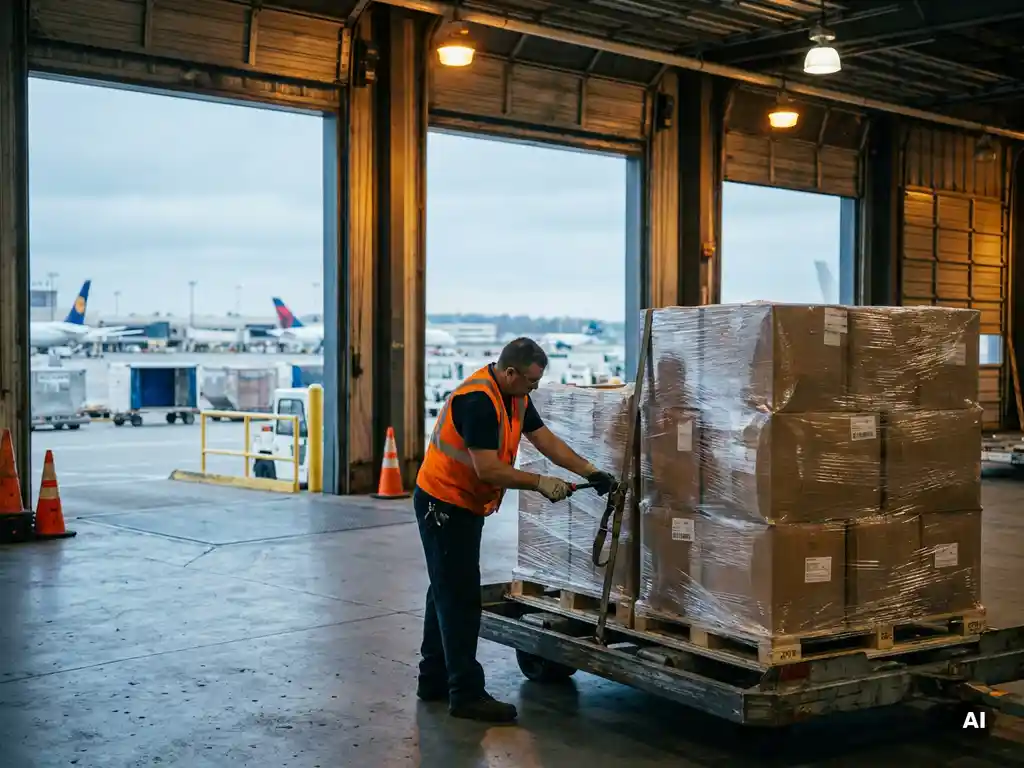
Between the moment a freight forwarder collects your goods and the moment they are loaded onto an aircraft, your cargo passes through several distinct handling stages. Each stage serves a specific logistical or regulatory purpose: consolidation, documentation, customs clearance, and physical transfer to the airline. For businesses shipping goods from Europe to destinations such as Nigeria, Ghana, Kenya, or Tanzania, understanding this process helps set realistic expectations and avoid costly surprises. The sections below walk through each stage in sequence.
How does a freight forwarder collect cargo from the shipper?
Cargo collection, also called pre-carriage, is the first physical step in the freight forwarding process. The forwarder arranges a vehicle to collect the goods from the shipper’s premises, a supplier’s warehouse, or a third-party location. Collection is coordinated against confirmed booking details: dimensions, weight, commodity type, and the destination. The shipper hands over the cargo along with the commercial invoice and packing list.
Before collection, the forwarder checks whether the goods require any special handling. Temperature-sensitive cargo, oversized items, and certain regulated commodities each require different vehicle types or handling protocols. For standard general cargo moving from Europe to Africa, a straightforward van or curtainsider truck is typically sufficient. The forwarder confirms the pickup window with the shipper and issues a collection receipt once the goods are loaded.
It is worth noting that collection timing matters. Air freight operates on tight cut-off schedules, and late pickups can push cargo to the next available flight, particularly on routes to East or West Africa where frequencies vary by carrier.
What happens to cargo at the forwarder’s warehouse?
Once collected, cargo is brought to the forwarder’s warehouse for inspection, documentation, and preparation. Staff verify the shipment against the booking: they check piece count, gross weight, and dimensions, and confirm that the goods match what is declared on the commercial invoice. Any discrepancy at this stage is resolved before the cargo moves further.
The warehouse is also where goods are prepared physically for air transport. This includes re-palletizing, applying IATA-compliant labels, and attaching airway bill numbers. If the shipment contains any items that fall under regulated categories, such as lithium batteries or certain chemicals, the warehouse team ensures the correct documentation and packaging standards are applied before the cargo is accepted for flight.
Dangerous goods, where applicable, are handled strictly in accordance with IATA regulations and are never stored alongside standard general cargo in a way that creates risk. Class 7 radioactive materials are outside the scope of standard air freight operations entirely.
What is cargo consolidation and why does it affect my shipment?
Cargo consolidation is the process of grouping multiple smaller shipments from different shippers into a single larger consignment, typically loaded into one Unit Load Device (ULD) or container. Forwarders use consolidation to fill aircraft capacity efficiently and to offer competitive rates to shippers who do not have enough volume to fill a dedicated shipment.
For businesses shipping to African destinations, consolidation is common on routes where direct full-charter capacity is limited. A shipment destined for Nairobi, Lagos, or Accra may be consolidated with other cargo heading to the same region before being tendered to the airline as a single master airway bill consignment.
The practical effect on your shipment is twofold. First, your goods may wait at the forwarder’s warehouse until the consolidation cut-off is reached, which can add one to two days to the pre-flight timeline. Second, consolidated cargo is released at destination under a house airway bill, which means the consignee receives documentation from the forwarder rather than directly from the airline. This is standard practice and does not affect the legal status of the shipment, but it is important to understand when planning for customs clearance at the destination end.
How does export customs clearance work before the airport?
Export customs clearance is the formal process by which goods are declared to the customs authority of the country of export before they leave. In most European countries, this is done electronically. The freight forwarder submits an export declaration on behalf of the shipper, referencing the commercial invoice, packing list, and any applicable licenses or certificates. Customs authorities assign an export Movement Reference Number (MRN), which authorizes the goods to leave the country.
The shipper must hold a valid customs identification number (EORI number in the EU) to be named as the exporter on the declaration. This is a legal requirement and confirms that the party exporting the goods is a registered business entity. Private individuals cannot hold an EORI number, which is one reason commercial air freight is strictly a business-to-business service.
The export declaration must be lodged and accepted before the cargo is presented to the airline. If there are any holds, queries, or document discrepancies, customs authorities can place a physical or documentary hold on the shipment, which directly delays departure. Experienced forwarders submit declarations well ahead of the airline’s cargo cut-off time to absorb any back-and-forth with customs without missing the flight.
How is cargo handed over to the airline?
Once export clearance is confirmed, the forwarder delivers the cargo to the airline’s cargo terminal at the departure airport. This handover is a formal process: the forwarder presents the master airway bill, the export declaration reference, and any special handling documentation. The airline’s ground handling agent weighs and measures the cargo, verifies it against the booking, and accepts it into the airline’s custody.
The cargo then enters the airline’s build-up area, where it is loaded into ULDs or pallets according to the aircraft’s load plan. The forwarder’s responsibility for physical custody ends at this point. From here, the airline is responsible for the cargo until it arrives at the destination airport.
Cut-off times vary by airline and route. On routes from Europe to West or East Africa, cargo cut-off is typically several hours before scheduled departure, sometimes the evening before for early morning flights. Missing the cut-off means the cargo is held for the next available service, which on some routes may only operate on certain days of the week.
What can delay cargo between pickup and departure?
Several factors can extend the time between cargo pickup and actual departure. The most common causes are documentation errors, customs holds, consolidation cut-off timing, and airline capacity issues.
- Incomplete or incorrect documentation: A mismatch between the commercial invoice and the physical goods, a missing certificate of origin, or an incorrect commodity description can stop the export declaration from being processed.
- Customs queries or holds: Customs authorities can flag shipments for additional checks. This is more likely when commodity descriptions are vague, declared values appear inconsistent, or the goods fall into a regulated category.
- Consolidation schedules: If your shipment misses the consolidation cut-off for a particular flight, it waits for the next grouping. On less frequent routes, this can mean a delay of several days.
- Airline capacity: Air cargo is subject to weight and volume limits per flight. Cargo can be offloaded if the aircraft is overbooked or if higher-priority shipments take precedence. This is more common during peak trade periods.
- Special handling requirements: Goods that require temperature control, oversized handling, or specific ULD types take longer to process and may not be accepted on every flight.
The most effective way to avoid delays is to have complete, accurate documentation ready before collection and to work with a forwarder who communicates cut-off deadlines clearly and books cargo well in advance of the target departure date.
How EAF manages the process from pickup to departure
We handle the entire pre-carriage and pre-flight process for businesses shipping goods from Europe to Africa, including to Nigeria, Ghana, Kenya, and Tanzania. Our role covers every stage described in this article, so you do not need to coordinate separately with trucking companies, warehouse operators, or customs agents.
- Coordinated collection from your premises or your supplier’s location across Europe
- In-house documentation review to catch errors before the export declaration is submitted
- Export customs clearance handled on your behalf, including EORI-based declarations
- Consolidation management on regular services to West and East Africa, with clear cut-off communication
- DDP delivery to the final consignee at destination, including import customs clearance and last-mile delivery, so your buyer receives goods duty-paid at their door
If you want a clear picture of what the process looks like for your specific shipment, get in touch with us directly. We provide straightforward answers and concrete timelines based on your cargo and destination.
Ähnliche Artikel
- What Are the Most Common Air Freight Export Mistakes?
- How Does Air Freight from Europe to South Africa Work?
- Air Freight to Kenya: How Shipments Reach Nairobi
- How Long Does Air Freight from Europe to Africa Take?
- What Is Air Freight Export and How Does It Work?
Dieser Inhalt wurde mithilfe von KI erstellt und kann Fehler enthalten.