
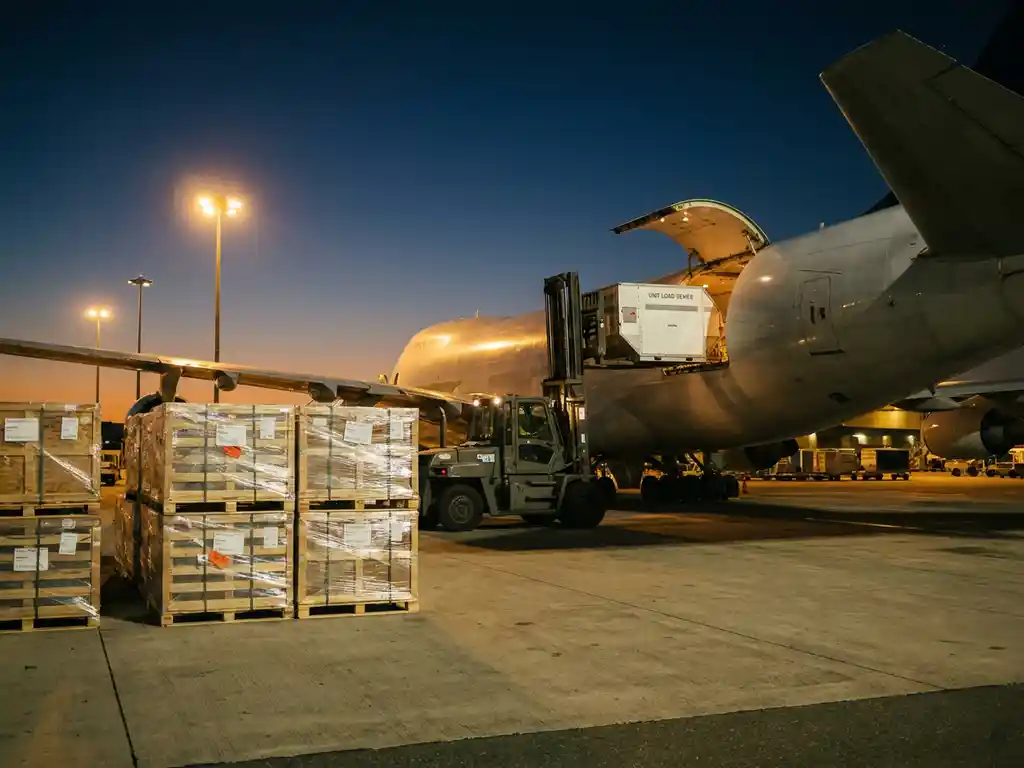
Air freight export is the process of shipping commercial goods from one country to another by air, using cargo aircraft or the belly hold of passenger planes. It is used by businesses that need to move goods quickly across international borders, particularly when time-sensitive delivery, product value, or supply chain reliability makes speed a priority. The sections below cover the full process, documentation requirements, cost structure, and how to decide when air freight is the right mode for your export shipment.
How does the air freight export process work step by step?
The air freight export process begins when a shipper books cargo space with a freight forwarder or airline, and ends when the consignee receives the goods at the destination. Between those two points, the shipment passes through a structured sequence of handling, documentation, customs clearance, and transport steps that the freight forwarder coordinates on the shipper’s behalf.
The typical sequence looks like this:
- Booking and rate confirmation: The exporter provides cargo details (weight, dimensions, commodity, destination) and the freight forwarder confirms space and rates with the airline.
- Cargo collection: Goods are picked up from the shipper’s premises or delivered to the freight forwarder’s warehouse for consolidation.
- Export customs clearance: The forwarder files an export declaration in the country of origin. The shipment is cleared before it reaches the airport.
- Acceptance at the cargo terminal: The cargo is handed over to the airline’s ground handling agent at the airport, where it is screened, weighed, and built into unit load devices (ULDs) or pallets.
- Flight and transit: The cargo travels on the booked flight, sometimes with a transit stop, depending on the routing to the destination country.
- Arrival and import customs clearance: At the destination airport, the consignee or their local agent handles import customs formalities and pays applicable duties and taxes, unless a DDP (Delivered Duty Paid) arrangement has been agreed, in which case the exporter or forwarder covers those costs.
- Last-mile delivery: Once cleared, the shipment is delivered to the consignee’s address.
For exports to destinations in West or East Africa, such as Nigeria, Ghana, Kenya, or Tanzania, each of these steps requires local knowledge, particularly at the import end, where customs procedures, port authority requirements, and last-mile infrastructure vary significantly between countries.
What documents are required for air freight export?
Air freight export requires a defined set of commercial and transport documents. The exact requirements depend on the destination country and the nature of the goods, but the core documents are consistent across most international air cargo shipments.
- Air Waybill (AWB): The primary transport document for air cargo. It serves as a contract of carriage between the shipper and the airline, a receipt for the goods, and a tracking reference. It is non-negotiable, meaning it does not confer title to the goods.
- Commercial invoice: Describes the goods, their value, the seller, and the buyer. Customs authorities at both origin and destination use this document to assess duties and verify the shipment.
- Packing list: Details the contents of each package, including weights and dimensions. It supports the commercial invoice and assists customs inspection.
- Export declaration: A statutory filing with the customs authority in the country of export. In the EU, this is submitted electronically through the national customs system.
- Certificate of origin: Required for many African destinations to confirm where the goods were manufactured. This affects applicable import duties under trade agreements.
- Dangerous goods declaration (if applicable): Required when shipping hazardous materials, prepared according to IATA Dangerous Goods Regulations.
- Additional permits or licences: Certain product categories, including pharmaceuticals, chemicals, food products, and controlled equipment, may require specific export licences or import permits at the destination.
For shipments to Nigeria, Ghana, Kenya, or Tanzania, destination-specific requirements often add complexity. Pre-shipment inspection certificates, destination inspection programmes, and import approval documents from local regulatory bodies are common. A freight forwarder with direct experience in these corridors can identify what is needed before the cargo moves, preventing delays at the destination airport.
How is air freight cost calculated?
Air freight costs are calculated based on chargeable weight, which is the higher of the actual gross weight and the volumetric (dimensional) weight of the shipment. Airlines charge by whichever weight is greater, because cargo that takes up significant space but weighs relatively little still occupies capacity that could otherwise carry heavier freight.
Volumetric weight is calculated by dividing the total volume of the shipment (length x width x height in centimetres) by a standard divisor, typically 6,000 for air freight. A shipment measuring 100 x 80 x 60 cm has a volume of 480,000 cm³, giving a volumetric weight of 80 kg. If the actual weight is 40 kg, the airline charges based on 80 kg.
Beyond the base freight rate per kilogram, a complete air freight invoice typically includes:
- Fuel surcharge: Adjusted periodically based on jet fuel prices.
- Security surcharge: Covers mandatory screening and handling at the cargo terminal.
- Origin charges: Handling, documentation, and export customs fees at the departure airport.
- Destination charges: Import handling, customs clearance, and delivery fees at the receiving end.
- Duties and taxes: Levied by the destination country’s customs authority. Under a DDP arrangement, these are paid by the shipper or forwarder rather than the consignee.
For exports to Africa, destination charges and import duties can represent a substantial portion of total landed cost. Requesting a full door-to-door quote, including all origin and destination fees, gives a more accurate picture of total cost than a base freight rate alone.
What are the differences between air freight and express air shipping?
Air freight and express air shipping both move goods by aircraft, but they operate through different networks and serve different needs. The key difference is that express services use proprietary door-to-door networks with fixed transit times and integrated customs clearance, while air freight moves through airline cargo networks coordinated by freight forwarders with more flexibility in routing, volume, and cargo type.
Express services are typically suited to small, urgent shipments where a guaranteed transit time and a single-provider service outweigh cost considerations. Air freight handled by a specialist forwarder is better suited to larger commercial shipments, complex customs requirements, and destinations where express networks have limited reach or no reliable last-mile infrastructure.
For business-to-business exports to African markets, air cargo services coordinated through an experienced freight forwarder generally offer more control over the full shipment, including customs documentation, import duty management, and delivery to the consignee’s premises, particularly in markets where express network coverage is inconsistent.
What types of cargo can be shipped by air freight export?
Most commercial goods can be shipped by air freight, but the mode is particularly well suited to high-value, time-sensitive, or perishable cargo where the cost premium over sea freight is justified by the shorter transit time or the nature of the goods.
Common categories of cargo shipped by air freight export include:
- Industrial equipment and spare parts: Particularly where production downtime makes delays costly.
- Pharmaceuticals and medical supplies: Temperature-sensitive or urgently needed products.
- Electronics and technology goods: High value relative to weight, making air freight economically viable.
- Perishable goods: Fresh produce, cut flowers, and food products that cannot withstand long sea transit times.
- Textiles and garments: Especially for time-critical retail or seasonal deliveries.
- Dangerous goods (selected classes): Many hazardous materials can be transported by air under IATA Dangerous Goods Regulations, provided they are correctly classified, packaged, and declared. Class 7 radioactive materials are excluded from air cargo.
Cargo that is very heavy, bulky, or low in value relative to its weight, such as raw materials, heavy machinery, or construction materials, is generally better suited to sea freight, where the lower cost per kilogram offsets the longer transit time.
When should you choose air freight over sea freight for exports?
Air freight is the right choice when speed, reliability, or cargo characteristics outweigh the cost difference compared to sea freight. For exports from Europe to Africa, sea freight to major ports such as Lagos, Tema, Mombasa, or Dar es Salaam typically takes three to six weeks. Air freight reduces that to two to five days, depending on the destination and routing.
The decision typically comes down to several practical factors:
- Urgency: If a production line is waiting for a spare part or a contract deadline is fixed, air freight eliminates the risk of a multi-week transit.
- Cargo value: Higher-value goods carry a lower cost-to-value ratio for air freight. The premium is easier to justify when the goods themselves are expensive.
- Perishability: Goods with a short shelf life cannot survive a sea voyage and must travel by air.
- Cash flow and inventory: Air freight reduces the time goods are in transit, which can improve working capital and reduce the need for large buffer stocks at the destination.
- Market conditions: Port congestion, vessel delays, or disruptions in sea freight schedules can make air freight a more reliable option even for cargo that would normally move by sea.
For ongoing exports to African markets, many businesses use a combination of both modes, moving regular stock by sea and using air freight for urgent replenishments or high-priority orders.
How EAF supports your air freight export to Africa
We specialise in air freight exports from Europe to Africa, with a particular focus on Nigeria, Ghana, Kenya, Tanzania, and the surrounding regions. Our service goes beyond booking cargo space. We manage the parts of the export process that create the most friction for businesses: customs documentation, import duty calculations, destination handling, and last-mile delivery to the consignee’s door.
For businesses that need certainty on total landed cost and delivery, we offer DDP (Delivered Duty Paid) shipments, meaning we handle import customs clearance and duty payment at the destination on your behalf. The consignee receives the goods without dealing with local customs or unexpected charges.
What we handle for you:
- Export customs filing and documentation in the country of origin
- Air cargo booking and routing optimised for African destinations
- Dangerous goods handling in compliance with IATA regulations (excluding Class 7)
- Import customs clearance and duty management at the destination
- DDP door-to-door delivery across West and East Africa
- Coordination of destination-specific permits, inspections, and regulatory requirements
If you are planning an export shipment to Africa and want a clear, complete quote that covers the full process from collection to delivery, get in touch with us directly. We will assess your cargo and destination requirements and provide a straightforward proposal.
Ähnliche Artikel
- What Are the Most Common Air Freight Export Mistakes?
- How Does Insurance Work for Air Freight Shipments to Africa?
- How Does Air Freight from Europe to South Africa Work?
- How Does Air Freight from Europe to Nigeria Work?
- What Documents Do You Need for Air Freight Export to Africa?
Dieser Inhalt wurde mithilfe von KI erstellt und kann Fehler enthalten.