
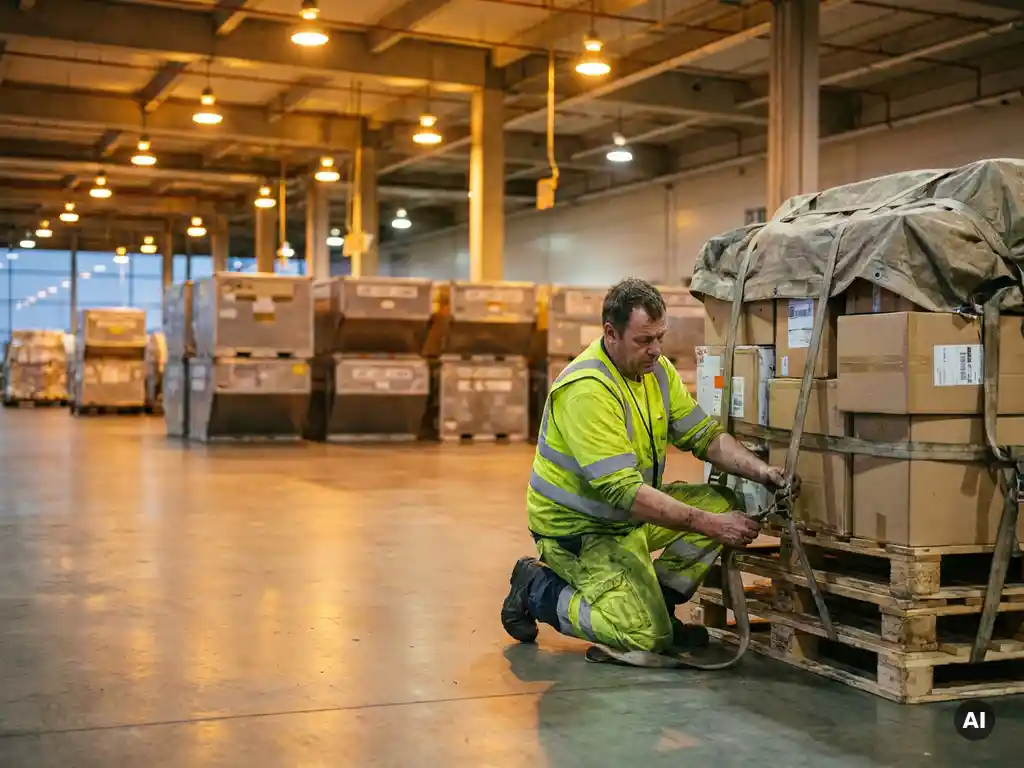
For air freight to Nairobi, businesses shipping from Europe should plan for transit times of two to five business days, prepare a standard set of customs documents, and account for Kenya’s import duties and VAT on arrival. The process is well-established, but the details, correct documentation, commodity restrictions, and cost structure, determine whether a shipment clears smoothly or gets delayed. The sections below answer the most common questions businesses face when shipping air cargo to Kenya.
How long does air freight to Nairobi actually take?
Air freight from Europe to Nairobi typically takes two to five business days from the moment cargo is handed over to an airline. Direct or single-stop services from major European hubs reach Jomo Kenyatta International Airport (JKIA) fastest, while multi-stop routings can add one to two days. Customs clearance at JKIA is additional and usually takes one to three business days depending on documentation completeness.
The actual flight time is only part of the equation. Cargo acceptance cut-off times, airline frequency on specific routes, and the speed of customs release all influence the final delivery window. For time-sensitive shipments (spare parts, medical supplies, or perishables), choosing a direct routing and ensuring documents are submitted in advance makes a measurable difference. Businesses with regular shipments to Nairobi benefit from working with a freight forwarder who has established carrier relationships on the Europe-Kenya corridor.
What documents are required for air cargo to Kenya?
The core documents required for air cargo shipments to Kenya are an Air Waybill (AWB), a commercial invoice, a packing list, and an import declaration. Depending on the commodity, additional certificates, such as a certificate of origin, phytosanitary certificate, or conformity certificate, may be mandatory before goods can clear customs.
The Kenya Revenue Authority (KRA) requires that importers have a valid PIN (Personal Identification Number) and a registered customs agent to file the import entry. The commercial invoice must state the correct HS tariff code, country of origin, and full description of goods. Errors or omissions on any of these documents are the most common cause of customs delays at JKIA. For businesses shipping regularly to Kenya, maintaining a consistent document template reviewed by a qualified freight forwarder reduces the risk of avoidable holds.
How does customs clearance work at Jomo Kenyatta International Airport?
Customs clearance at JKIA is managed by the Kenya Revenue Authority and processed through the Kenya TradeNet System, the country’s single-window electronic platform for trade documentation. Once cargo arrives, the licensed customs agent files an import declaration, KRA assesses duties and taxes, and the importer pays before goods are released. The process typically takes one to three business days when documents are in order.
Shipments may be selected for physical examination, which adds time. High-value goods, regulated commodities, and first-time importers are more likely to be flagged for inspection. Having a local clearing agent with active KRA accreditation and knowledge of JKIA procedures is essential; the process is not straightforward for businesses attempting to self-clear without local representation. For European exporters shipping on DDP (Delivered Duty Paid) terms, the freight forwarder manages the entire clearance process, including duty payment, on behalf of the consignee.
What determines the cost of air freight from Europe to Nairobi?
The cost of air freight to Nairobi from Europe is driven by chargeable weight, the airline rate on the specific routing, fuel and security surcharges, and destination handling fees at JKIA. Import duties and VAT (charged by the Kenya Revenue Authority on the CIF (cost, insurance and freight) value of goods) are a significant additional cost that businesses must factor into landed cost calculations.
Chargeable weight is calculated as the greater of actual gross weight and volumetric weight (length × width × height in cm ÷ 6,000). Bulky but light cargo is therefore often rated on volume rather than mass. Beyond the freight rate itself, costs to account for include:
- Airline surcharges: fuel, security, and sometimes peak-season surcharges
- Origin charges: export documentation, handling, and screening fees
- Destination charges: JKIA handling, storage if clearance is delayed, and customs agent fees
- Import duties and VAT: Kenya applies duty rates that vary by HS code, plus 16% VAT on most goods
- Last-mile delivery: transport from JKIA to the final delivery address in Nairobi or upcountry
Businesses comparing quotes should ensure they are comparing like-for-like: an all-in DDP quote covering duties and door delivery is a different product from a port-to-port airfreight rate. Understanding the full cost structure avoids surprises at destination.
What goods are restricted or prohibited for air freight into Kenya?
Kenya prohibits or restricts a range of goods from entering by air. Outright prohibitions include counterfeit goods, narcotics, and certain weapons. Restricted goods (meaning they require a permit or licence before importation) include pharmaceuticals, chemicals, food products, agricultural inputs, communications equipment, and some electrical goods. Dangerous goods accepted for air transport must comply with IATA regulations and be correctly classified and declared.
For businesses shipping industrial or technical goods, it is worth checking whether the product requires a Kenya Bureau of Standards (KEBS) import inspection certificate or a Conformity Assessment Certificate (CoC) before shipment. These requirements apply to a broad list of regulated product categories and must be arranged before the goods leave Europe, not after they arrive at JKIA. Attempting to clear non-compliant goods results in holds, fines, or destruction of cargo. A freight forwarder with Africa-specific expertise will flag these requirements during the booking process rather than after the fact.
When should you choose air freight over sea freight for Kenya shipments?
Air freight to Nairobi is the right choice when delivery speed, cargo value, or product sensitivity outweigh the cost premium over sea freight. Sea freight from Europe to Mombasa takes four to six weeks; air freight reaches Nairobi in days. For time-critical goods, high-value equipment, or perishables, the cost difference is justified by the reduction in transit risk and the ability to respond quickly to demand.
Air freight makes practical sense in several specific scenarios:
- Urgent spare parts or machinery components where production downtime is costly
- Pharmaceuticals and medical supplies with short shelf lives or cold-chain requirements
- High-value goods where insurance costs and risk exposure during a long sea transit are significant
- Sample shipments ahead of larger sea freight consignments
- Small volumes where a full container is not economically viable and consolidation on sea freight adds weeks
For larger, non-urgent shipments of industrial goods, machinery, or raw materials, sea freight via Mombasa remains the cost-effective route. Many businesses use both modes: air freight for urgent or high-value cargo, sea freight for planned, bulk replenishment. The choice depends on the shipment’s commercial context, not a single factor in isolation.
How EAF supports your air freight shipments to Nairobi
We have been moving cargo from Europe to Kenya for over 30 years, and Nairobi is one of our core destinations. As part of our East Africa network, we cover Nairobi and connect onward to Tanzania, Uganda, Rwanda, and Mozambique. Our air freight service to Kenya is built around removing the complexity that businesses encounter when shipping to Africa, including customs clearance, local delivery, and duty management.
Specifically, we offer:
- DDP (Delivered Duty Paid) shipments to Nairobi: we handle import duties, customs clearance at JKIA, and last-mile delivery, so your goods arrive at the consignee’s door without additional steps on their end
- Document review and pre-clearance preparation: we check your commercial invoice, packing list, and commodity-specific requirements before departure to prevent delays
- Guidance on restricted or regulated goods, including KEBS conformity requirements and IATA dangerous goods classification where applicable
- Regular consolidation departures from Europe to Nairobi, suitable for shipments that do not fill a full charter or dedicated air consignment
- Cross-trade options for cargo originating outside Europe that needs to reach Kenya
If you are planning a shipment to Nairobi and want a clear, all-in quote with no surprises at destination, get in touch with us directly. We respond with specifics, not estimates.
Ähnliche Artikel
- Which documents are required for air freight to Ghana?
- What's the Difference Between a Freight Forwarder and an Airline?
- What Is a Commercial Invoice and Why Is It Needed for Export?
- What Happens to Your Cargo Between Pickup and the Airport?
- What Documents Do You Need for Air Freight Export to Africa?
Dieser Inhalt wurde mithilfe von KI erstellt und kann Fehler enthalten.