
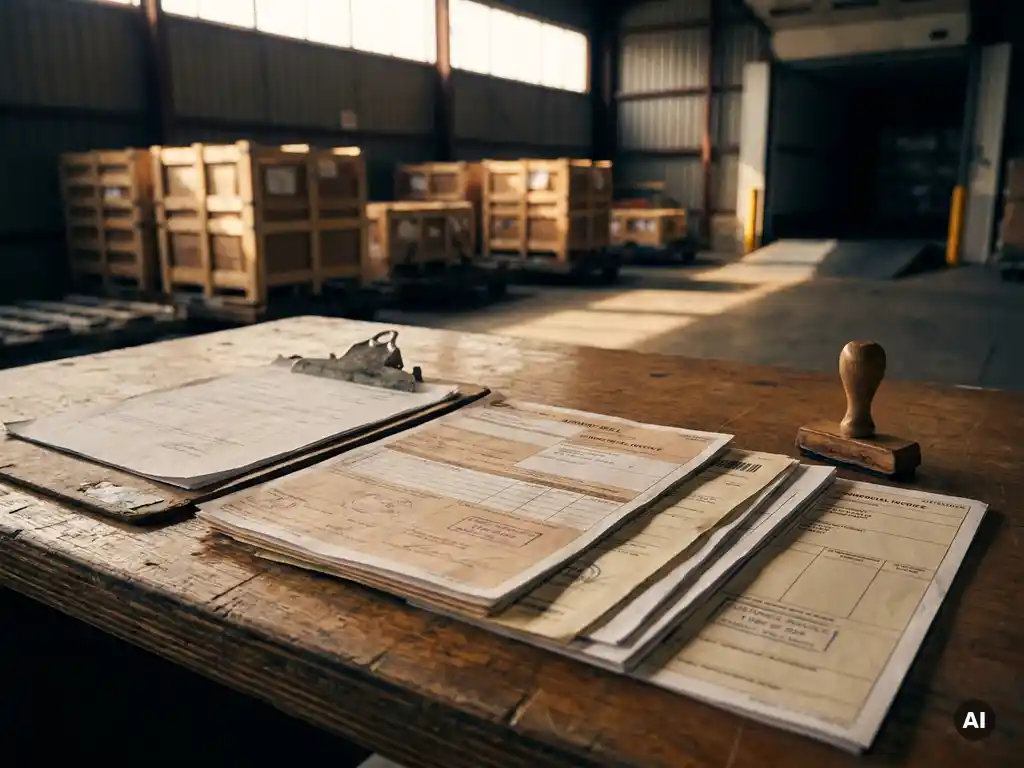
Air freight shipments from Europe to Ghana require a core set of customs documents: a commercial invoice, packing list, airway bill, and bill of entry. Depending on the goods, additional certificates such as a certificate of origin, import permits, or conformity certificates may apply. Businesses shipping cargo by air to Ghana should prepare these documents accurately before the shipment departs, as errors at Kotoka International Airport can cause significant clearance delays.
Ghana Customs, managed by the Ghana Revenue Authority (GRA), enforces strict documentary requirements for all air imports. The rules apply to commercial consignments, meaning businesses with a valid importer identification number are the primary parties responsible for compliance. The sections below address each key document requirement in detail.
Which documents does Ghana customs require for air imports?
Ghana customs requires a commercial invoice, packing list, airway bill, and a Ghana Customs Declaration (bill of entry) for all commercial air imports. Depending on the goods category, additional documents such as a certificate of origin, import permit, or conformity assessment certificate from the Ghana Standards Authority may also be mandatory.
Here is the standard document set for air freight to Ghana:
- Commercial invoice: the primary valuation document used by customs to assess duties and taxes
- Packing list: itemises the contents of each package by weight, quantity, and dimensions
- Airway bill (AWB): the air transport contract and proof of shipment issued by the carrier or freight forwarder
- Ghana Customs Declaration / Bill of Entry: filed electronically through the Ghana Community Network Services (GCNet) or UNIPASS system
- Certificate of origin: required for certain goods or when claiming preferential duty rates
- Import permit or licence: mandatory for restricted or controlled product categories
- Conformity assessment certificate: required for regulated goods subject to Ghana Standards Authority (GSA) inspection
All documents must be in English, which simplifies the process for European exporters. The airway bill Ghana customs receives must match the commercial invoice values exactly. Discrepancies are one of the leading causes of holds at the airport.
What information must appear on the commercial invoice for Ghana?
The commercial invoice for Ghana must include the full names and addresses of the exporter and importer, a detailed description of the goods, the HS tariff code, country of origin, unit price, total value, currency, Incoterms, and the importer’s Tax Identification Number (TIN). Incomplete invoices are a primary trigger for customs queries and delays.
Ghana customs uses the invoice value to determine the customs value under the WTO Customs Valuation Agreement. The declared value must reflect the actual transaction price. Undervaluation is treated seriously and can result in penalties, cargo holds, or confiscation.
Key fields that are frequently missing or incorrect on invoices destined for Ghana include:
- The HS (Harmonised System) tariff code: required for duty classification
- The importer’s Ghana TIN: needed to file the customs declaration
- The Incoterms (e.g. CIF, FOB, or DDP): affect how customs calculates the dutiable value
- A precise goods description: generic terms like “spare parts” or “electronics” are insufficient
- The country of origin: distinct from the country of export
For businesses using air freight services on a DDP (Delivered Duty Paid) basis, the invoice must clearly reflect the agreed trade term so customs can apply the correct valuation method.
When is a certificate of origin required for air freight to Ghana?
A certificate of origin is required for air freight to Ghana when the goods are subject to preferential duty rates under a trade agreement, when customs specifically requests verification of origin, or when the product category is regulated and origin determines admissibility. It is also commonly required for goods from countries with specific trade arrangements with Ghana.
Ghana is a signatory to the African Continental Free Trade Area (AfCFTA) and has trade arrangements under the ECOWAS framework. Goods originating in qualifying countries may benefit from reduced tariff rates, but only if a valid certificate of origin accompanies the shipment.
Even outside preferential arrangements, Ghana customs may request a certificate of origin for goods where the declared origin affects the applicable duty rate or import restrictions. European exporters should obtain a certificate of origin from their local chamber of commerce before the shipment departs. For certain agricultural or food products, the certificate of origin may also be required alongside a phytosanitary or health certificate.
What permits or licences apply to restricted goods shipped by air to Ghana?
Restricted goods shipped by air to Ghana require category-specific import permits or licences issued by the relevant Ghanaian authority before the cargo arrives. Common categories include pharmaceuticals, medical devices, food products, chemicals, telecommunications equipment, and used goods. Shipping without the required permit leads to cargo detention or refusal of entry.
The key regulatory bodies and their areas of control include:
- Food and Drugs Authority (FDA Ghana): pharmaceuticals, food products, cosmetics, and medical devices
- Ghana Standards Authority (GSA): products subject to mandatory conformity assessment, including electronics and certain consumer goods
- Environmental Protection Agency (EPA): chemicals and hazardous substances
- National Communications Authority (NCA): telecommunications and radio frequency equipment
- Ministry of Trade and Industry: certain controlled or sensitive product categories
For businesses shipping goods that fall into regulated categories, the import permit must be obtained in advance and submitted as part of the Ghana customs documents package. Permits are typically tied to the importer’s TIN and the specific shipment details, so they cannot be reused across different consignments without verification.
How does the Ghana single window system affect document submission?
Ghana operates an electronic single window system through which all import documents for air cargo must be submitted digitally before or upon arrival. This system, currently running through the UNIPASS platform (which replaced the legacy GCNet system), centralises customs declarations, permit verifications, and duty payments into one electronic portal, reducing manual processing and improving clearance speed.
Under the single window system, the customs broker or licensed clearing agent files the bill of entry electronically using the data from the commercial invoice, packing list, and airway bill. All supporting documents are uploaded digitally. Ghana customs then processes the declaration and assigns a risk assessment channel: green (automatic release), yellow (documentary check), or red (physical inspection).
For air freight importers, the practical implications are:
- Documents must be accurate and consistent across all fields: the system cross-checks data automatically
- Permit numbers from regulatory agencies are entered directly into the system, so permits must be obtained before filing
- Duty payments are made electronically through the portal
- A licensed Ghanaian customs broker must handle the filing: foreign freight forwarders cannot file directly
Businesses that prepare clean, complete documentation before the flight departs are far more likely to receive green channel clearance and avoid delays at Kotoka International Airport.
What are the most common document errors that delay air freight clearance in Ghana?
The most common document errors that delay air cargo clearance in Ghana are mismatches between the airway bill and commercial invoice values, vague goods descriptions, missing importer TIN, incorrect HS codes, and the absence of required permits or certificates. These errors trigger manual review or physical inspection, which can add several days to the clearance process.
Based on recurring patterns in air cargo clearance, the errors that cause the most disruption are:
- Value discrepancies: the declared value on the invoice does not match the airway bill or the actual transaction value, raising undervaluation flags
- Insufficient goods description: terms like “samples,” “machine parts,” or “general merchandise” are rejected; customs requires specific technical descriptions
- Wrong or missing HS code: incorrect tariff classification leads to wrong duty calculation and potential reclassification by customs
- Missing importer TIN: the bill of entry cannot be filed without a valid Ghana Tax Identification Number
- Absent or expired import permit: regulated goods arriving without the required permit are automatically held
- Incoterms not stated: customs cannot correctly calculate the dutiable value without knowing the agreed delivery term
- Inconsistent shipper/consignee details: name or address discrepancies between documents create identity verification issues
The most effective way to avoid these errors is to have all documents reviewed by an experienced freight forwarder before the shipment departs Europe. Once cargo is in transit, correcting documentation remotely is time-consuming and often requires a customs examination.
How EAF supports your air freight documentation to Ghana
Navigating Ghana customs requirements is one of the more demanding aspects of shipping air cargo from Europe to West Africa. We handle the full documentation process for our clients, from invoice review to permit coordination and customs filing through our local partners in Ghana.
When you ship with us, we provide:
- Pre-shipment document review: we check your commercial invoice, packing list, and airway bill for errors before the cargo departs Europe
- HS code verification: we confirm the correct tariff classification for your goods to avoid reclassification delays
- Import permit guidance: we identify which permits apply to your product category and coordinate with the relevant Ghanaian authorities
- DDP shipments: for clients who want full cost certainty, we offer Delivered Duty Paid services to Ghana, covering customs duties, taxes, and last-mile delivery
- Local customs clearance: through our established partner network in Ghana, we manage the UNIPASS filing and clearance process on your behalf
We work exclusively with B2B clients shipping commercial cargo from Europe to Africa. If you are preparing an air freight shipment to Ghana and want to ensure your documentation is correct before departure, contact our team for a direct consultation.
Ähnliche Artikel
- How Can You Reduce Air Freight Costs When Shipping to Africa?
- Which documents are required for air freight to Nigeria?
- How Do You Choose an Air Freight Forwarder for Shipping to Africa?
- What Is the Role of a Customs Broker in Air Freight Exports?
- What Is Air Freight Export and How Does It Work?
Dieser Inhalt wurde mithilfe von KI erstellt und kann Fehler enthalten.