
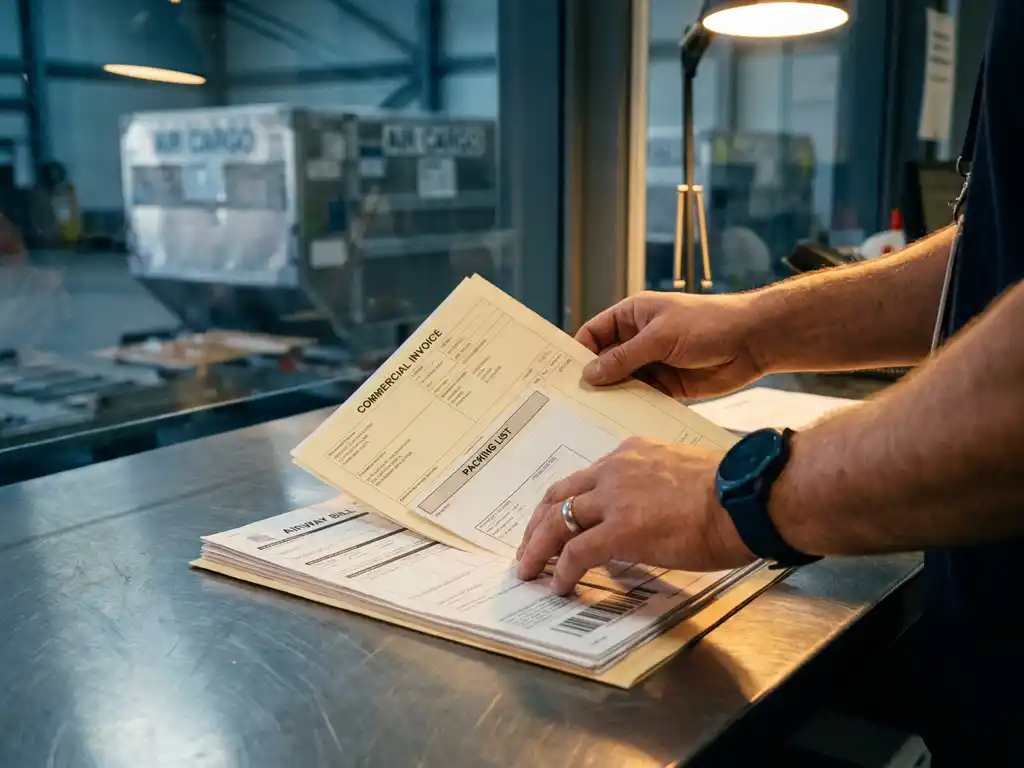
To export goods by air freight from Europe to Africa, businesses need a core set of shipping documents for every shipment: an Air Waybill, a commercial invoice, a packing list, and an export declaration. Depending on the destination country and the nature of the goods, additional certificates such as a certificate of origin or a phytosanitary certificate may also be required. Getting the paperwork right before the shipment moves is essential — incomplete or incorrect documents are one of the most common causes of customs delays and additional costs on African routes.
Which documents are mandatory for every air freight export to Africa?
Every air freight export to Africa requires at minimum four core documents: an Air Waybill (AWB), a commercial invoice, a packing list, and an export declaration filed in the country of origin. These documents are required regardless of destination country, cargo type, or shipment size. Without them, the shipment cannot be cleared for departure or accepted at the destination airport.
Here is what each document covers:
- Air Waybill (AWB): The transport contract between the shipper and the carrier. It identifies the cargo, the parties involved, and the routing.
- Commercial invoice: States the value, description, and terms of sale of the goods. Customs authorities use it to assess duties and taxes.
- Packing list: Details the contents, quantities, weights, and dimensions of each package. It must match the commercial invoice exactly.
- Export declaration: Filed electronically with customs in the country of origin (in the EU, this is done via the Export Control System). It is a legal requirement for goods leaving the European Union.
Depending on the goods and destination, additional documents are commonly required. A certificate of origin is frequently requested at African ports of entry to determine applicable duty rates. Goods of animal or plant origin typically require a phytosanitary or veterinary health certificate. Certain product categories such as pharmaceuticals, chemicals, or food items may require import permits issued by the destination country’s authorities before the shipment can be cleared.
For shipments delivered on DDP (Delivered Duty Paid) terms, where the exporter takes responsibility for duties and taxes at destination, the documentation set must be especially complete and accurate. Any discrepancy between documents can trigger reassessment of duties or outright refusal of the shipment at customs.
What is an Air Waybill and what must it include?
An Air Waybill (AWB) is the contract of carriage for air freight shipments. It is issued by the airline or an IATA-accredited freight forwarder acting on the airline’s behalf, and it serves as proof that the carrier has accepted the goods for transport. Unlike a Bill of Lading in sea freight, an AWB is a non-negotiable document — it does not transfer title to the goods.
A correctly completed AWB must include the following information:
- Full name and address of the shipper and consignee
- Airport of departure and airport of destination
- Description of the goods, including nature, quantity, and weight
- Declared value for customs and, where applicable, declared value for carriage
- Number of pieces and packaging type
- Freight charges and payment terms (prepaid or collect)
- Special handling instructions, if applicable (e.g. for temperature-sensitive or hazardous goods)
- The carrier’s conditions of contract
There are two types of AWB: the Master Air Waybill (MAWB), issued by the airline to the freight forwarder, and the House Air Waybill (HAWB), issued by the forwarder to the shipper. In consolidated shipments, where multiple shippers’ goods travel under one MAWB, each individual shipment has its own HAWB. Both documents travel with the cargo and are presented at customs in the destination country.
For destinations such as Nigeria, Kenya, or Ghana, customs authorities scrutinize AWB details closely. The cargo description on the AWB must match the commercial invoice precisely. Vague descriptions like “spare parts” or “general merchandise” without further specification are a common source of delays.
Do documentation requirements differ between African countries?
Yes, documentation requirements for air freight exports to Africa vary significantly between countries. While the core documents are universal, each country has its own customs regulations, import licensing requirements, and pre-shipment inspection schemes that add layers of country-specific paperwork.
Some examples of country-specific requirements that businesses frequently encounter:
- Nigeria: Many product categories require a Form M (import declaration) and may be subject to pre-shipment inspection by an approved inspection agency before the goods leave Europe. A Combined Certificate of Value and Origin (CCVO) is also commonly required.
- Ghana: Ghana requires a Destination Inspection (DI) process for most commercial imports. Goods must be registered in the Ghana Customs Management System, and a Ghana Import Declaration Form (GIDF) is required.
- Kenya: The Kenya Revenue Authority requires an Import Declaration Form (IDF) before shipment. Certain goods are also subject to pre-export verification of conformity (PVoC) to Kenyan standards.
- Tanzania: Tanzania requires a certificate of conformity for many regulated product categories and an import permit for goods falling under specific control lists.
Beyond country-specific requirements, the nature of the goods also affects the documentation needed. Pharmaceuticals, food products, chemicals, electronics, and machinery each carry their own compliance requirements that may involve additional certificates, safety data sheets, or regulatory approvals. Businesses without prior experience on a specific African route often underestimate the volume of country-specific paperwork involved.
What happens if export documents are incomplete or incorrect?
If air freight export documents are incomplete or contain errors, the shipment will be held at customs — either at the point of departure or, more seriously, at the destination airport. Customs holds lead to storage fees, demurrage charges, and in some cases the goods may be returned to the sender or confiscated. For time-sensitive cargo, the financial and operational consequences can be significant.
The most common documentation errors that cause problems on African routes include:
- Mismatches between the commercial invoice value and the AWB declared value
- Incorrect or vague cargo descriptions that do not align with HS (Harmonized System) tariff codes
- Missing certificates of origin when destination customs requires them for duty assessment
- Incorrect consignee details or missing importer tax identification numbers
- Failure to obtain required import permits before the shipment departs
- Undervaluation of goods on the commercial invoice, which customs authorities actively screen for
In countries with pre-shipment inspection requirements, such as Nigeria, errors can cause problems even before the goods leave Europe. If the inspection agency identifies discrepancies between the declared information and the physical cargo, the shipment cannot be released until the issue is resolved — which may require re-documentation, additional inspections, or formal appeals to customs authorities at destination.
The cost of correcting documentation errors after a shipment has departed is almost always higher than the cost of getting the paperwork right before departure. This is particularly true for DDP shipments, where the exporter carries the full financial exposure for duties, taxes, and any penalties arising from incorrect declarations.
How does a freight forwarder help with air freight documentation?
A freight forwarder prepares, checks, and submits the export documentation on behalf of the shipper. For air freight exports to Africa, this means handling everything from the export declaration and AWB to country-specific certificates and pre-shipment inspection coordination. An experienced forwarder reduces the risk of errors and ensures the full document set is compliant before the shipment moves.
Specifically, a freight forwarder with Africa expertise will:
- Advise on the exact document requirements for the specific destination country and product type
- Prepare or review the commercial invoice and packing list for customs compliance
- Issue the House Air Waybill and coordinate with the airline on the Master Air Waybill
- File the export declaration with the relevant customs authority in the country of origin
- Coordinate pre-shipment inspections where required (e.g. for Nigeria or Ghana)
- Obtain certificates of origin through the relevant chamber of commerce
- Liaise with destination agents to confirm import permit requirements before shipment
For DDP shipments, the forwarder’s role extends beyond export documentation. On DDP terms, the forwarder also manages import customs clearance and duty payment at destination, which requires a complete and accurate document set from the outset. Any gap in the paperwork at origin creates complications that must be resolved at destination — often at greater cost and delay.
Businesses that export regularly to African markets benefit from working with a forwarder who has direct operational experience in those markets, not just general air freight knowledge. Country-specific customs practices, local inspection agency requirements, and the practical realities of clearing goods in cities like Lagos, Accra, Nairobi, or Dar es Salaam require hands-on familiarity that goes beyond standard export procedures.
How EAF supports your air freight export documentation
We have been handling air freight exports to Africa for over 30 years, with direct operational experience in West and East African markets including Nigeria, Ghana, Kenya, and Tanzania. Documentation management is a core part of what we do — not an add-on.
When you work with us, we handle the documentation process end to end:
- We advise you on the exact document requirements for your destination country and cargo type before the shipment is booked
- We prepare and review all export documents, including AWB, commercial invoice alignment, and export declaration
- We coordinate pre-shipment inspections and certificates of origin where required
- For DDP shipments, we manage import customs clearance and duty payment at destination, ensuring the full document chain is consistent from origin to delivery
- We flag potential compliance issues before departure, not after the shipment is held at customs
As an IATA-accredited agent and ISO 9001-certified company, we operate to structured quality standards across every shipment. Our network of longstanding partners in all major African trading hubs gives us direct insight into local customs requirements that change regularly and are not always reflected in official documentation guides.
If you are preparing an air freight export to Africa and want to make sure your documentation is correct from the start, contact us for a direct consultation.
Ähnliche Artikel
- What Is Air Charter and When Does It Make Sense for Shipping to Africa?
- What Are the Most Common Air Freight Export Mistakes?
- How Does Air Freight from Europe to South Africa Work?
- How Does Air Freight from Europe to Nigeria Work?
- What Is Air Freight Export and How Does It Work?
Dieser Inhalt wurde mithilfe von KI erstellt und kann Fehler enthalten.