
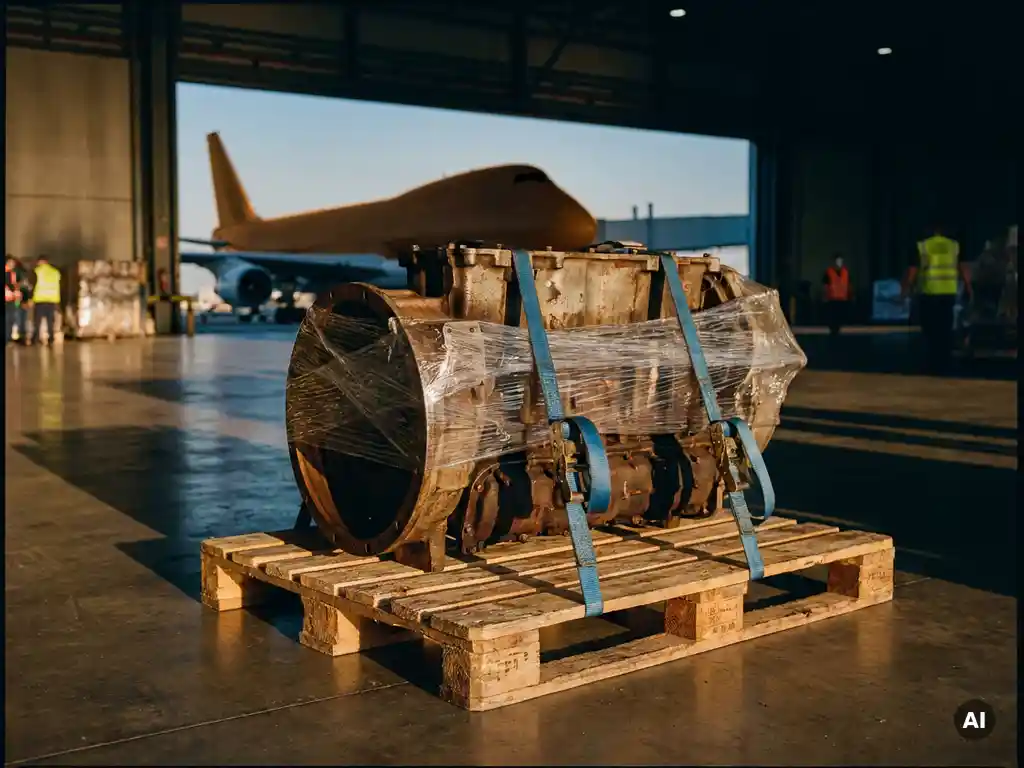
To ship spare parts to Africa by air, businesses in Europe work with an accredited freight forwarder who handles export documentation, customs clearance at the African destination, and last-mile delivery. Air freight is the standard choice for time-sensitive parts because it offers transit times of two to seven days, depending on the destination country. The sections below address the most common questions businesses face when shipping spare parts by air to Africa.
What documents are required to ship spare parts to Africa by air?
Shipping spare parts to Africa by air requires a commercial invoice, packing list, airway bill (AWB), and a certificate of origin in most cases. Depending on the destination country and the nature of the parts, you may also need an import permit, a pre-shipment inspection certificate, or a manufacturer’s declaration for controlled goods.
The commercial invoice is the most critical document. It must accurately state the HS code (Harmonized System tariff code) for each spare part, the declared value, the country of manufacture, and the consignee’s customs registration number. Errors on the invoice are the most common cause of customs delays in countries like Nigeria, Ghana, Kenya, and Tanzania.
Additional documents that frequently apply to spare parts shipments include:
- Packing list: Itemizes each part by quantity, weight, and dimensions
- Certificate of origin: Required for preferential tariff treatment or regulatory compliance
- Form M or SON permit (Nigeria): Mandatory for many categories of goods entering Nigeria
- Pre-Export Verification of Conformity (PVoC): Required for regulated products entering Kenya
- Manufacturer’s certificate or datasheet: Often requested for technical or industrial spare parts
Your freight forwarder should review the document requirements for the specific destination before the shipment leaves Europe. Missing or incorrect paperwork does not just cause delays — it can result in fines or confiscation at the port of entry.
How long does air freight to Africa typically take?
Air freight from Europe to major African hubs typically takes two to five business days for the flight and customs clearance combined. Transit time depends on the destination airport, the frequency of direct or connecting flights, and how quickly customs formalities are completed on arrival.
Flights to well-connected airports such as Lagos (LOS), Accra (ACC), and Nairobi (NBO) generally have multiple weekly departures from European cargo hubs, which keeps transit times short. More remote destinations in East Africa, such as Dar es Salaam, Kampala, or Maputo, may require a connection, adding one to two days.
Customs clearance is often the variable that most affects total delivery time. In countries with pre-clearance requirements or mandatory physical inspections, the process can take an additional two to four business days after the aircraft lands. Working with a forwarder who has established local agent relationships at the destination significantly reduces this uncertainty.
For businesses shipping critical replacement parts under machine downtime pressure, understanding the realistic door-to-door timeline — not just the flight time — is essential when planning. A freight specialist for Africa can provide realistic lead times per country based on current conditions.
What are the customs rules for importing spare parts in Africa?
Customs rules for spare parts vary significantly by country, but all African customs authorities require accurate HS code classification, a declared customs value, and a registered importer with a valid tax identification or customs number. There is no unified customs framework across Africa — each country applies its own tariff schedule and import regulations.
In Nigeria, spare parts are subject to import duty rates that vary by HS code, and many categories require a Form M to be opened at a Nigerian bank before the shipment departs Europe. Ghana applies the ECOWAS Common External Tariff, which sets duty rates based on the product category. Kenya uses the East African Community Common External Tariff and may require PVoC certification for regulated spare parts.
A key distinction for B2B importers is the difference between CIF (Cost, Insurance, Freight) and DDP (Delivered Duty Paid) terms. Under CIF, the importer in Africa is responsible for clearing the goods and paying all duties. Under DDP, the European shipper or their forwarder arranges and pays for customs clearance, delivering the goods duty-paid to the consignee’s door. DDP removes customs risk and administrative burden from the African buyer entirely, which is particularly valuable for businesses that lack a local customs team.
What is the difference between express air freight and standard air freight for spare parts?
Standard air freight moves cargo on scheduled airline services using cargo capacity on passenger or freighter aircraft, with the shipper booking space through a freight forwarder. Express air freight uses dedicated courier networks with faster processing, priority handling, and door-to-door tracking, typically at a significantly higher cost per kilogram.
For most B2B spare parts shipments to Africa, standard air freight through a specialist forwarder provides the right balance of speed and cost. A well-managed standard air freight shipment from Europe to Nigeria or Kenya takes two to five days door-to-door. Express courier services may reduce that by one day, but the cost premium is rarely justified unless the shipment is very small and the downtime cost is exceptionally high.
Standard air freight also handles larger and heavier spare parts more effectively. Courier networks impose strict weight and dimension limits per piece, which makes them impractical for industrial components, engine parts, or heavy machinery spares. Standard air freight has no such restriction and can accommodate oversized or consolidated shipments.
One important consideration: express courier shipments to many African destinations still pass through the same local customs process as standard freight. The speed advantage of express services is often absorbed at customs, making the cost difference harder to justify for regular B2B shipments.
How are dangerous goods and hazardous spare parts handled in air freight?
Dangerous goods in air freight are classified and regulated under IATA’s Dangerous Goods Regulations (DGR). Spare parts that fall into hazardous categories — such as items containing lithium batteries, flammable fluids, aerosols, or pressurized components — must be declared, properly packaged, and labeled according to IATA DGR standards before they can be accepted for air transport.
Common spare parts that trigger dangerous goods requirements include:
- Parts pre-filled with fuel, hydraulic fluid, or lubricants (Class 3 flammable liquids)
- Airbag inflators or seatbelt pretensioners (Class 1 explosives)
- Equipment containing lithium-ion or lithium-metal batteries (Class 9)
- Aerosol-based maintenance products (Class 2)
- Corrosive cleaning or treatment compounds (Class 8)
Shippers are legally responsible for correct classification and packaging. If dangerous goods are misdeclared or improperly packaged, the shipment can be rejected by the airline, and the shipper may face regulatory penalties. Your freight forwarder should have IATA DGR-trained staff who can advise on classification and documentation before the shipment is tendered to the airline.
Class 7 (radioactive materials) is outside the scope of standard spare parts logistics and requires specialist handling that most freight forwarders do not provide.
How do you choose the right air freight partner for spare parts to Africa?
The right air freight partner for spare parts to Africa should have direct experience with African customs procedures, established local agent networks at your destination, and the capability to handle DDP shipments. IATA accreditation is a baseline requirement — it confirms the forwarder is authorized to issue airway bills and work directly with airlines.
When evaluating a freight forwarder for spare parts logistics to Africa, consider the following criteria:
- Country-specific knowledge: The forwarder should understand the import regulations, documentation requirements, and customs processes for your specific destination — not just Africa in general
- Local agent network: Reliable on-the-ground partners in Nigeria, Ghana, Kenya, or Tanzania are essential for customs clearance and last-mile delivery
- DDP capability: If your African customer cannot manage customs clearance, the forwarder must be able to deliver duty-paid to the final address
- Dangerous goods handling: If any of your spare parts are hazardous, confirm the forwarder has IATA DGR-trained staff
- Transparency on costs: All-in pricing that includes destination charges, customs duties (under DDP), and delivery costs avoids unexpected invoices
- Track record: Experience with industrial or technical spare parts shipments is more relevant than general freight volume
A forwarder who specializes in air freight services to Africa will understand the nuances that a general logistics provider may not — including which airports have reliable cargo handling, which routes have capacity constraints, and how customs authorities in different countries treat specific HS codes for spare parts.
How EAF helps with spare parts air freight to Africa
We have been shipping goods from Europe to Africa for over 30 years, and spare parts logistics is one of the most technically demanding segments we handle. Our approach is built around removing the complexity from our clients’ side — from documentation preparation to customs clearance and final delivery.
Specifically, we offer:
- DDP shipments to Nigeria, Ghana, Kenya, Tanzania, and beyond — we handle customs clearance and duty payment so your African customer receives goods at their door without administrative involvement
- Document review and HS code guidance — we check commercial invoices and supporting documents before shipment to prevent customs delays
- IATA DGR-compliant handling for spare parts that contain hazardous components
- Established local agent networks in West and East Africa for reliable on-the-ground execution
- Consolidated and direct air freight options depending on urgency, weight, and destination
If you are shipping spare parts to Africa and need a freight partner who understands the destination as well as the origin, contact us directly to discuss your shipment requirements.
Ähnliche Artikel
- How Should You Package Goods for Air Freight to Africa?
- What's Included in an Air Freight Quote to Africa?
- What Happens to Your Cargo Between Pickup and the Airport?
- How Does Air Freight from Europe to South Africa Work?
- How Long Does Air Freight from Europe to Africa Take?
Dieser Inhalt wurde mithilfe von KI erstellt und kann Fehler enthalten.