
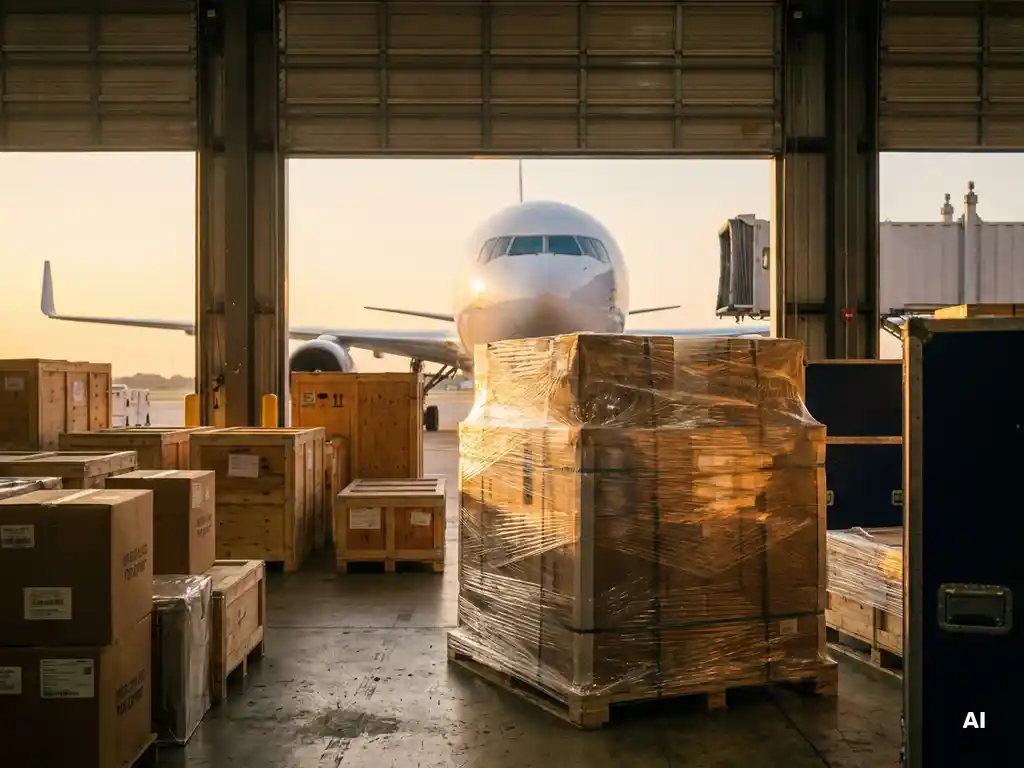
Consolidated air freight to Nigeria is worthwhile when a B2B shipment is too large for express courier services but too small to justify a full charter load. For most exporters, this means shipments roughly between 50 kg and 500 kg, though the real threshold depends on cargo value, urgency, and total landed cost. The questions below address each factor in detail.
What is the minimum shipment size that makes consolidation worthwhile?
Air freight consolidation to Nigeria typically becomes cost-effective from around 50 kg or 0.5 cubic metres. Below that threshold, express courier rates are often competitive and operationally simpler. Above roughly 500 kg, a dedicated groupage booking may still apply, but shippers should also model full-charter costs at that point.
The more relevant measure is the chargeable weight, which carriers calculate as the higher of actual weight and volumetric weight. Lightweight but bulky goods, such as machinery components or packaging materials, frequently exceed their actual weight in volumetric terms. A shipment that looks small on a pallet can carry a chargeable weight that makes consolidation the only economical air option for a business that cannot wait for sea transit.
For B2B exporters from Europe, the practical rule is straightforward: if your shipment has a customs value that justifies air speed and a chargeable weight above 50 kg, consolidation is worth evaluating. If the cargo is under that threshold, courier may serve you better. If it is over 500 kg, request both a groupage and a charter quote before committing.
How does consolidated air freight to Nigeria differ from a full charter load?
In a consolidated air freight shipment, your cargo shares space in an aircraft with goods from other shippers. You pay only for the space and weight your consignment occupies. A full charter, or exclusive aircraft load, means you book the entire cargo capacity for your shipment alone and bear the total cost of that capacity.
The practical differences for exporters shipping to Nigeria are significant:
- Cost structure: Consolidation spreads fixed costs across multiple shippers. A charter concentrates all costs on one party, making it viable only for very large or time-critical consignments.
- Departure frequency: Consolidated services run on fixed schedules, typically weekly, depending on the forwarder’s volume to Lagos. Charters can be arranged on demand but require sufficient volume to justify the cost.
- Transit flexibility: A charter can be routed and timed to your exact requirements. Consolidated shipments follow the forwarder’s established routing.
- Minimum commitment: Consolidation has no minimum beyond the forwarder’s threshold. A charter requires filling a meaningful portion of aircraft capacity to be economical.
For the majority of European exporters sending regular mid-sized shipments to Nigeria, consolidated air freight is the more practical and cost-efficient route.
What types of goods are best suited for air freight consolidation?
Goods that are high in value relative to their weight, time-sensitive, or perishable are best suited for air freight consolidation to Nigeria. Consolidation makes economic sense when the cost of delay, spoilage, or lost sales exceeds the premium of air over sea freight.
Typical cargo categories that move well via air consolidation to Nigeria include:
- Spare parts and industrial components where machine downtime is costly
- Pharmaceuticals and medical supplies with strict shelf-life requirements
- Electronics and telecoms equipment
- Samples, prototypes, and urgent commercial documents
- High-value consumer goods where inventory financing costs are significant
- Seasonal goods with narrow delivery windows
Goods that are heavy, low in value per kilogram, or not time-sensitive, such as construction materials, bulk chemicals, or raw commodities, are generally better suited to sea freight. The decision is primarily an economic one: calculate the value of speed against the freight rate differential.
How long does consolidated air freight to Nigeria take?
Consolidated air freight from Europe to Nigeria typically takes between three and seven business days door-to-door, depending on the routing, customs clearance in Lagos, and the delivery arrangement. Flight time from European hubs to Lagos is around six to eight hours, but consolidation cut-off schedules, transit connections, and Nigerian customs processing add the bulk of total transit time.
Several factors influence the actual duration:
- Consolidation schedule: Your cargo must be ready before the weekly or bi-weekly cut-off. Missing a cut-off adds the full frequency interval to your transit time.
- Customs clearance at Lagos: Nigerian customs processing can vary considerably. Shipments with complete, accurate documentation clear faster. Errors in commercial invoices or packing lists are a common source of delay.
- Delivery terms: A shipment delivered to the airport (airport-to-airport) hands responsibility to the local recipient at Lagos. A DDP delivery, where the forwarder manages customs and last-mile delivery, adds coordination time but removes that burden from the consignee entirely.
Businesses that need predictable, end-to-end transit times should consider DDP terms, which place customs responsibility on the freight specialist rather than the local Nigerian recipient.
What costs should shippers expect beyond the freight rate?
The published freight rate covers only the airline’s charge for moving the cargo. Shippers exporting to Nigeria should budget for a range of additional costs that are standard in international air freight and Nigerian customs practice.
Common additional charges include:
- Fuel and security surcharges: Applied by airlines and passed through by forwarders. These fluctuate with market conditions.
- Origin handling and documentation fees: Covering warehouse handling, air waybill preparation, and export customs formalities in Europe.
- Nigerian import duties and taxes: Nigeria applies import duties that vary by HS code. VAT at the applicable rate is also assessed on most commercial imports.
- Destination handling and customs clearance fees: Charged at Lagos airport by the handling agent and customs broker.
- Last-mile delivery: If delivery to the consignee’s premises in Nigeria is required, local transport costs apply.
The most transparent way to manage these costs is to ship on DDP terms, where all duties, taxes, and delivery costs are included in a single agreed price. This eliminates surprise charges for the consignee and simplifies budgeting for the exporter. For a full picture of air freight services and what is included, requesting a door-to-door DDP quote is the most reliable approach.
When should a shipper choose sea freight over air consolidation for Nigeria?
Sea freight is the better choice when cargo is heavy, bulky, or low in value per kilogram, and when the shipment timeline allows for four to eight weeks of ocean transit. For most standard commercial goods where speed is not critical, sea freight to Nigeria offers a substantially lower cost per kilogram or cubic metre.
Consider sea freight when one or more of these conditions apply:
- The shipment exceeds one or two tonnes and is not time-sensitive
- The goods are raw materials, construction inputs, or bulk consumer goods with a long shelf life
- The buyer in Nigeria can plan inventory well in advance and has storage capacity
- The freight cost is a significant portion of the total landed cost, making air rates prohibitive
Air consolidation remains the right choice when the value of speed, the risk of stockouts, or the nature of the goods justifies the higher freight rate. Many exporters to Nigeria use both modes: air for urgent or high-value shipments, sea for regular replenishment of slower-moving goods. The two modes are complementary rather than mutually exclusive.
How EAF handles consolidated air freight to Nigeria
We specialise in consolidated air freight from Europe to Nigeria and across West and East Africa, with a focus on complete, door-to-door solutions that remove the complexity of Nigerian customs from our clients’ operations. As an Africa freight specialist with over 30 years of active presence in the region, we handle the parts of the shipment that most exporters find difficult:
- Regular consolidation departures to Lagos with fixed cut-off schedules
- DDP shipping to Nigeria, including import duties, VAT, and last-mile delivery
- Export customs documentation from Europe, prepared correctly to avoid Nigerian clearance delays
- Transparent, all-in pricing that covers freight, surcharges, duties, and delivery in a single quote
- Direct handling by experienced staff with established contacts at Nigerian customs and handling agents
If you are a business exporting goods from Europe to Nigeria and want to know whether consolidation is the right option for your next shipment, contact us for a straightforward, no-obligation quote.
Ähnliche Artikel
- What should you consider for customs clearance for air freight to Ghana?
- How Should You Package Goods for Air Freight to Africa?
- What Is Air Charter and When Does It Make Sense for Shipping to Africa?
- How Does Insurance Work for Air Freight Shipments to Africa?
- How Is Air Freight Cost Calculated?
Dieser Inhalt wurde mithilfe von KI erstellt und kann Fehler enthalten.