
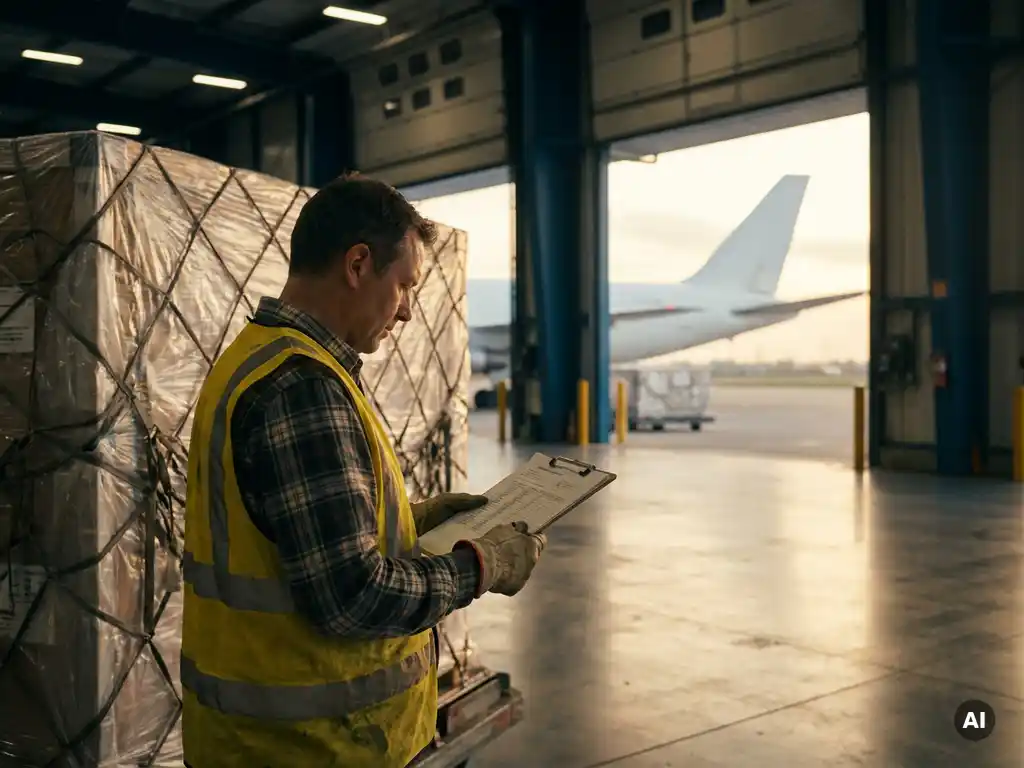
A freight forwarder and an airline serve different roles in air cargo transport. The airline physically moves cargo from one airport to another. The freight forwarder manages the entire shipment process around that flight, including documentation, customs clearance, and delivery to the final destination. For businesses shipping goods internationally, the freight forwarder is typically the primary point of contact.
Understanding how these two parties interact helps businesses make better logistics decisions, particularly when shipping commercial goods to destinations where customs complexity and last-mile delivery require specialist handling.
What does a freight forwarder actually do?
A freight forwarder is a logistics intermediary that organizes the movement of cargo on behalf of a shipper. Rather than operating aircraft or vessels, a freight forwarder coordinates all the parties and processes involved in getting goods from a point of origin to a final destination, including booking cargo space, preparing export documentation, and managing customs clearance at both ends.
In practice, a freight forwarder acts as the operational backbone of an international shipment. Their responsibilities typically include:
- Preparing and submitting export and import declarations
- Booking cargo capacity with carriers
- Arranging pickup from the shipper’s premises
- Consolidating smaller shipments to optimize cost
- Managing customs procedures at origin and destination
- Coordinating last-mile delivery to the consignee
- Handling special requirements such as dangerous goods documentation or temperature-sensitive cargo
For businesses exporting to markets with complex import regulations, such as Nigeria, Ghana, Kenya, or Tanzania, the freight forwarder’s role extends well beyond simple cargo booking. Local knowledge, established relationships with customs authorities, and experience with destination-country compliance requirements become critical factors in whether a shipment clears smoothly or is held at the port of entry.
What role does the airline play in cargo transport?
The airline’s role in cargo transport is to physically carry freight between airports. Airlines operate the aircraft, manage cargo loading and handling at their terminals, and issue the air waybill (AWB), which is the primary transport document for air cargo. The airline is responsible for the cargo while it is in their custody, from acceptance at the origin airport to delivery at the destination airport.
Airlines offer cargo space in two ways: in the belly hold of passenger aircraft, and on dedicated freighter aircraft. Belly cargo is common on scheduled passenger routes and provides cost-effective capacity for standard shipments. Freighter services offer greater volume and flexibility, particularly for high-priority or oversized cargo.
What airlines do not typically provide is end-to-end logistics management. They do not handle customs clearance, prepare export documentation, or arrange delivery to a business address. Their contractual responsibility ends at the destination airport unless additional services have been explicitly arranged.
Who owns the cargo — the airline or the freight forwarder?
Neither the airline nor the freight forwarder owns the cargo. The cargo belongs to the shipper until ownership transfers to the buyer according to the agreed trade terms (Incoterms). The airline acts as a carrier and takes temporary custody of the goods during transport. The freight forwarder acts as an agent of the shipper and never takes ownership of the goods.
The distinction in liability is important. Under the Montreal Convention, airlines carry limited liability for loss or damage to cargo while in their care, based on the weight of the shipment. Freight forwarders carry their own liability for errors or omissions in the services they provide, such as incorrect documentation or missed deadlines. Cargo insurance, arranged separately, covers the commercial value of the goods beyond these standard liability limits.
When a freight forwarder issues a house air waybill (HAWB) to a shipper, they take on the role of a contractual carrier toward that shipper, even though the actual flight is operated by an airline under a master air waybill (MAWB). This layered structure is standard in the industry and allows freight forwarders to consolidate multiple shipments onto a single airline booking.
Should you book directly with an airline or use a freight forwarder?
For most businesses shipping commercial cargo internationally, using a freight forwarder is the more practical choice. Direct airline bookings make sense only when a shipper has significant volume, in-house customs expertise, and established relationships with carriers. Without these, the operational complexity of managing documentation, customs, and last-mile delivery outweighs any potential cost savings from bypassing a forwarder.
There are several reasons why freight forwarders add value that airlines cannot replicate:
- Customs handling: Airlines do not manage customs declarations. A freight forwarder handles import and export filings, duties, and compliance requirements on the shipper’s behalf.
- Carrier access: Freight forwarders have contracts with multiple airlines and can select the best routing, transit time, and rate for each shipment.
- Consolidation: For smaller shipments, forwarders consolidate cargo from multiple clients into a single booking, reducing cost per kilogram.
- DDP delivery: A freight forwarder can offer Delivered Duty Paid terms, meaning the goods arrive at the buyer’s door with all duties and clearance costs settled, a service airlines do not provide.
- Local knowledge: For destinations such as Lagos, Accra, Nairobi, or Dar es Salaam, a forwarder with established local contacts can navigate import procedures that vary significantly by country and commodity.
Businesses with a customs number and regular export activity to Africa will find that a specialist air freight forwarder reduces risk, saves administrative time, and often achieves better rates than a direct airline booking.
How do freight forwarders and airlines work together?
Freight forwarders and airlines operate as interdependent partners in the cargo supply chain. The freight forwarder brings consolidated cargo volume to the airline, and the airline provides the physical transport capacity the forwarder needs to fulfill its commitments to shippers. This relationship is formalized through IATA accreditation, which authorizes freight forwarders to issue air waybills and transact directly with airlines.
In operational terms, the process works as follows. The freight forwarder receives cargo from one or more shippers, prepares the necessary documentation, and books space on a specific flight with an airline. The airline issues a master air waybill covering the consolidated shipment. At the destination airport, the freight forwarder’s local agent or partner collects the cargo, completes customs clearance, and arranges onward delivery.
For routes into Africa, this cooperation is especially important. Many African airports have specific handling requirements, and local customs procedures can be unpredictable without established contacts on the ground. A freight forwarder with a genuine partner network in the destination country adds reliability that the airline alone cannot provide.
How EAF supports your air freight shipments to Africa
We are a specialist freight forwarder focused on exports from Europe to Africa, with over 30 years of operational experience on these routes. As an IATA-accredited agent, we manage the full process from cargo pickup in Europe to delivery at the buyer’s premises in West and East Africa, including all customs formalities at origin and destination.
For businesses exporting commercial goods to Nigeria, Ghana, Kenya, Tanzania, and neighboring markets, we offer:
- Air freight to Africa with access to multiple airline routings and competitive rates
- DDP delivery (Delivered Duty Paid), meaning all import duties and clearance costs are handled before the goods reach the consignee
- Full customs management at both European origin and African destination
- Local partner networks in Lagos, Accra, Nairobi, and beyond for reliable last-mile delivery
- ISO 9001-certified processes for consistent, auditable service quality
If your business exports goods from Europe to Africa and you want a forwarder who handles the complexity so you do not have to, get in touch with us for a direct conversation about your shipment requirements.
Ähnliche Artikel
- What does SONCAP mean and when is it required for air freight to Nigeria?
- What should you consider for customs clearance for air freight to Ghana?
- How Do You Ship to Landlocked African Countries by Air?
- What Goods Can and Can't Be Shipped to Africa by Air?
- What Documents Do You Need for Air Freight Export to Africa?
Dieser Inhalt wurde mithilfe von KI erstellt und kann Fehler enthalten.