
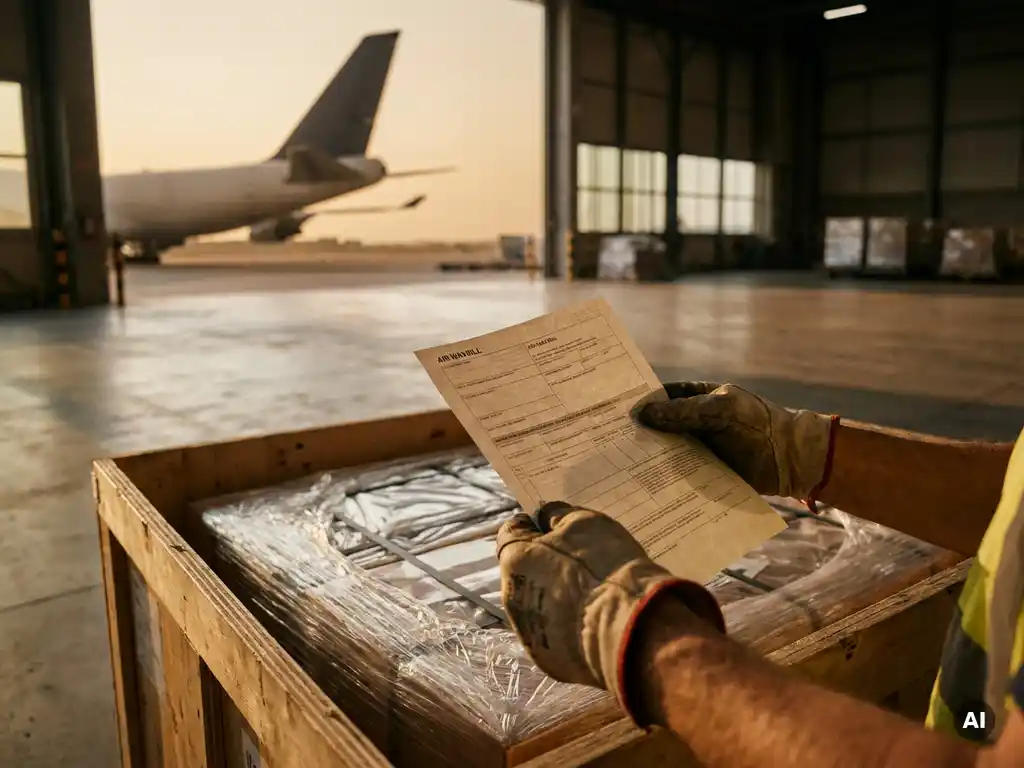
An air waybill (AWB) is the primary transport document for air freight shipments. It serves as a contract of carriage between the shipper and the airline, a receipt for the goods, and a key reference document for customs clearance. For any business exporting goods by air, the AWB is non-negotiable: no shipment moves without one.
The air waybill travels with the cargo and is used by airlines, freight forwarders, customs authorities, and consignees at every stage of the journey. The sections below answer the most common questions exporters have about AWBs, from what they contain to what happens when something goes wrong.
What information does an air waybill contain?
An air waybill contains the full details needed to identify, transport, and clear a shipment. The document records the shipper’s name and address, the consignee’s details, the origin and destination airports, a description of the goods, the number of pieces, gross weight, dimensions, and the declared value for customs. It also includes the freight charges, any special handling instructions, and the unique AWB number used to track the shipment.
Most AWBs follow the standardized format set by IATA, which means airlines and freight forwarders worldwide work from the same document structure. This consistency matters for air freight to Africa, where shipments often transit multiple countries before reaching the final destination.
Additional fields cover:
- Harmonized System (HS) codes for customs classification
- Country of origin of the goods
- Dangerous goods declarations, where applicable
- Insurance details, if arranged
- Special instructions for perishable, fragile, or time-sensitive cargo
How does an air waybill differ from a bill of lading?
The key difference is that an air waybill is a non-negotiable document, while an ocean bill of lading can be issued as a negotiable title to goods. This means the AWB cannot be transferred to a third party or used to sell the cargo in transit. The consignee named on the AWB is the only party entitled to receive the shipment at destination.
A bill of lading, by contrast, can function as a document of title, which is why it plays a central role in trade finance instruments like letters of credit. For air freight, the speed of transport makes negotiable documents largely unnecessary: the cargo typically arrives before the paperwork would ever need to be transferred.
In practical terms, this distinction affects how payment and ownership are structured. Exporters using air freight for time-critical shipments to destinations like Nigeria, Kenya, or Ghana generally accept the non-negotiable nature of the AWB without issue, since the goods arrive within days rather than weeks.
What is the difference between a master AWB and a house AWB?
A master AWB (MAWB) is issued by the airline to the freight forwarder and covers the entire consolidated shipment. A house AWB (HAWB) is issued by the freight forwarder to each individual shipper within that consolidation. The two documents work together: the MAWB governs the relationship between the airline and the forwarder, while the HAWB governs the relationship between the forwarder and the exporting business.
When a freight forwarder consolidates cargo from multiple shippers into a single aircraft shipment, only one MAWB is issued to the airline. Each shipper in that consolidation receives their own HAWB, which contains the specific details of their goods. At destination, the forwarder’s local partner deconsolidates the shipment and handles each HAWB individually.
For exporters, the HAWB is the operative document. It is what customs authorities, the consignee, and the receiving agent work from. The MAWB number is useful for tracking the physical shipment on the airline’s system, but the HAWB is what drives the clearance process on the ground.
Who is responsible for issuing an air waybill?
The air waybill is typically issued by the freight forwarder acting on behalf of the shipper, or directly by the airline for direct shipments. In the vast majority of commercial export transactions, a licensed freight forwarder prepares and issues the house AWB, while the airline issues the master AWB. The shipper is responsible for ensuring that all information provided to the forwarder is accurate and complete.
IATA-accredited agents are authorized to issue AWBs on behalf of airlines. This accreditation is a baseline requirement for any freight forwarder handling international air cargo. When you work with an accredited agent, the AWB is a legally valid transport contract from the moment it is issued.
The shipper retains legal responsibility for the accuracy of the goods description, declared value, and any required documentation. Errors or omissions in the information provided to the forwarder can result in delays, fines, or customs holds at destination.
What happens if an air waybill contains errors?
Errors on an air waybill can cause serious disruptions, including shipment holds at the origin airport, delays at transit points, customs clearance failures at destination, and financial penalties. The severity depends on the nature of the error: a misspelled consignee name may be correctable with a simple amendment, while an incorrect goods description or HS code can trigger a full customs examination.
Common errors that cause problems include:
- Incorrect or missing consignee details (name, address, tax ID)
- Wrong or vague goods descriptions
- Mismatched weights or piece counts between the AWB and the actual shipment
- Missing or incorrect HS codes
- Errors in declared value, which affect duty calculations
- Incomplete dangerous goods declarations where required
Amendments to an AWB after departure are possible but involve coordination between the airline, the origin forwarder, and the destination agent. In markets like Tanzania, Uganda, or Mozambique, where customs processes can be less flexible, errors are better caught and corrected before the shipment departs Europe.
When is an air waybill required for export shipments?
An air waybill is required for every commercial air freight export shipment without exception. No airline will accept cargo without a completed AWB, and no customs authority will process an air freight shipment that lacks one. This applies to all commercial goods moving from Europe to Africa by air, regardless of value, weight, or destination country.
For air freight export services, the AWB is generated as part of the standard booking and documentation process. It is not an optional document or one that only applies above certain thresholds. Even low-value commercial samples require an AWB when shipped by air freight through a licensed forwarder.
The AWB must be completed and accepted by the airline before the cargo is loaded. In most cases, the forwarder submits the AWB data electronically to the airline system (e-AWB) before physical acceptance of the goods at the cargo terminal. Paper AWBs are still used in some markets, but electronic submission has become the standard across major air freight corridors.
How EAF supports your air freight documentation
Managing air waybill documentation correctly is one of the most detail-sensitive parts of exporting goods by air to Africa. We handle this process end to end for our business clients, so that documentation errors do not become operational problems at destination.
As an IATA-accredited agent, we issue house AWBs directly and coordinate master AWBs with our airline partners. Our documentation process covers:
- Preparation and issuance of house and master AWBs
- HS code verification and goods description accuracy checks
- Coordination of all required export documents (commercial invoice, packing list, certificates of origin)
- DDP (Delivered Duty Paid) shipments to Nigeria, Ghana, Kenya, Tanzania, and beyond, where we handle customs clearance and last-mile delivery on the receiving end
- Pre-departure review to catch errors before the shipment is loaded
If you are exporting goods from Europe to Africa and want a freight partner who manages the documentation as part of a complete door-to-door solution, get in touch with us to discuss your shipment.
Ähnliche Artikel
- How Can You Reduce Air Freight Costs When Shipping to Africa?
- What Is a Certificate of Origin and When Do You Need One?
- What's Included in an Air Freight Quote to Africa?
- What Are the Most Common Air Freight Export Mistakes?
- Sending Goods by Air to Ghana: What Exporters Should Know
Dieser Inhalt wurde mithilfe von KI erstellt und kann Fehler enthalten.